


Municipalities
Between the 1940s and 1950s, the Spanish army began building Line P, or the Pyrenees Line: an immense defensive system designed to prevent a possible invasion across the northern border. Between 8,000 and 10,000 bunkers were planned, although only about 2,000 were built. These bunkers were grouped into resistance centers and were intended to cover virtually all the Pyrenean passes and necks. Most were never used, but today they are part of the country's historical heritage and can be visited as a silent testimony to that turbulent period.
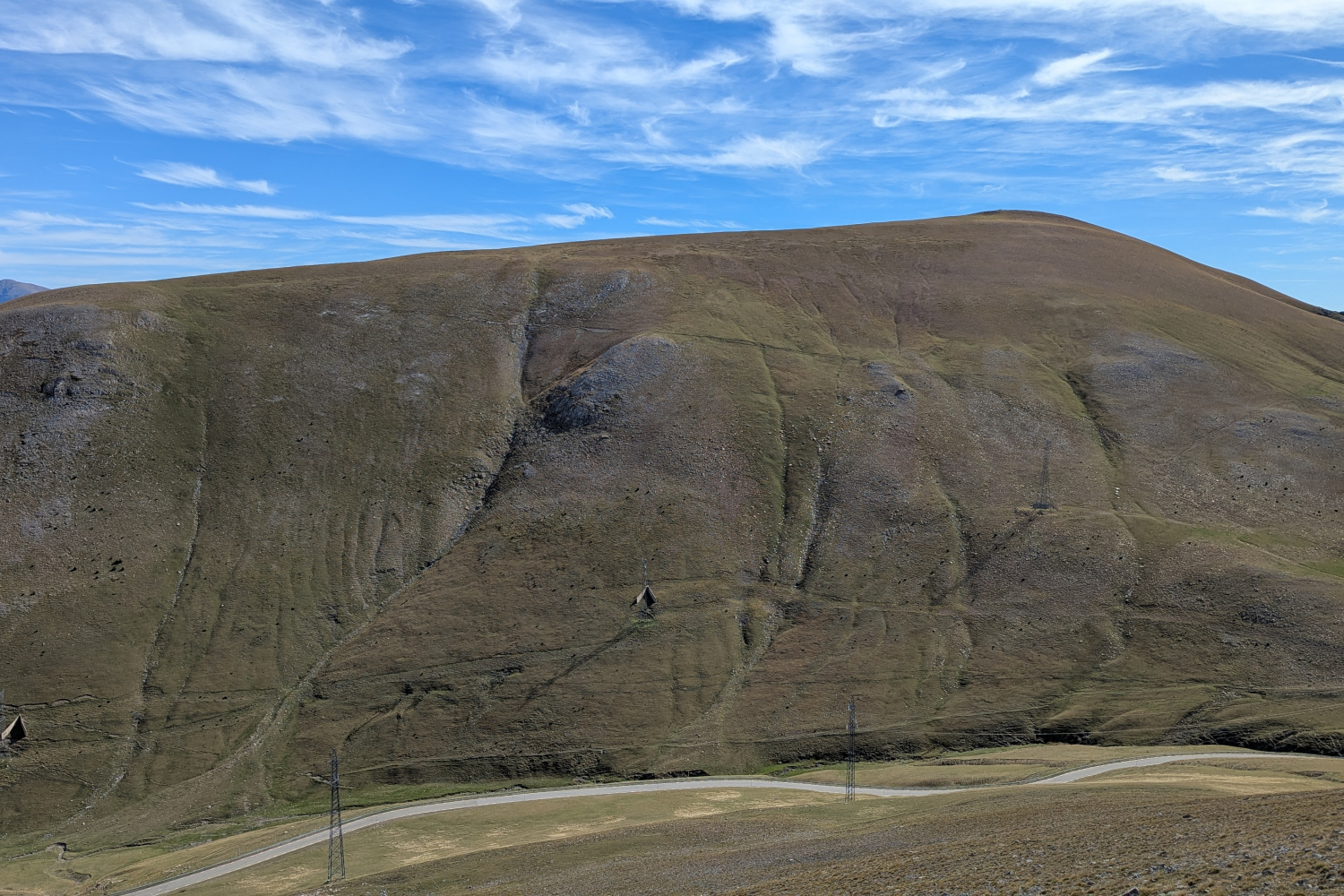
The Coll de Pal (2,106 m), located between the Serrat Gran and Puigllançada, is one of the areas where a group of well-defined bunkers can be visited. The route we propose allows you to visit six different bunkers, arranged in a figure-8 pattern: four on the Serrat Gran side and two on the Puigllançada side.
However, it should be noted that this is not an easy hike: although its distance is not excessive, it has a significant amount of elevation gain, and much of the route runs through open mountain terrain, with constant ups and downs. The altitude, wind, and lack of shade also make it a challenging route. It is an ideal option for hikers accustomed to high mountain walks who want to combine nature and historical memory.
We leave from Coll de Pal (2,106 m), an impressive high mountain pass that immediately offers a spectacular panoramic view. On clear days, along the route, you can see almost half of Catalonia: Pedraforca with its unmistakable silhouette, the white wall of the Sierra del Cadí, Moixeró, the Puigllançada massif, and, if we look closely to the south, we can see the Montserrat mountain range and even Collserola dominating the Barcelona horizon. The views alone are worth coming here.
The bunkers were built during the 1950s by the Spanish Army's 1st Fortress Sapper Regiment and are part of the 50th Coll de Pal resistance center. They were never used, and some of them were never even completed.
From the starting point, we'll approach, one after another, the six bunkers that make up this route. Each stop is a surprise, a window open to both the landscape and history.
Personnel Shelter Bunker (4)
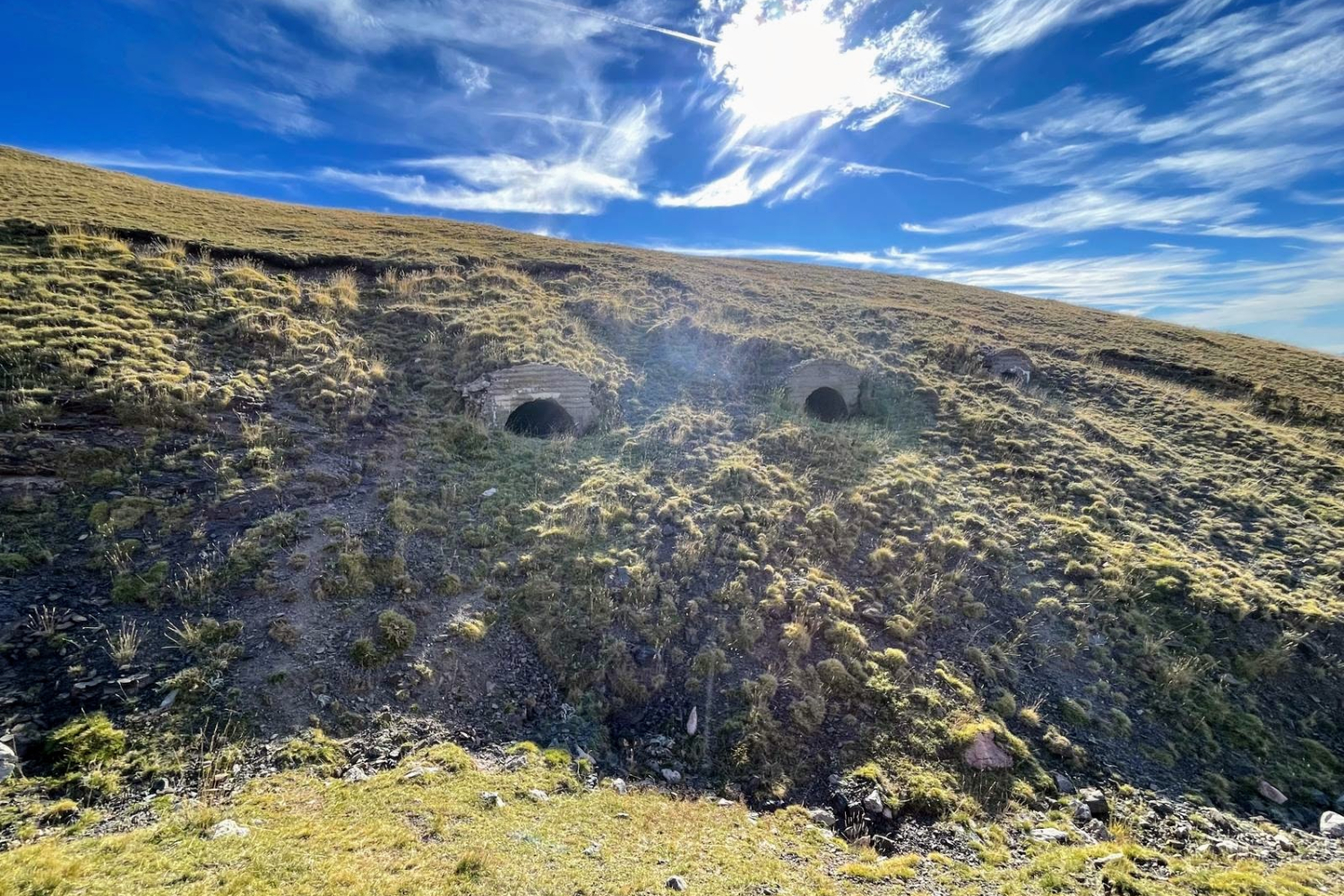
The first point of visit is the troop shelter, one of the most unique in the entire complex. It is not a rifle bunker, but an excavated gallery-like space with three entrances. Inside, a room was planned with wooden benches for resting, shelves for storing food and supplies, and a space for the reserve troops. The idea was to protect the soldiers from the elements and possible bombings.
The initial plan called for a depth of about 3.5 meters, but the work was left unfinished and never fully opened. We can only see the three entrances, but we cannot enter. However, it's easy to imagine what life would have been like in those rooms: darkness, dampness, and waiting.
From this point, the views are wide towards the Moixeró and the meadows of Cerdanya.
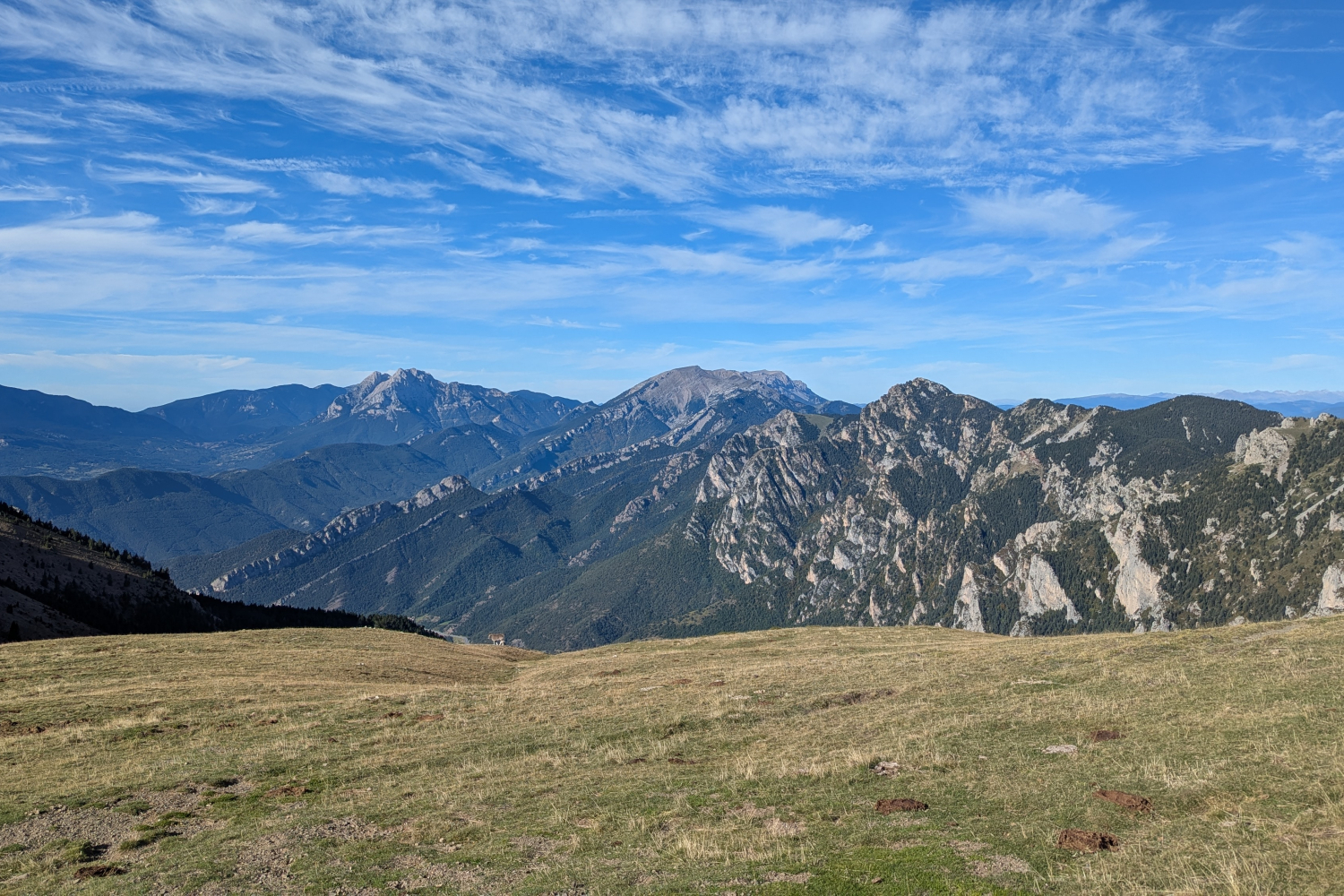
Vistes al Pedraforca i la Serra del Cadí
Command Bunker (1)
We continued to the command bunker, located in a strategic location overlooking the entire neck. It was the key piece of the complex, as the resistance center's headquarters would have been based here. The structure has an observation room with two fan-shaped loopholes, which allowed access control and coordination of the other positions.
Next to it was a rest room, connected by a corridor, where the commanders could take refuge and rest during periods of guard duty. Unlike the machine gun nests, there was no space here for heavy weapons, but rather for surveillance and planning.
It's a magnificent spot from which to understand the general layout of the bunkers and also to pause and contemplate the landscape: Cadí to the north, Pedraforca to the southwest, and, on the horizon, Montserrat, which stands out among the mists of the plain.
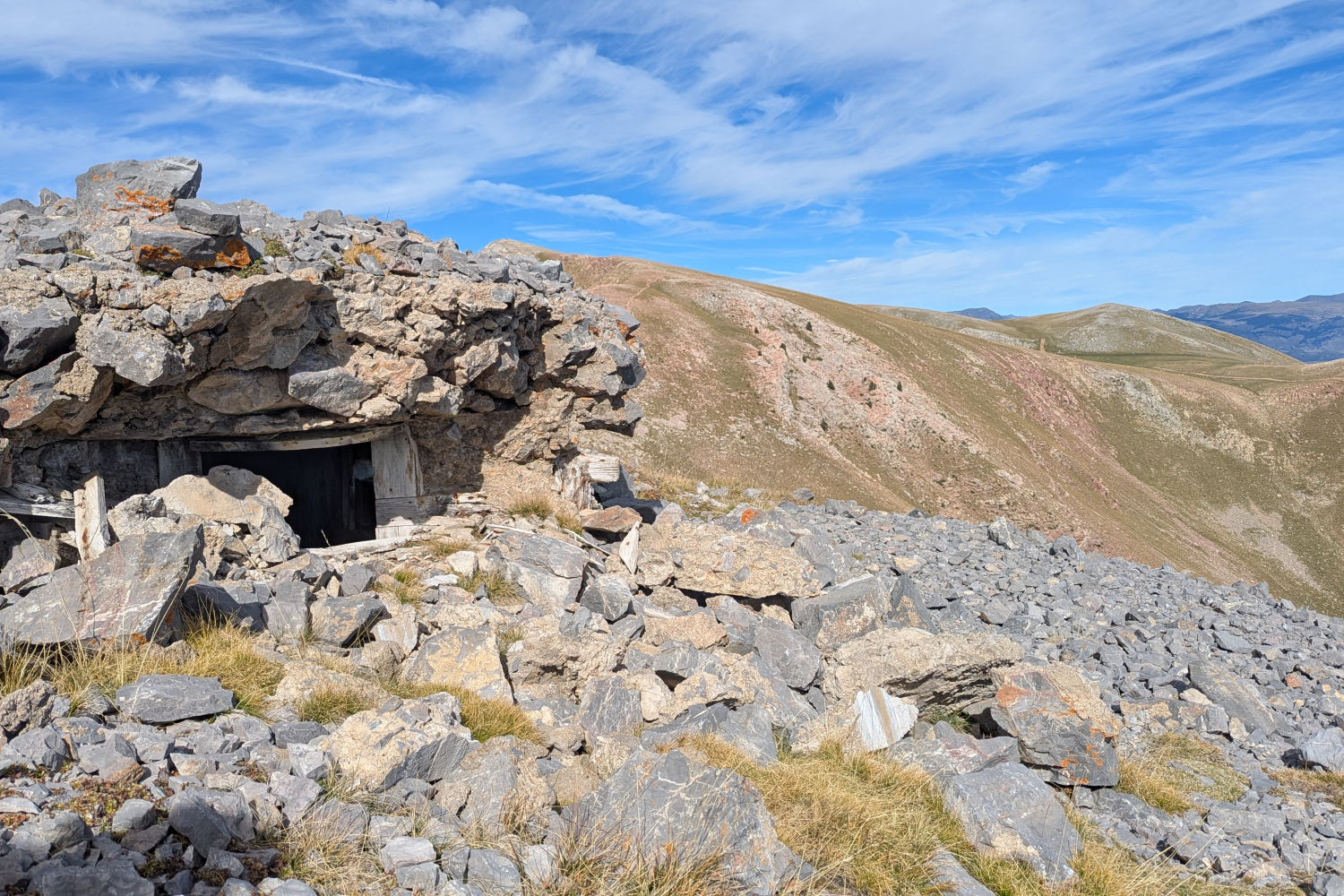
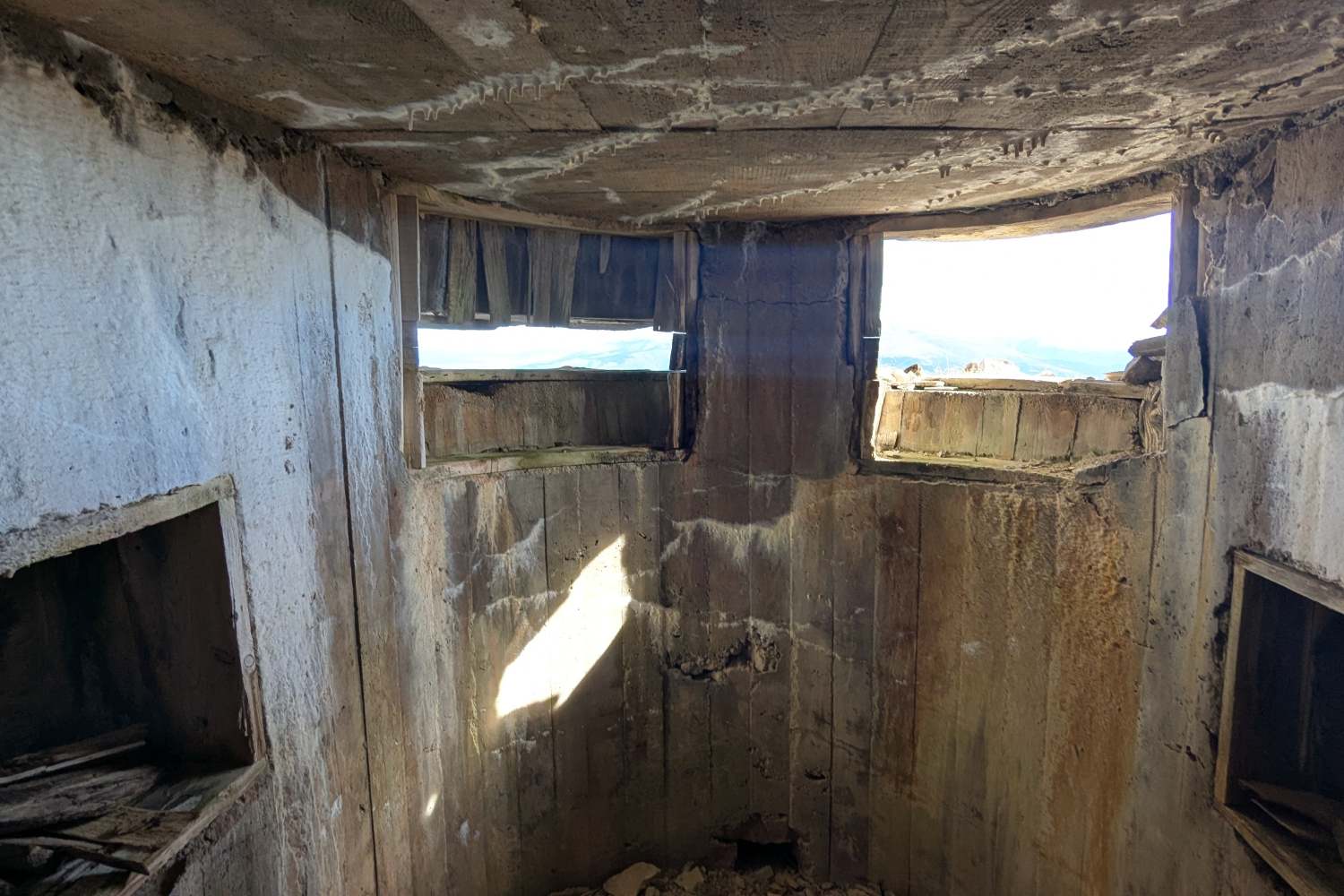
Interior del búnker, con apilleras en abanicol
Machine Gun Bunker (2)
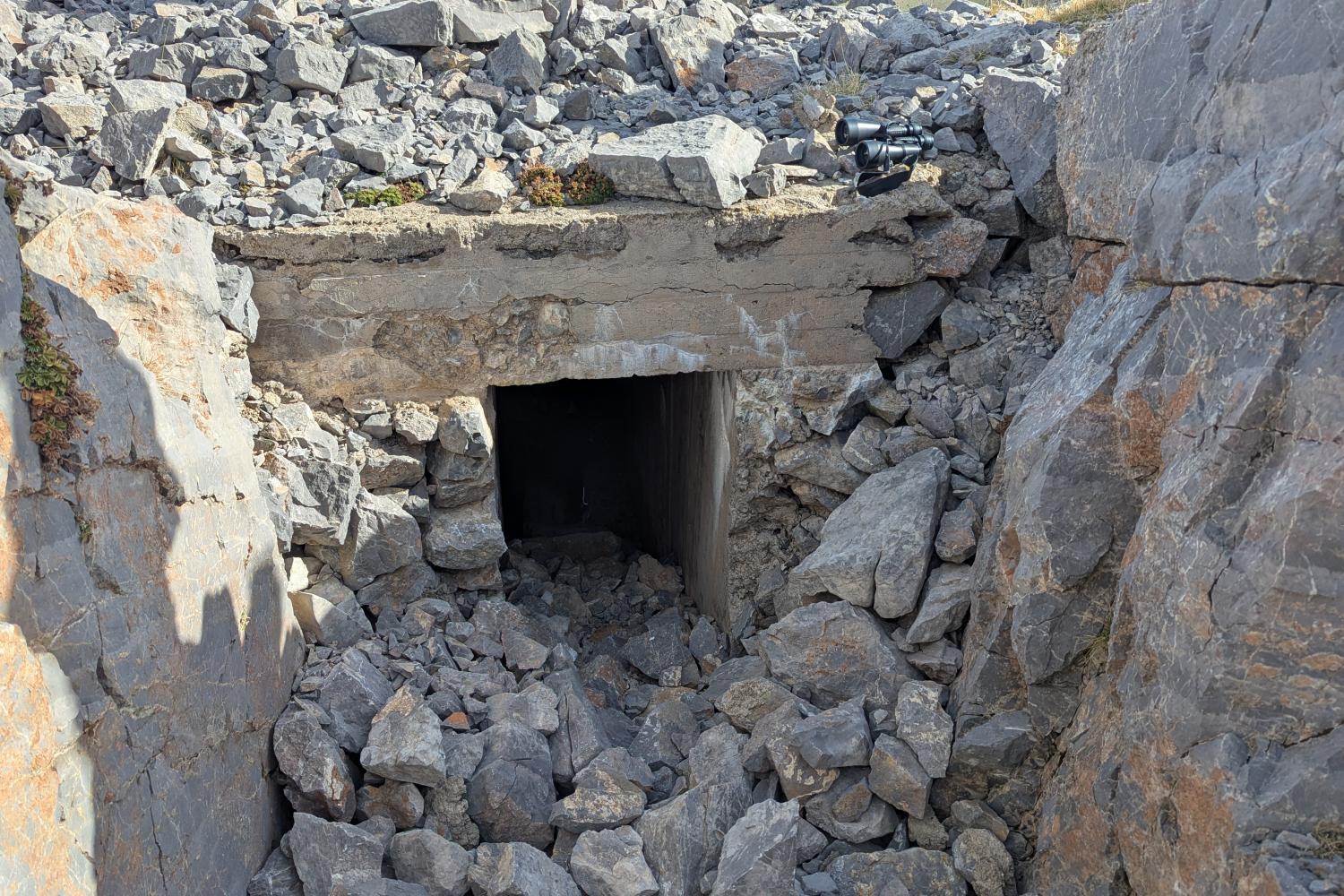
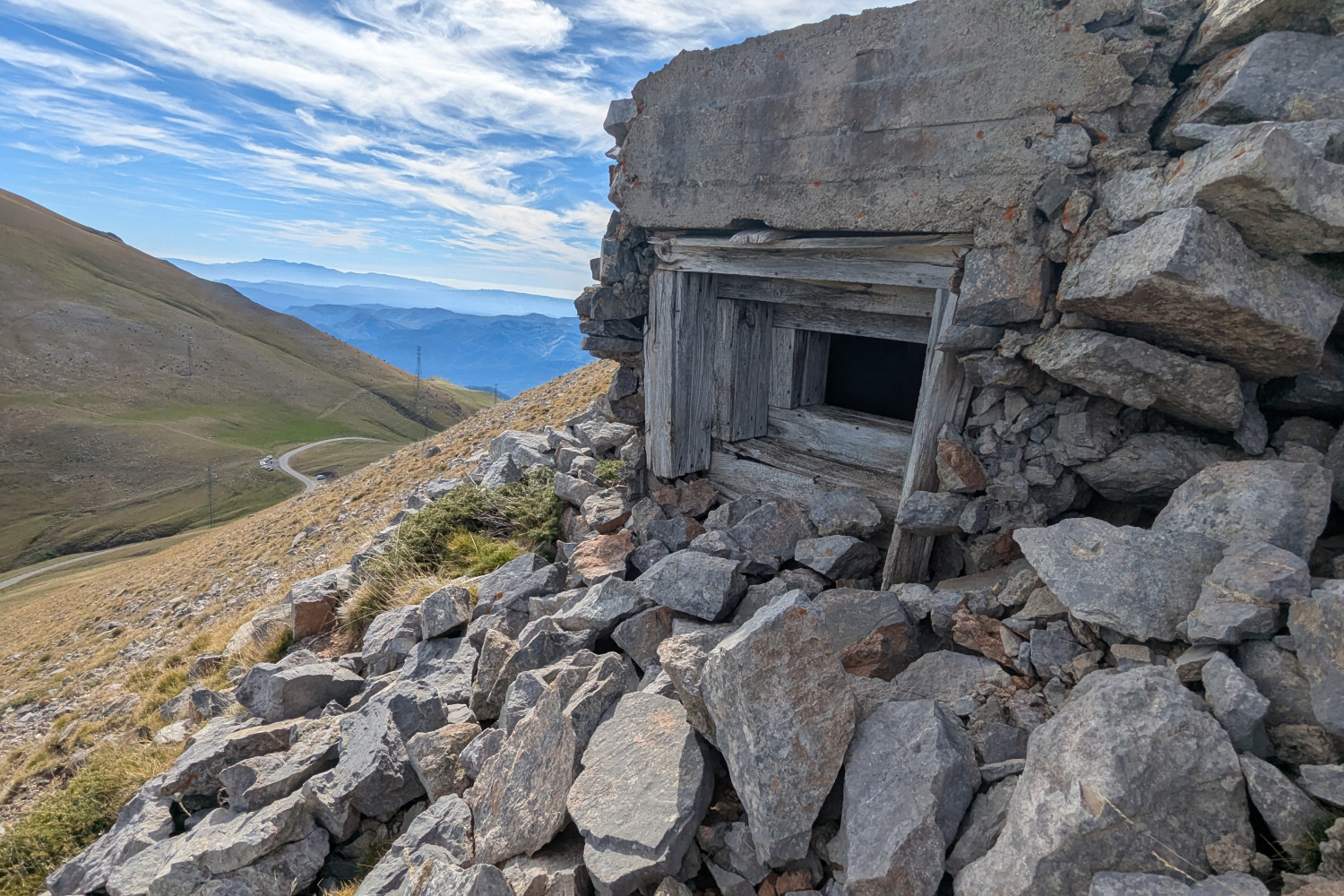
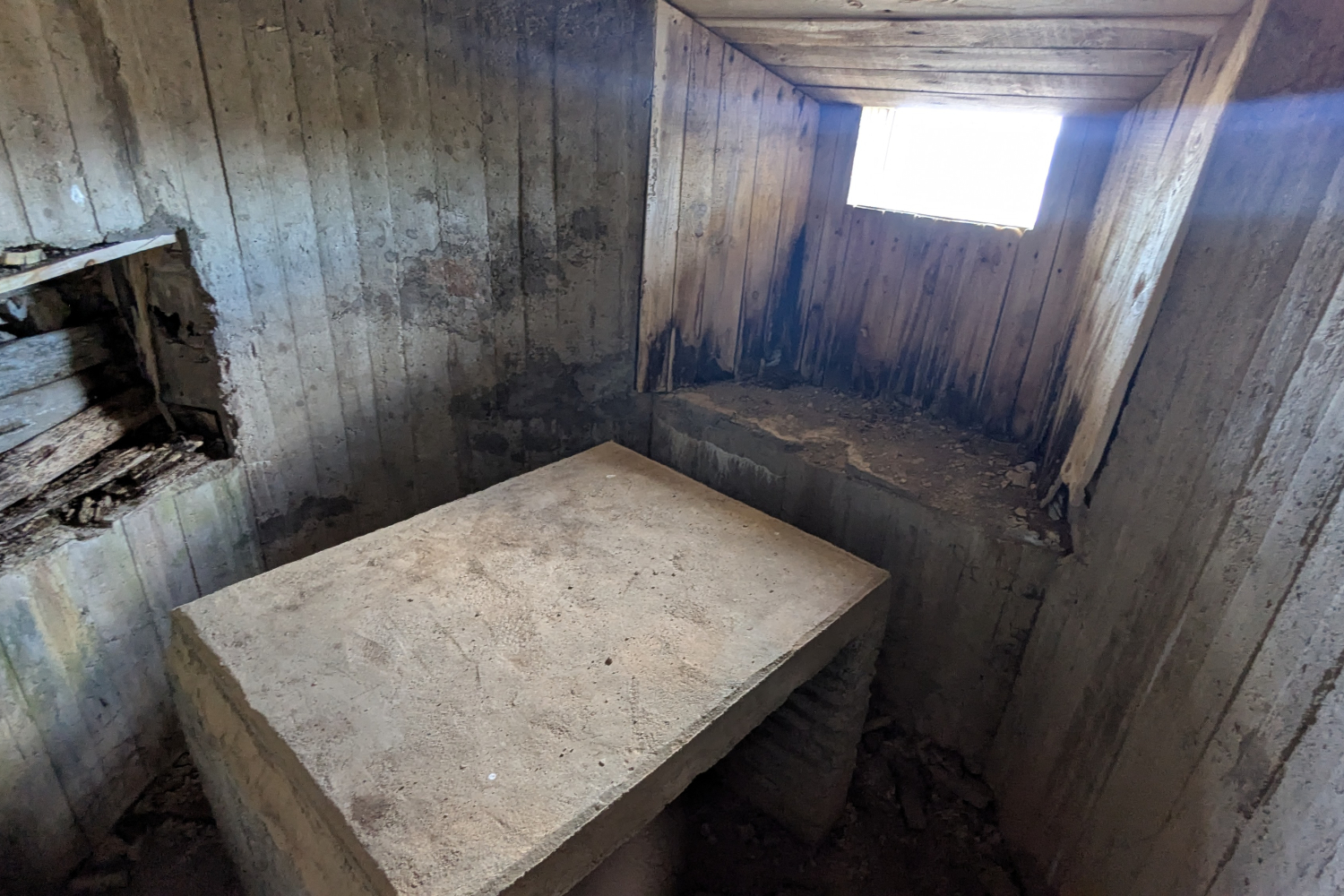
Next, we arrive at Bunker 2, one of the most typical machine-gun nests in the complex. It has a square floor plan, approximately 2 meters by 2 meters, and is almost 2 meters high. Inside is the concrete bench where the shooter sat and cavities in the walls housed ammunition boxes. The loophole, facing the neck, offered a partial panoramic view, ideal for controlling access.
This bunker was designed to house machine guns such as the Alfa 44 or the older Hotchkiss 1914, heavy and reliable weapons that were intended to pound the terrain with sustained fire. Its position followed military logic: to monitor and cover the natural mountain passes.
Machine Gun Bunker 3 (3)
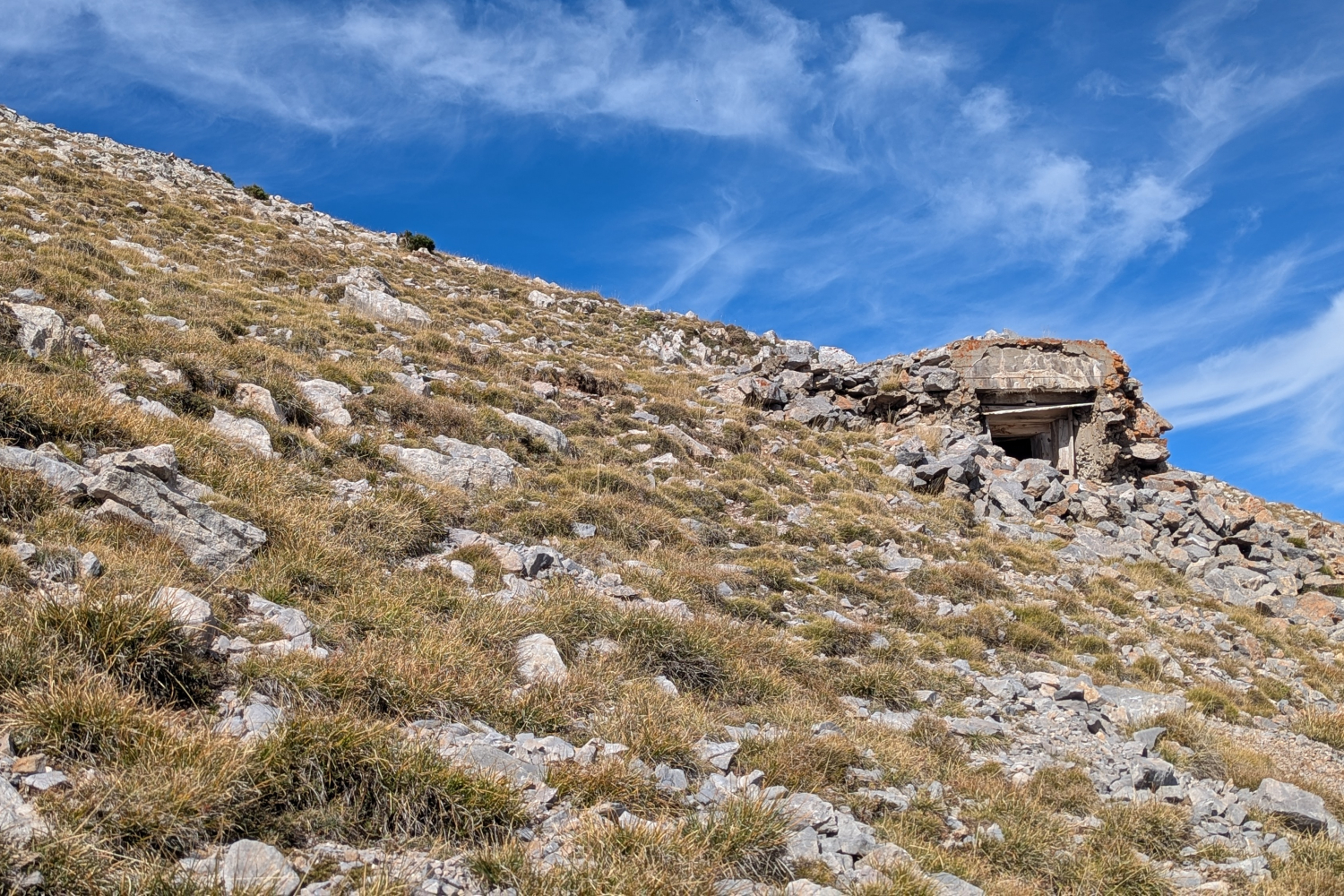
Just 40 meters from Bunker 2 is Bunker 3, almost identical in structure and function. Both nests worked together, crossing each other's firing ranges to protect their necks. Here, too, we find the loophole, the dugout, and the ammunition bays.
Today, these quiet spaces serve as privileged viewing points. Currently, the bunker is inaccessible, as a rock blocks the entrance.
Machine Gun Bunker (Puigllançada) (5)
We now cross to the Puigllançada slope, where the terrain is more open and the bunkers can already be seen from afar. Bunker 5 is another machine-gun nest, with the same typology: a compact layout, a dugout, and a loophole.
It was positioned to control the entire mountain slope and possible access points from the east. Like the rest, it was never armed, but its placement clearly shows the idea of defending the pass as a strategic point.
Machine Gun Bunker (Puigllançada) (5)
A few meters further on, we find Bunker 6, sister to Bunker 5, strategically located to cover another sector. The two made it impossible to cross the area without being exposed. However, today it's an ideal place to stop, breathe deeply, and enjoy the immense panorama.
With these six bunkers visited, we conclude our route and return to the starting point. The route can be completed in any order that best suits you, but either way, it always ends up being a journey full of discoveries: military architecture, landscape, and history.
It's a demanding hike, with constant climbs and a significant amount of elevation gain, but every effort is rewarded with natural viewpoints that encompass the entire Pyrenees and much of the Pre-Pyrenees. An experience that combines nature, memory, and adventure, in the heart of Berguedà.
Published by Jordi Lemonche on 7 of october of 2025

Nearby experiences
Nearby routes
Looking for mushrooms in Berguedà and Solsonès
Avià, Bagà, Berga, Capolat, Casserres, Castellar de n'Hug, Cercs, Gironella, Guardiola de Berguedà, L'Espunyola, La Pobla de Lillet, Olvan, Prats de Lluçanès, Puig-reig, Saldes, Sant Llorenç de Morunys, Solsona, Vilada
Mushroom hunting has become a national sport in its own way and we have to enjoy our forests. Go to look for mushrooms and is a general obsession, and this is great news because it means that citizens of this country appreciates and loves the…
The Way of the Cathars
Bagà, Bellver de Cerdanya, Berga, Gósol
The Way of the Cathars (75 km and +) commemorates the exile of the Occitan Cathars, called Cathars and Good Women, who promoted pure and simple Christianity, based on spirituality and confronted the 13th century Catholic Church. Currently,…
Route through Cap de la Boixassa through the Empedrats and return for the Adou del Bastareny
Bagà
The calcareous terrain of Alt Berguedà has given rise to several springs of water that gush out in fountains and spectacular waterfalls. The most typical is in the Fuentes del Llobregat, but in the Bastareny valley, near Bagà,…
Grand Tour of Catalonia - Section 4. Ode in nature: from La Seu d'Urgell to Figueres
Bagà, Banyoles, Bellver de Cerdanya, Besalú, Camprodon, Castellar de n'Hug, Figueres, Guardiola de Berguedà, Llívia, Meranges, Olot, Puigcerdà, Ribes de Freser, Ripoll
I want to do this route by electric vehicle! This route is designed to be done by electric vehicle, although it can be done with any other car. Along the route we will suggest municipalities that have charging points and places of interest…
Related routes
The air raid shelters in Barcelona
Barcelona
Now that is so fashionable debate about historical memory in Spain, is a good time to remember the Civil War and its impact on Barcelona. From femturisme.cat we wanted to publish a route dedicated especially to bomb shelters were built in the…
Isona: the reconstruction of a town between two fronts
Castell de Mur, Isona i Conca Dellà
One of the bloodiest episodes in the recent history of Catalonia has been the Spanish Civil War. Many Catalan towns were scenes and witnesses of confrontations and terrifying episodes, which are still present in the memory of their people,…
Route of the Sierra de Bellmunt Almenara
Montgai
It is a circular route that crosses the Sierra de Bellmunt Almenara, signposted along its entire route with the sky blue color. Along the route we will find explanatory signs on some interesting points, such as the characteristic mud huts or…
Seeking Freedom on the roads of the Pyrenees
Esterri d'Àneu, Llavorsí, Naut Aran (Salardú), Sort
With the route of this month from Femturisme we invite you to visit one of the paths followed by those Republicans who passed through the Pyrenees to flee to France to avoid falling into the hands of the fascist regime, one of the existing…
Events
European Heritage Days in Collbató
16 OctoberAlfaro Year in Sant Andreu de Llavaneres
16 OctoberForest week in Sant Celoni
16 OctoberRACC Costa Dorada Rally in Salou
From 16 to 17 OctoberZim Zam Cassà - Cassà de la Selva Urban Art Festival
From 16 to 17 OctoberFirauto Balaguer
From 16 to 18 OctoberFira Mediterrània de Manresa 2026
From 15 to 18 October
News








 Sustainable turism
 Biosphere