

Hostal de Montclar
Municipalities
Located in the town square of Montclar, south of Berguedà, the Hostal de Montclar is a benchmark of traditional Berguedà cuisine. Its origins date back to the Middle Ages, when it was part of the first buildings sheltered by the local castle.
Over the centuries, the hostel has served as a meeting point for municipal meetings and even as a school. With ancient names such as Cal Paraire or Cal Guardabosc, it is one of the few buildings that has remained in operation until the mid-twentieth century.
Culinary specialties
The Hostal de Montclar stands out for its gastronomic offer based on local and nearby products. Among its specialties, the following stand out:
- Black peas: a legume native to the area, prepared according to the traditional recipe.
- Masked potatoes: a typical dish made with potatoes and black sausage.
- Harvest Potatoes with chillies: stew that combines potatoes with seasonal mushrooms.
- Grilled meats from Berguedà: selection of local meats cooked on the grill.
- Garden produce: fresh, locally grown vegetables and greens.
Practical information
- You can enjoy a fork breakfast from Wednesday to Sunday.
- We do not serve dinner.
- We do not charge by card.
- Pets will only be allowed on the terrace.
- In order to enjoy our services, you must always make a reservation in advance.
Discovering Montclar and Berguedà
Montclar is an ideal starting point for exploring the Berguedà region, known for its natural landscapes, hiking trails and cultural heritage. The proximity to other municipalities such as Berga or Avià allows visitors to discover the richness of the area.
The town preserves elements of interest such as the parish church of Sant Martí, built in Romanesque style in the 12th century, which stands out for its single nave with an apse and a bell tower with a hipped roof. Inside, you can see a baroque altar and other neoclassical elements. This church was completely renovated in 1970.
Nearby routes
Permanent orientation circuits in Montclar
Montclar
The permanent orientation circuits are fixed routes so that everyone can do them at any time. To carry them out, the help of a compass or a mobile is necessary. The Montclar circuits allow you to discover a new destination very well connected…
Circular route the Tossals de Vilella
Montmajor
Los Tossals is one of the least traveled and least known mountain ranges in Berguedà. The fact that it is in the shadow of other great peaks and its modest height means that it is not in the spotlight of the general public. This is precisely…
A walk through the plans of Montmajor in Baix Berguedà
Montmajor
We suggest a walk around the Montmajor nucleus and see how the landscape of Baix Berguedà leaves the pre-Pyrenean reliefs of the region and becomes more typical of Solsonès. A family tour between fields, farmhouses and forests…
The Pujol de Planès and the Navel stream in Montmajor
Montmajor
A hidden secret, a surprising proposal. The peace, beauty and tranquility of this corner of Berguedà will not leave us indifferent. The privileged enclave of the hermitage of San Esteban de la Colina de Planès offers us spectacular…
Route through the streams of Sorba, Agua de Ora and Gargallà
Montmajor
We propose a route to discover the natural environment of the Sorba, Agua de Ora and Gargallà streams, in Montmajor el Baix Berguedà. Are you accompanying us?
Looking for mushrooms in Berguedà and Solsonès
Avià, Bagà, Berga, Capolat, Casserres, Castellar de n'Hug, Cercs, Gironella, Guardiola de Berguedà, L'Espunyola, La Pobla de Lillet, Olvan, Prats de Lluçanès, Puig-reig, Saldes, Sant Llorenç de Morunys, Solsona, Vilada
Mushroom hunting has become a national sport in its own way and we have to enjoy our forests. Go to look for mushrooms and is a general obsession, and this is great news because it means that citizens of this country appreciates and loves the…
Events
The Berguedà mushroom kitchen
From 18 September to 22 NovemberNovemberfest - The Hops and Craft Beer Festival of Avià
24 OctoberOktoberfest Solsona
24 October"Tocats per la tardor" in Prats de Lluçanès
24 OctoberBerga Mushroom Festival
25 OctoberCycle of Healthy Walks in Guardiola de Berguedà
26 OctoberPopular Chestnut Festival dinner in Avià
31 October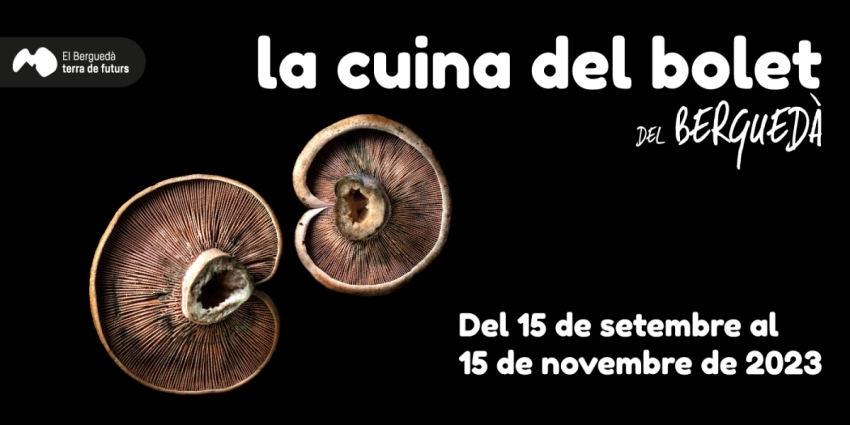
News
Gothic Architecture: The light and height of medieval Catalonia
Gothic architecture marks a turning point in the history of Catalonia. It was the style that transformed cities, places of worship, and the way people built collectively. A style that changed not only the stone itself, but also the way people…
Iron architecture: the light and steam of industrial Catalonia
In the 19th century, the Industrial Revolution not only changed the way people worked and lived, but also profoundly transformed architecture. The arrival of new materials, such as cast iron, wrought iron, and glass, opened up possibilities…







 Sustainable turism
 Biosphere