


La Roca dels Bous, the Noguera site where fire explains the life of Neanderthals
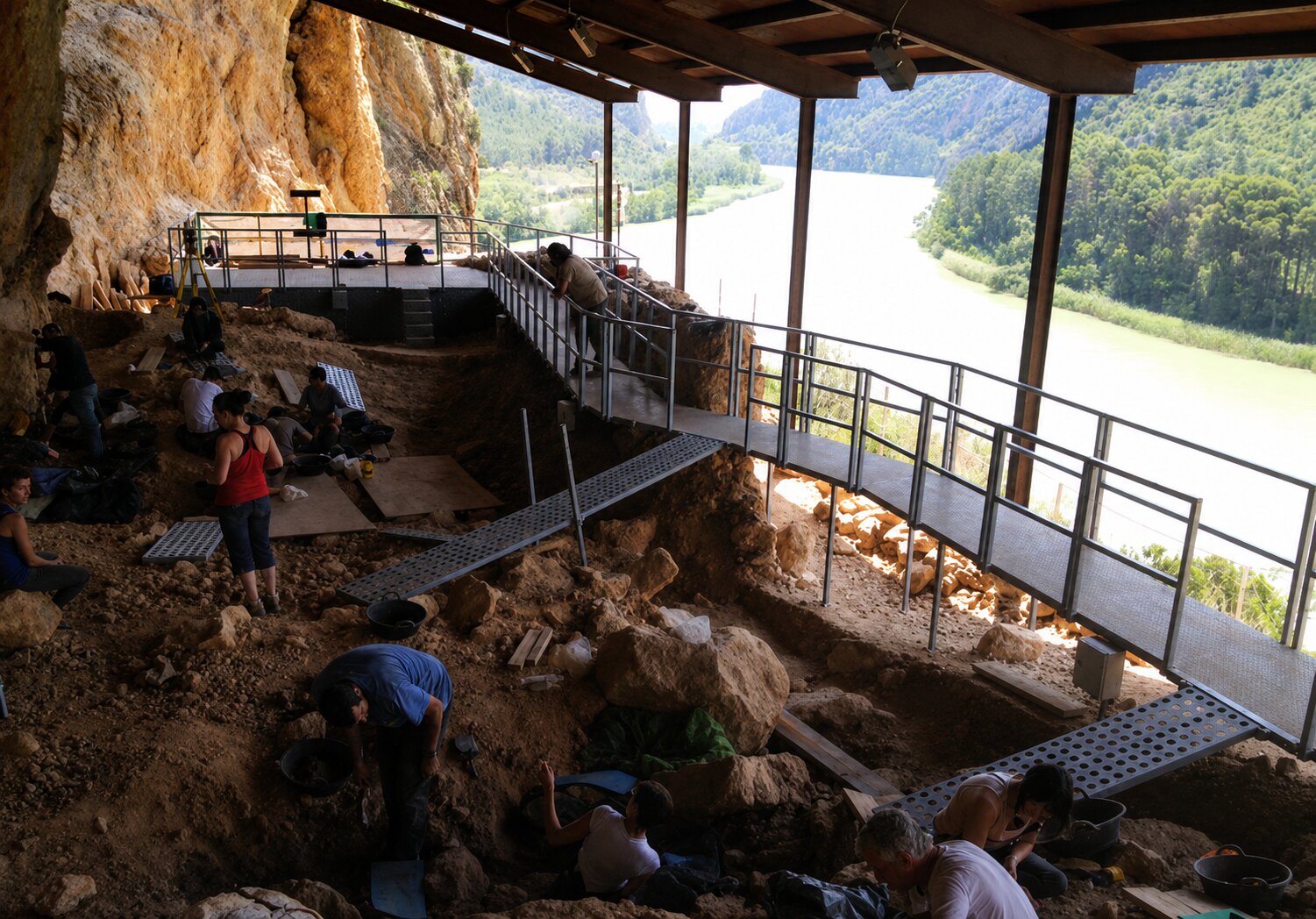
In Sant Llorenç de Montgai ( Camarasa ), surrounded by a spectacular landscape between the Segre River, the cliffs , and the first mountain ranges of the Lleida Pre-Pyrenees, lies an archaeological site that allows us to approach one of the great questions of prehistory: how did Neanderthals live? The answer, at Roca dels Bous, often comes through an element as commonplace as it is fascinating: fire.
This prehistoric rock shelter, located in the Aspres de la Noguera mountains, is a key site for understanding Neanderthal occupation during the Middle Paleolithic in northeastern Iberia. Over years of excavations, archaeologists have documented stone tools and animal remains. These indicate repeated stays at the site, marked by numerous combustion structures. This evidence of fire is precisely one of the elements that makes Roca dels Bous an exceptional archaeological site.
A site where fire has been exceptionally preserved
When we think of a prehistoric campfire, it's easy to imagine flames burning inside a rock shelter. However, what truly interests archaeologists, thousands of years later, is not just the fire that burned there, but the marks it left behind. Blackened sediments, heat-altered soil, ash and charcoal—small clues that allow us to reconstruct what was happening around it.
At Roca dels Bous, this record has been exceptionally well preserved. In many Paleolithic sites, the remains of hearths disappear due to erosion, rain, wind, the passage of time, or alterations in the sediment. Here, however, a large number of hearths have been preserved thanks to the site's formation conditions and the rapid burial of some areas. This has allowed for the identification of combustion structures with ash remains and surfaces directly affected by fire.
This finding is especially valuable because it offers a unique opportunity to study how Neanderthals used fire, how they organized their living space, and what activities they carried out within the rock shelter. Fire, at this site, is not an isolated discovery, but rather a recurring presence.
More than just warmth: the diverse functions of bonfires
Excavations have shown that numerous hearths were lit throughout the different periods of occupation. In some archaeological sites, more than forty hearths have been documented. This abundance indicates that fire was an essential part of the daily life of the Neanderthal groups who passed through this area.
A wide variety of activities took place around the hearths. Lithic remains show that stone tools were shaped and repaired near the fire. Animal remains, although often highly fragmented, also indicate activities related to the processing and consumption of animals. Thus, hearths served as central points of human activity, providing spaces for warmth, lighting shelters, processing food, working tools, and organizing the life of the group.
Some combustion structures appear to be located near the rock shelter wall. This placement does not seem accidental: positioning the fire at these points could have helped to make better use of the light and heat, turning the rock face into a surface that amplified the effects of the hearth. Evidence of hearth maintenance and cleaning has also been identified, such as the disposal of ashes, revealing a planned and repeated use of fire.
A window into Neanderthal life in the Pre-Pyrenees
Roca dels Bous was not a permanent settlement, but rather a site occupied repeatedly for millennia. Neanderthal groups would arrive there, stay for probably short periods, and engage in activities related to hunting, food processing, toolmaking, and the use of local resources.
Its location was strategic: the rock shelter sits at a crossroads between the Lleida plain and the pre-Pyrenean foothills, near the Segre River and areas where raw materials for toolmaking could be obtained. The landscape, now attractive to nature lovers and active tourists, was also an important corridor for prehistoric human groups.
Dating places the occupation of Roca dels Bous approximately between 55,000 and 48,000 years ago, a period marked by significant climate change. In this context, the management and frequent use of fire must have been fundamental. The fires not only helped to withstand the cold and darkness, but also structured the space and social life within the rock shelter.
A place to visit and understand prehistory
One of the great strengths of Roca dels Bous is that it is not only a site for scientific research, but also an archaeological site open to the public. Its transformation into a museum has allowed it to become an engaging experience for understanding prehistoric heritage, with tours designed to facilitate the comprehension of an archaeological record that, at first glance, can be difficult to interpret.
Digital tablets and audiovisual resources help visitors imagine what this space was like tens of thousands of years ago. Where today we see stones, sediments, and dark markings on the ground, technology allows us to recreate scenes of Neanderthal life: toolmaking, the use of fire, food preparation, and shelter organization.
The combination of research, landscape, and educational outreach makes Roca dels Bous a highly recommended visit for discovering the Noguera region from a different perspective. It's an ideal option for families, history buffs, and anyone who wants to understand how archaeology helps us reconstruct the past.
Visiting Roca dels Bous is like stepping into an ancient hearth that continues to tell stories even today. It's not necessary to imagine it as an extraordinary scene or ritual, but rather as an essential part of life: a meeting place, a work site, a source of warmth, and a means of survival. A fire that, after thousands of years, allows us to observe firsthand the lives of Neanderthals in the Noguera region.
Published by Youssef Haouriqui on 23 of july of 2026 at 10:00h

Events
European Heritage Days in Collbató
16 OctoberAlfaro Year in Sant Andreu de Llavaneres
16 OctoberForest week in Sant Celoni
16 OctoberRACC Costa Dorada Rally in Salou
From 16 to 17 OctoberZim Zam Cassà - Cassà de la Selva Urban Art Festival
From 16 to 17 OctoberEbrencas Letters Days in Amposta
From 16 to 18 OctoberFirauto Balaguer
From 16 to 18 October
Experiences







 Sustainable turism
 Biosphere