


Municipalities
We propose a circular route in the Solsonès region through which you will discover an extensive cultural heritage of interesting Romanesque hermitages.
La Vall de Lord is an area rich in cultural heritage, where its hermitages stand out, which are isolated in the middle of the forests of the municipality of La Coma and La Pedra. A good example are the parish church of La Coma, Sant Sadurní de la Pedra and Santa Creu del Roser.
The forests of diverse vegetation through which the route travels fill with different shades of green in spring and with red, orange and yellow tones during autumn.
We propose a circular route to discover these Romanesque hermitages.
- Distance: 10.80 Km
- Duration: 3 hours
- Cumulative elevation gain: 460 m
- Difficulty: Moderate with steep slopes
Very close to the route are the picnic areas of Fuente Puda, a source of sulphurous waters, and Fuentes del Cardener, point where the river of the same name is born.
From Sant Llorenç de Morunys we take the C-426 road towards La Coma and la Pedra; We continue along this road until we reach the town of La Coma. Once we have left the City Hall turnoff on the left, we will find a car park on the right. Here we leave the car and start the route.
Km 0. We go down the street that goes down to the right of the Cal Nin restaurant, towards the church of Sant Quirze and Santa Julita de la Coma. We continue down the street until we reach Calle Mayor, behind the town hall. Signpost. We go down the stairs that turn into a path that takes us to the river. We cross the bridge and take the track that coincides with the Vall de Lord green path. We follow the GR-7 markings in the direction of Sant Llorenç de Morunys.
Km 1,7. Sant Llorenç road to Coma. We go up to the left until we find the detour towards La Piedra and the Puda fountain. We go up the asphalt track towards the hermitage of San Saturní de la Pedra.
Km 2,8. Hermitage of San Saturní de la Pedra. We climbed the stairs to the cemetery and followed the path up. We cross the track and continue climbing some stairs passing in front of a house, following the direction sign. We find yellow markings that will help us to follow the well-traced path that passes along the left side of a line of cattle.
Km 3,4. We leave the yarn and take a path to the left that takes us up.
Km 4.4. We cross the track and follow the path with the markings.
Km 4.9. Crossroad. A signpost shows us the different routes to follow. We take the path to the left towards the hermitage of Roser. We find the track again and follow it to the left.
Coll de la Cruz and hermitage of Roser. The hermitage is a few meters to the left. Signpost. Returning from the hermitage, we take the track to the left that glides towards the Sierra del Verde (2,282m).
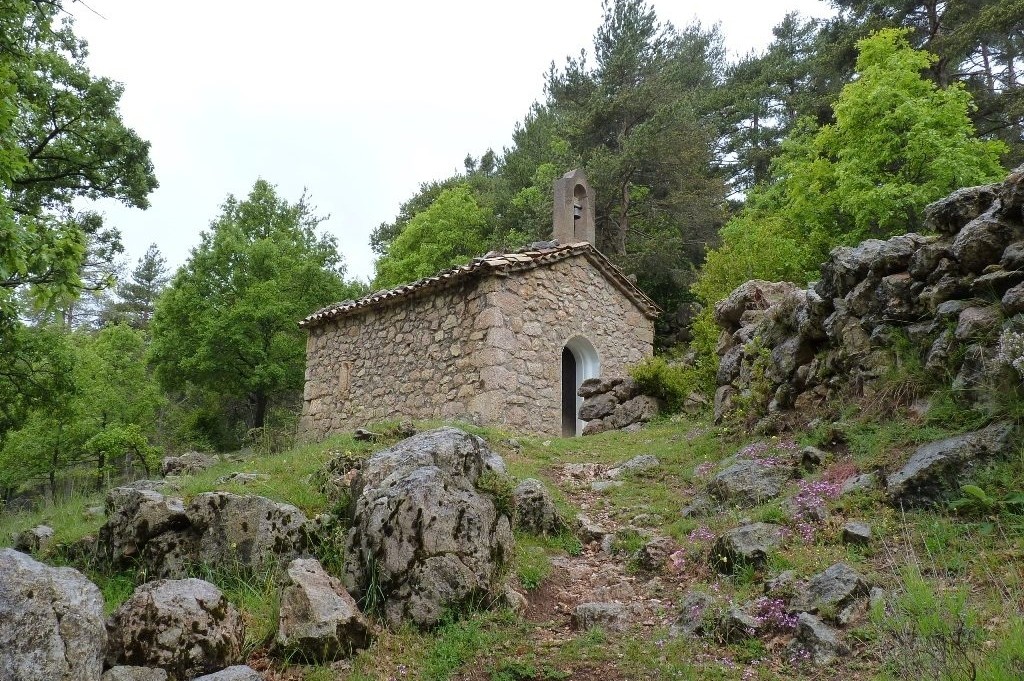
Ermita de Santa Creu del Roser
Km 6.1. Before the house in ruins of Cal Dam, we find a signpost that marks the route to Santa Julita de la Coma. We must jump the protective fence and go down a path that is not very marked but clear to recognize. We will find yellow marks that show us the way. The path goes down the ravine, to the left of the river that we feel below.
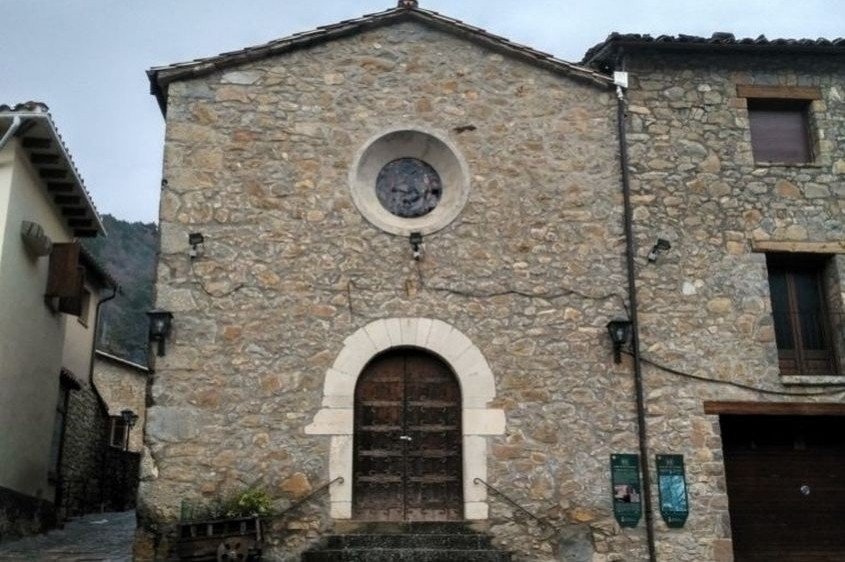
Ermita de Santa Julita
Km 7.1. We reach the Mosoll River, which we cross the ford, and we follow the path to the left, passing under the rocks of the Minguell.
Km 8. Casa del Minguell and Minguell fountain. We pass by the right of the Minguell house and we follow the marks that indicate the path without losing altitude. We continue straight on the path to the left until we reach the Colina del Rincón.
Km 8.9. House of the Hill of the Corner. Crossing of tracks. We follow the track on the left that leads us to La Coma. Further on we take a path to the right. This trail runs flat through the forest and then down hard along the side of a stone wall and the rubble of a house. We are on the nucleus of the Coma.
Km 10.3. We take a track next to a deposit that will take us to the starting point of the route.
Km 10.81. We arrived at the nucleus of the Coma; We follow the road a few meters until we find the car park where we have started the route. End of the route.
Places of interest
Sant Quirze and Santa Julita
Parish Church of La Coma located in the Plaza Mayor. Sant Quirze y Santa Julita is the parish church of La Coma and is located in the same main square of the town. The first document that makes reference is the act of consecration of the church of San Saturnino de Tavèrnoles, of 1040, year in which the bishop of Urgell confirmed all the possessions that the monastery had.
Witnesses of the old church are the forged iron of the door, which is currently observed at the entrance of the monument. The whole is conserved very entire, which leads to think that it was replaced in later times. Probably its author was a humble craftsman who made an element that reinforced the wooden structure while giving the door an ornamental motif that made it more attractive.
Sant Sadurní de la Pedra
This church is known, when Count Wifredo el Velloso and Bishop Galderic repopulated the Valley between the years 872 and 878. It is a Romanesque church from the 9th century with three square apses with a barrel vault, hidden between the later incorporations 18th century. The door has large voussoirs that form a middle arch and followed by a bevelled flange on the front. It has an airy bell tower and preserves a Baroque altar.
Santa Creu del Roser
It is named after a church that was previously dedicated to the Holy Cross, a very popular devotion between the 11th and 12th centuries. Later, in the 18th century, it took the name of the Roser. Its structure, small in size, has a square plan and has been recently renovated.
Source: Vall de Lord Tourist Office / Solsonès Tourist Office
Nearby experiences
Nearby routes
The splendor of the Solsonès Baroque
Pinell de Solsonès, Pinós, Riner, Sant Llorenç de Morunys, Solsona
Baroque art invaded the religious buildings of Catalonia during the seventeenth and eighteenth centuries, and is characterized by its ornamental abundance. This period left a legacy of altarpieces of great value, works of great sculptural quality…
Route with snowshoes in the Mirador del Pla de la Leche from El Fornell
La Coma i la Pedra
La Cerdanya, with its soft reliefs and quite high, is an ideal terrain to start snowshoeing. The surroundings of the Nordic ski resorts of Guils, Lles and Aransa are a good option to try snowshoes for the first time. In the case of the Aransa…
Grand Tour de Catalunya - Section 1. Vineyards with taste in the sea: from Barcelona to Tarragona
Aiguamúrcia, Barcelona, Cabra del Camp, Cardona, El Vendrell, Monistrol de Montserrat, Mura, Navès, Sant Fruitós de Bages, Sant Llorenç de Morunys, Sant Sadurní d'Anoia, Sitges, Solsona, Súria, Tarragona, Vilafranca del Penedès
I want to do this route by electric vehicle! This route is designed to be done by electric vehicle, although it can be done with any other car. Along the route we will suggest municipalities that have charging points and places of interest…
Shrines in Solsonès
Guixers, Lladurs, Pinós, Riner, Sant Llorenç de Morunys
The Solsona is, as described at the time Josep Pla: one of the regions that form the "highlands of Tenerife, cold, exposed to the gusts of wind of the Pyrenees, agriculturally lean and admirable restraint" and which stands out as a sparsely…
Related routes
Circular route of the Water Museum of Lleida and the suburb of the Gold Cup
Lleida
If you come to Lleida you cannot miss the Water Museum. Only then will you understand the link between this land and water, and the human ingenuity that allowed it to be distributed throughout the territory. And since you are in the Museum,…
Crossing through the mountains of the guerrilla Carrasclet
Colldejou, Pratdip
Autumn is a very good time to go hiking, you can admire the beauty of the landscapes and the weather invites you to go out and play sports. That is why we propose a route to get to know the Baix Camp through a walk through the imposing mountains…
Path of the Segremorta in La Molina
Alp
We propose the Segremorta road, a traditional path in La Molina that has now been recovered for tourist use. The circular route begins and ends at the Albergue de la Virgen de las Nieves and can be done on foot or by bicycle. The total length…
Path of the sources in Peramola
Peramola
Peramola has recovered the path of the fountains, a two-kilometer walk that crosses the Romanesque bridge of the town and the path that runs through the Peramola stream, in the middle of the forest. One of the most emblematic routes in Peramola,…
Events
Forest week in Sant Celoni
16 OctoberAmateur Theatre Showcase in Sant Gregori
16 OctoberEuropean Heritage Days in Collbató
16 OctoberRACC Costa Dorada Rally in Salou
From 16 to 17 OctoberZim Zam Cassà - Cassà de la Selva Urban Art Festival
From 16 to 17 OctoberFira Mediterrània de Manresa 2026
From 15 to 18 OctoberMoaré Terrassa Festival
From 16 to 18 October
News








 Sustainable turism
 Biosphere