


Turisme Solsonès
Municipalities
Solsonès is a region located in the heart of Catalonia, known for its natural beauty, mountain landscapes, and historical heritage. With a predominantly rural environment and low population density, Solsonès is often called the "region of a thousand farmhouses," a territory that preserves the essence of Catalan rural life amidst green valleys, lush forests, and mountains.
The capital of the region, Solsona, is a small city brimming with medieval character and boasting a rich architectural heritage. Its old town is surrounded by the remains of ancient walls, and strolling along its cobbled streets, you can discover monuments such as Solsona Cathedral, Gothic in style with Romanesque elements, and the Episcopal Palace, which houses the Diocesan and Regional Museum, where you can admire valuable works of sacred art and archaeological pieces. Solsona is also known for its traditional festivals, especially its carnival, one of the oldest and most emblematic in Catalonia.
The region boasts a privileged natural environment. One of its most outstanding features is the Port del Comte mountain range, which offers numerous hiking trails, as well as a popular ski resort during the winter months. Nature lovers can also enjoy the tranquility of places like the Llosa del Cavall Reservoir, a lake that offers spectacular views and where activities such as canoeing and other water sports can be enjoyed.
The rural heritage of Solsonès is another of its great attractions. The farmhouses scattered throughout the region are examples of traditional architecture, many of which are still inhabited and preserve the rural way of life. Furthermore, the region boasts numerous Romanesque churches and hermitages, such as the Hermitage of Sant Quirze de Pedret or the Church of Sant Esteve d'Olius, one of the most outstanding examples of Catalan Romanesque architecture.
The cuisine of Solsonès reflects the region's rural and mountain traditions. Cured meats, such as longaniza and fuet, as well as artichokes from the Vall de Lord and mushrooms, are highly prized in local cooking. Traditional dishes like game stews and mountain trinxat can also be found in its restaurants.
Stay awhile, discover its charming villages, enjoy the natural landscapes and be captivated by the history and gastronomy of Solsonès, a region where nature and rural life remain intact, offering a unique and authentic experience.
Featured places of interest
The Solsona Museum
The Solsona Museum is one of the most important cultural institutions in the region and a key element in understanding its history. Its collection offers a comprehensive overview, from prehistory to more recent times, providing visitors with a complete picture of the area's past. It is not just a place to admire ancient objects, but a center that helps to understand how the identity of Solsonès has been shaped over the centuries.
The museum's importance also lies in its preservation and dissemination of invaluable religious, artistic, and archaeological heritage. This collection is especially relevant in a region where churches, sanctuaries, and expressions of devotion have played a fundamental role. Therefore, a visit to the museum perfectly complements the exploration of the area: after visiting landscapes, villages, and monuments, visitors can delve deeper into their historical significance. Ultimately, it is a space where memory, art, and knowledge converge.
The Baroque Solsonès
One of the region's greatest heritage assets is its collection of Baroque art. Solsonès preserves altarpieces, sanctuaries, and churches that constitute a legacy of great quality, showcasing the religious and artistic fervor of the 17th and 18th centuries. This heritage is especially valuable because it is not limited to a single work or building, but is distributed throughout the region, creating a kind of cultural itinerary that allows visitors to understand a very fruitful period in local history.
The Baroque art of Solsonès stands out for its decorative richness and its ability to express emotion, spirituality, and solemnity. Through these spaces, one can see how art served not only to beautify but also to transmit religious messages and strengthen community life. This makes the discovery of Baroque Solsonès particularly interesting for both art lovers and those who wish to delve deeper into the historical and symbolic dimensions of the region's cultural landscape.
The Vall d'Ora
The Vall d'Ora is one of the most evocative places in the Solsonès region because it combines nature, heritage, and rural history. Bisected by the Aigua d'Ora river, it offers a tranquil and harmonious landscape that invites contemplation and leisurely strolls. It is a place where the presence of water has been fundamental, not only in shaping the natural environment but also in the human activities carried out for centuries. Therefore, the valley is also a valuable testament to daily life and traditional work.
In this setting, we find mills, bridges, old paths, and other features that recall how rural communities have used natural resources. Furthermore, the valley preserves buildings of historical and religious interest that blend seamlessly into the landscape. A visit to Vall d'Ora allows you to discover another side of the Solsonès region: quieter, more connected to the land and traditional trades, but equally rich in culture. It is an ideal place to understand the profound relationship between nature and human history.
Sant Pere de Graudescales
Within the Vall d'Ora region, Sant Pere de Graudescales holds a prominent place. This ancient Romanesque monastery is one of the medieval gems of the area. Its appeal lies not only in its age but also in the harmony of its forms and the spiritual value it conveys. Situated in a stunning natural setting, the church presents a serene and austere image, characteristic of Catalan Romanesque architecture.
The exterior simplicity, the apses, and the characteristic Romanesque architectural elements make this building a particularly attractive visit for those who appreciate medieval art. But beyond its architectural value, Sant Pere de Graudescales also possesses remarkable symbolic power: it represents the imprint of monasticism on the region and the importance these centers held in the spiritual and cultural life of the Middle Ages. It is, therefore, a small space in size, but immense in historical significance.
I left Cambrils
The Cambrils Saltworks is one of the most unique sites in the Solsonès region and throughout inland Catalonia. Its main characteristic is that it bears witness to an activity unusual in a mountainous area: the extraction and processing of salt. This element makes the saltworks a site of great heritage interest, as it allows visitors to discover a way of life and production that seems extraordinary today. The preserved structures and the interpretive center help to understand how this resource was obtained and its economic importance.
A visit to the Cambrils Saltworks is a truly comprehensive experience, combining industrial heritage, stunning scenery, and educational content. Furthermore, the site has been revitalized as a tourist and wellness destination, further enhancing its appeal. It serves as a prime example of how the Solsonès region has successfully reclaimed elements of its industrial past and transformed them into cultural and tourist attractions. The saltworks showcases a region capable of preserving its history while simultaneously offering new ways to experience it.
The Geographical Center of Catalonia
One of the most symbolic points in the region is the Geographical Center of Catalonia, located near the Pinós Sanctuary. This place holds special significance because it represents the center of Catalan territory and, therefore, occupies a space imbued with identity. Beyond its purely geographical significance, it is a place that invites reflection on the centrality of Solsonès within Catalonia and its role as a territory of passage, connection, and balance between different areas of Catalonia.
The natural setting further reinforces this symbolism. It is an open, elevated space with excellent views, ideal for contemplating the landscape and becoming aware of the relationship between geography and identity. The presence of the Compass Rose adds a cultural and symbolic dimension that makes it especially appealing. It is not just a point on the map, but a space capable of inspiring emotion and conveying a sense of collective belonging.
Sant Esteve d'Olius
Sant Esteve d'Olius is another of the most outstanding heritage sites in Solsonès. This Romanesque church stands out for its architectural beauty and the harmony with which it blends into the landscape. As is often the case with Romanesque architecture in the region, its appeal lies not in its grand scale, but in its artistic quality and the sense of serenity it conveys. It is a place that invites leisurely observation and allows one to appreciate the sobriety and balance characteristic of this style.
Furthermore, the Olius complex holds added interest because it reflects the historical continuity of settlement and religious life in the region. Its preservation allows us to understand how these small churches have served as centers of gathering, spirituality, and local identity for centuries. A visit to Sant Esteve d'Olius is therefore an opportunity to discover an essential part of the medieval heritage of the Solsonès region and to appreciate the strength of its Romanesque legacy.
Odèn
Odèn is a municipality in the north of Solsonès, in the first foothills of the Pyrenees, typically rural and mountainous, close to large cities, with…
Solsona
Solsona is the capital of the Solsonès region and is characterized by its peaceful atmosphere and rich history and culture. History and evolution of the…
Experiences
Events
Day of the siege in Castellfollit de Riubregós
17 OctoberSolsonès Land Fair. Solsoterra
From 17 to 18 OctoberFeast of Sant Galderic de Avià
From 17 to 18 OctoberOktoberfest Solsona
24 OctoberNovemberfest - The Hops and Craft Beer Festival of Avià
24 OctoberBerga Mushroom Festival
25 OctoberGuided tour of Sant Esteve Castle in Castellfollit de Riubregós
8 NovemberFamily Medieval Gymkhana in Súria
8 NovemberSúria Medieval Crafts Fair
From 14 to 15 NovemberReturn to La Maria, the Avià Mountain Race
From 14 to 15 NovemberThe Tractor Race in Casserres
28 November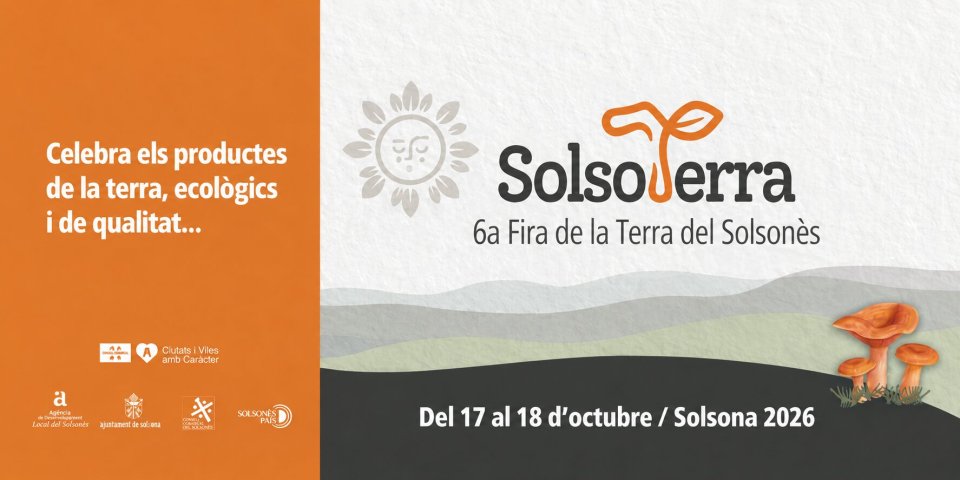
Nearby routes
The splendor of the Solsonès Baroque
Baroque art invaded the religious buildings of Catalonia during the seventeenth and eighteenth centuries, and is characterized by its ornamental abundance. This period left a legacy of altarpieces of great value, works of great sculptural quality…
Grand Tour de Catalunya - Section 1. Vineyards with taste in the sea: from Barcelona to Tarragona
I want to do this route by electric vehicle! This route is designed to be done by electric vehicle, although it can be done with any other car. Along the route we will suggest municipalities that have charging points and places of interest…
The origin of Carnival
From femturisme we want to encourage you to participate in some of the most traditional carnivals that exist in Catalonia, in which mockery and criticism are the main course of the party. We are talking about the Carnival of Vilanova i la Geltrú…
After the Nova Planta laws
After a war there are always catastrophic: people killed, injured, destruction of buildings, etc. But we should not consider only tangible harm. Also keep in mind all that is not seen, but felt that over the years the catastrophe left clear…








 Sustainable turism
 Biosphere