


Santa Coloma de Cervelló
The town of Santa Coloma de Cervelló, in the Baix Llobregat, is located on top of the San Antonio mountain .
The first human settlements in this territory date back to the ninth century in the middle of medieval times, being a Holy Coloma de Montpedrós that honors its summit. Although Iberian remains have also been found that justify that this existence was earlier. From the eleventh century is the Romanesque Salvana Tower, the name of this tower that is part of the castle as a whole comes from the lords who owned them, the Salbà. Initially it was called Tower of Them and it was a defensive tower. In the same period there is the Parish Church. By the seventeenth century all the manor houses that exist in this municipality and that are one of the main attractions were constituted; Torre Forés, Can Ribot, Can Baruta...
With the Industrial Revolution of the 18th century a strong industrial process began in Catalonia. One of the territories chosen by the entrepreneur Eusebi Güell to implement a textile factory was Santa Coloma since it was a municipality near Barcelona and its port and, in addition, it must be taken into account that the river ran for it. The majority of the territories where an industry was installed around it took place a process of urbanization getting to form a colony, as is the case of Santa Coloma with Colonia Güell. This has had a great echo since it built a church, Gaudí Crypt, designed by the great artist Antoni Gaudí. This has been declared a World Heritage Site by UNESCO and has won the award of sustainable cultural tourism destinations in Europe 2018. The Crypt is the church of the crooked columns, the laboratory of the Sagrada Familia and work where the great architect of Catalan modernism Antoni Gaudí experienced many architectural solutions. At the same time contemplating the work of Gaudí, Colonia Güell offers the visitor the possibility of touring the streets contemplating the most significant modernist constructions of the life of the colony and of great architectural interest. In addition, you can visit the Interpretation Center, located in the building of the former consumer cooperative, which has a permanent exhibition to understand the whole of the colony and Church in particular.
Today the economy of this town continues to be based in the industry. Although more and more it is oriented towards the service sector.
Santa Coloma, too, has a great natural environment. Green spaces, forest, mountains.... Highlight the Park of the Fountain of the Rogue and the Cherry Tree.
Events
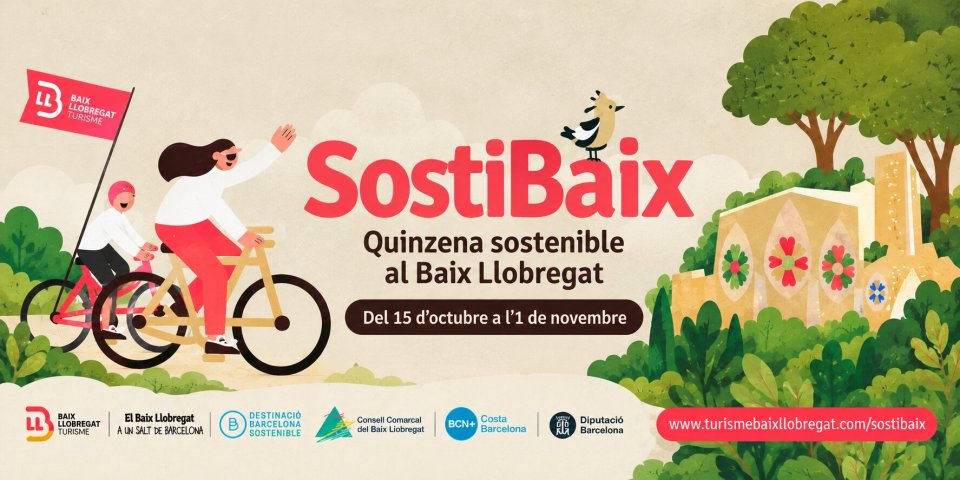
Sostibaix, the sustainable fortnight of Baix Llobregat
From 15 October to 1 NovemberPanoràmic Festival in Granollers, Barcelona, Terrassa and Vic
From 15 October to 27 DecemberThe Castañera in La Pedrera!
17 OctoberScenic programming in Gelida
17 OctoberMARIDA'm: The secrets of two liquid golds of Catalonia, Sant Sadurní
17 OctoberTransmaresme Bike
24 OctoberOpen doors at the Cava Centre, Sant Sadurní d'Anoia
1 NovemberFestival 42 - Barcelona Fantasy Festival
From 4 to 8 NovemberMost, International Wine Film Festival in Penedès and Priorat
From 5 to 15 NovemberTerror Molins, Molins de Rei Horror Film Festival
From 6 to 15 NovemberRoute through the medieval town of Torre-ramona in Subirats
8 NovemberNearby routes
The Baix Llobregat, a trip through history
Mediterranean Trail
A stroll through the gardens surrounding Barcelona
The main characters in the the siege of 1714
Trying the 1714 food
Itinerary Jujol in Sant Joan Despí
May 18: International Museum Day in Barcelona
Following the work of Puig i Cadafalch along the coast
Sports tourist destinations of Catalonia
Llobregat path
News
Iron architecture: the light and steam of industrial Catalonia
In the 19th century, the Industrial Revolution not only changed the way people worked and lived, but also profoundly transformed architecture. The arrival of new materials, such as cast iron, wrought iron, and glass, opened up possibilities…
Gothic Architecture: The light and height of medieval Catalonia
Gothic architecture marks a turning point in the history of Catalonia. It was the style that transformed cities, places of worship, and the way people built collectively. A style that changed not only the stone itself, but also the way people…








 Sustainable turism
 Biosphere