


Iron architecture: the light and steam of industrial Catalonia
In the 19th century, the Industrial Revolution not only changed the way people worked and lived, but also profoundly transformed architecture. The arrival of new materials, such as cast iron, wrought iron, and glass, opened up possibilities that had previously seemed unthinkable: covering large spaces without the need for thick walls, building lighter structures, and harnessing natural light like never before.
In Catalonia, this new way of building grew at the same pace as industry and cities. Markets needed large spaces to accommodate an ever-increasing population, factories spread along rivers, and transport infrastructure became increasingly important. Iron became a symbol of this transformation: a material that represented modernity and that ended up leaving a very visible mark on Catalan architectural heritage.
An architecture born from industry
For centuries, stone, brick, and wood had been the primary building materials. But erecting large buildings with these resources required heavy structures and numerous support points. Iron changed that. Thanks to metal columns and large trusses, it became possible to cover vast areas, create more open interior spaces, and allow light to reach even the deepest corners.
This architecture is characterized by its exposed structures, lightweight roofs, skylights, and large interior spaces. Many of the metal components were manufactured in specialized workshops and then transported to the construction site for assembly. This system facilitated construction and directly linked architecture with advancements in the metalworking industry.
But iron architecture was not merely a matter of engineering. Columns, railings, and ornamental elements often incorporated elaborate forms, demonstrating that functionality could also be accompanied by beauty. In many buildings, the structure was not hidden behind the walls but became the dominant feature of the space.
The markets: large spaces for a growing city
One of the best examples for understanding the possibilities of iron is the covered markets. As Barcelona grew, facilities were needed that could accommodate numerous stalls, facilitate the movement of people and goods, and guarantee adequate ventilation and lighting. Large metal structures offered an ideal solution to these needs.
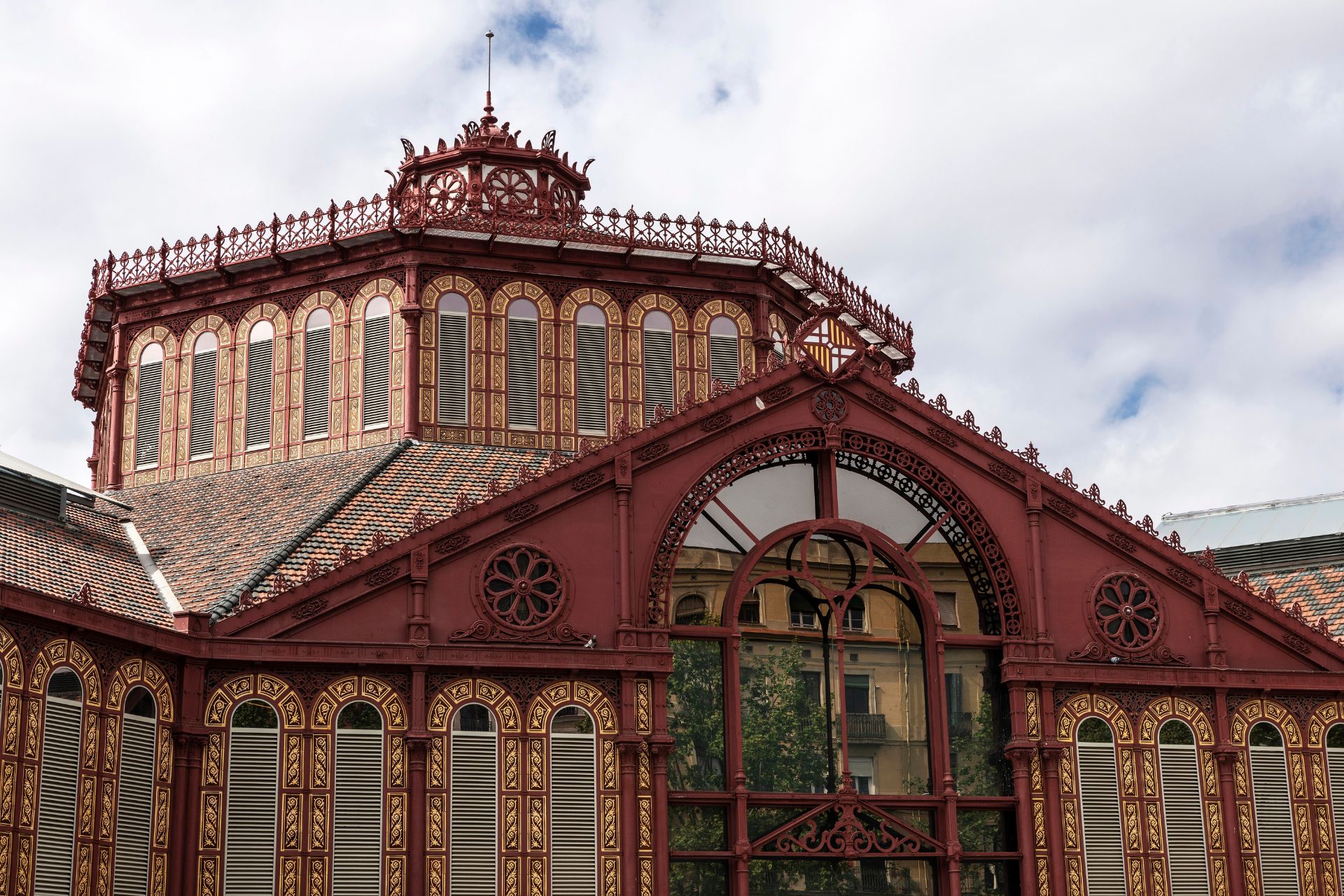
The Born Market, built in Barcelona during the 1870s, is one of the most representative examples of this architectural style in Catalonia. Designed by Josep Fontserè, with a metal structure by the engineer Josep Maria Cornet i Mas, the building is notable for its large halls, roofs, and cast-iron columns. The metal components were manufactured by La Maquinista Terrestre y Marítima, one of the most important industrial companies of the time.
The market functioned for decades as an essential facility for supplying the city, until the relocation of wholesale activity to Mercabarna changed its role. Its history took a new turn when archaeological excavations uncovered the remains of 18th-century Barcelona beneath the pavement. Today, the Born Centre for Culture and Memory allows visitors to explore this past within the same iron structure that was erected in the 19th century.
Another outstanding example is the Sant Antoni Market, inaugurated in 1882 and designed by Antoni Rovira i Trias. Its layout, organized around four large wings surrounding a central space, responded to the needs of a growing neighborhood. After extensive renovations, the market reopened in 2018, combining the preservation of its historic structure with new spaces and underground services. More than a century after its inauguration, it remains a vibrant facility that demonstrates how industrial heritage can be adapted to current needs.
Industrial colonies: factories that created towns
The industrial transformation was not limited to the large cities. Along the Catalan rivers, especially the Llobregat and the Ter, industrial colonies proliferated, complexes that brought together factories, housing, and services in a single space. Water provided the energy needed to power the textile machinery, while the proximity of the workers facilitated the operation of the companies.
A factory colony could include workers' housing, a church, a school, a store or company store, and the residence of the owning family. More than just factories, they were small population centers organized around industrial activity. Their architecture reflected this dual productive and residential function, with large factory buildings alongside buildings intended for daily life.
This model also had a social dimension that must be considered. Work, housing, and a large part of the services depended on the company itself, which profoundly shaped the lives of the workers and their families. Therefore, the industrial colonies are a heritage that allows us to understand both the technological advances of the time and the inequalities and forms of social organization that accompanied industrialization.
Among the best-known examples is the Sedó Colony in Esparreguera, which became one of the country's largest industrial complexes. Today, its heritage allows us to discover the scale of that activity and understand how a factory linked to hydroelectric power operated.
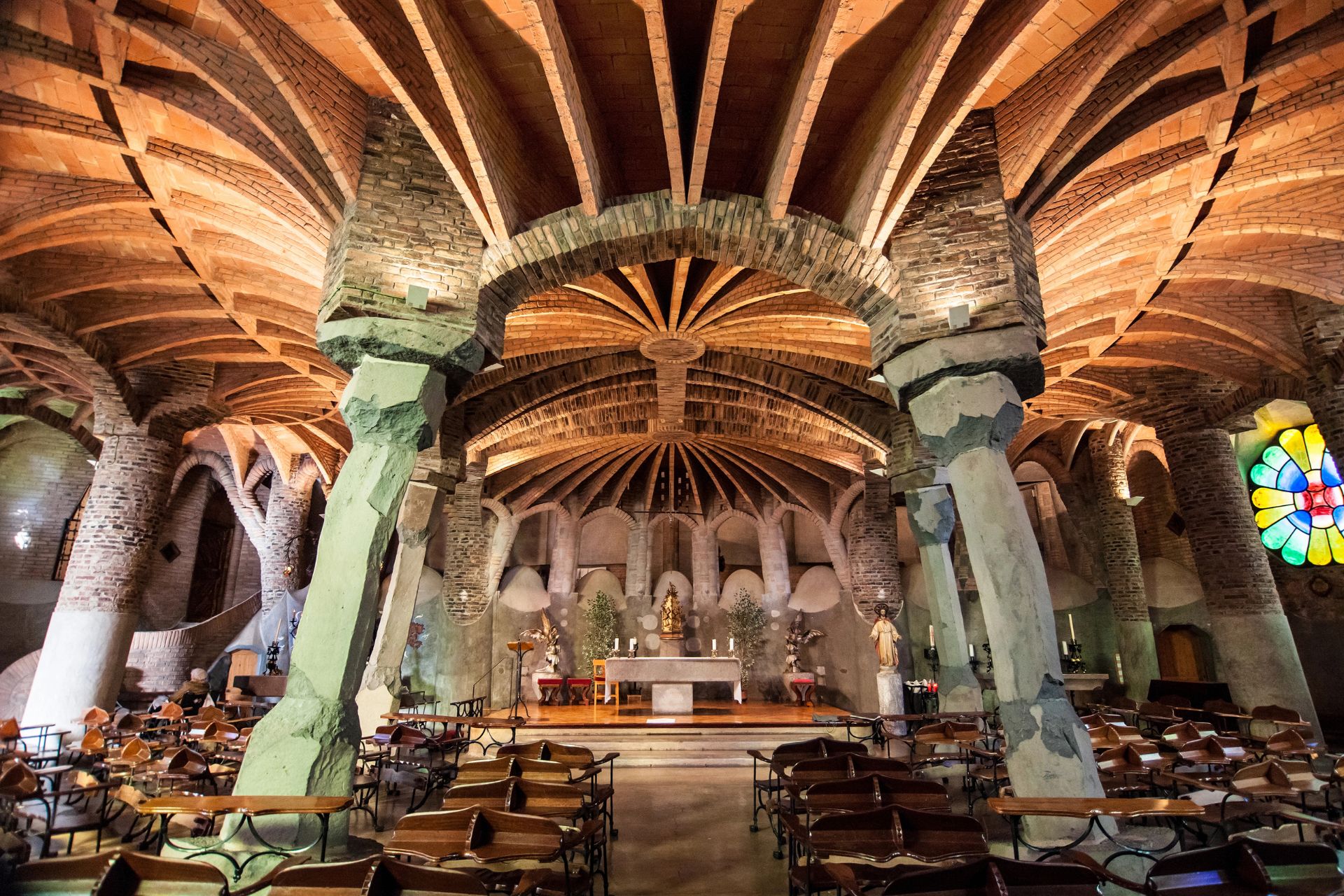
Also noteworthy is the Colonia Güell in Santa Coloma de Cervelló, developed by the businessman Eusebi Güell. The complex preserves industrial and residential buildings of great interest, but it is especially famous for its church, designed by Antoni Gaudí. The crypt, with its innovative forms, materials, and structural solutions, was a fundamental architectural laboratory for the architect's later work. It is a unique example of how the industrial world could also become a space for artistic experimentation.
From iron to modernism: a new way of building
Iron architecture paved the way for a new relationship between technique and aesthetics. What had initially been developed to solve practical needs ended up offering architects new expressive possibilities. Iron allowed them to draw curves, create slender structures, and work with decorative elements with a freedom that traditional materials did not always facilitate.
These possibilities continued into modernism, which incorporated wrought iron into balconies, railings, doors, and other ornamental elements. The material ceased to be exclusive to factories and markets, entering residential buildings as well, where it was combined with stone, ceramics, and glass. The boundary between architecture, craft, and industry became increasingly blurred.
Today, historic markets and former industrial colonies allow us to experience this transformation firsthand. Looking at the columns, trusses, and roofs is to discover an era when building meant experimenting with new techniques and imagining different cities. Iron architecture was not only the expression of an industrial Catalonia: it laid the foundations for a new way of understanding space, light, and the possibilities of modern architecture.
Published by Oriol Rosselló Gil on 13 of october of 2026 at 12:00h
Related routes
The Passions in Catalonia: tradition and sacred theatre
Catalonia is a country with a wide range of customs and traditions. Almost every month of the year there is a holiday to celebrate that takes us back in time and revives some part of our historical and cultural legacy. In this case, the beginning…
Paths of the Bishop and Abbot Oliba
The Barcelona regions of Osona and Bages, and the Girona region of Ripollès, are the protagonists of this route that takes the name of a capital figure in the history of Catalonia, the Bishop and Abbot Oliba. The route (173 km and +)…
Path of the natural parks
Starting and ending on the shores of the Mediterranean, the Sendero de los Parques Naturales (210 km), also known as Sendero de los Miradores, makes an arc towards the interior of the territory, always about 40-50 kilometers from Barcelona…
Route from the porch of Santa Oliva to Sant Salvador de les Espases
This is one of the busiest and most popular itineraries in Olesa de Montserrat. It starts in the old town and ends on a historic hill. Every year on the first Sunday of September, many people follow him to celebrate the great meeting.
Route from the Porch of Santa Oliva to the Collet de Sant Joan
We propose a low difficulty itinerary, very popular with the villagers of Olesa de Montserrat. In fact, it is also frequented by vehicles that mostly go to the vineyards.
Route of the three hermitages in Olesa de Montserrat
It is a route that allows you to enjoy the surroundings and visit the three hermitages that make up the Olesan heritage: the hermitage of Sant Jaume, Sant Pedre and Sant Salvador de las Espadas. The route of the route has a distance of about…
Montserrat, symbol of Catalonia
Montserrat is much more than a mountain in the interior of Catalonia, it is a must-see symbol for all those who wish to delve deeper into the country, it is a natural park that we can enjoy with marked walks, it is a monastery with an active…
The Academy of the Distrustful
During the early 18th century, the educated Catalan aristocracy organized themselves to defend and delve deeper into their history and culture. This was a common practice in other European cities, and in Barcelona, this institution was known,…
San Pedro and the Matamatxos Coast
This excursion brings us closer to the origins of the municipality of Hostalets crossing a series of streams and streams until we reach the Pierola torrent where we will find the old town of Pierola and a series of beautiful scattered farmhouses.…
Holidaymakers and Modernism in Hostalets de Pierola
The modernist heritage and magnificent views of the Montserrat mountain are the main attractions of this itinerary that runs through Hostalets de Pierola. An easy and flat route that brings us closer to the source of the Ocata, passing through…
Featured
La Passió d'Esparreguera
EsparregueraThe Passion of Esparraquera is a show with great dramatic and technical complexity, which manages to transmit to the current spectator the essence of characters with two thousand years of history. The grandeur of the theatre (1,800 seats), the large number of actors on stage, the dizzying changes of scenery, the perfect union of the text, and the original music performed live by an orchestra and a choir... make the Passion of Esparreguera a theatrical production with unique characteristics. The music Live music is one of the most important distinguishing features of the Passion Play, helping the spectator to immerse themselves more easily in the show in perfect coordination with word and action. An orchestra of thirty musicians, a choir of fifty voices and an organ with seven hundred pipes are the instruments that bring the soundtrack of La Pasión de Esparraguera to life. The theater The theatre, with a capacity of 1,800 spectators, is considered one of the largest in Catalonia. Opened in 1969, it was specially designed to stage The Passion. The 375 m2 stage is equipped with a cyclorama, elevators, motorized side platforms and a 25-metre-high curtain. The interior area for costumes and characterisation has a capacity for 600 actors. Services Bar - Cafeteria Service. Souvenir sales. Access for disabled people. Free parking in front of the theatre for cars and coaches. Information service that will assist you in the office located in the theatre lobby. How to get there By N-II highway, Exit 581 (South Esparreguera) By highway A-2, Exit 25 (Martorell - Montserrat - Lleida)
Alberg Viladoms de Baix, Fundesplai
Castellbell i el VilarViladoms de Baix is located in the municipality of Castellbell and Vilar, in the Bages region. The equipment, sustainable and with a modern and futuristic style, offers an extraordinary panoramic view of the Montserrat mountain. The modules-casitas form the various rooms with private bathrooms, dining rooms and activity rooms, scattered throughout the forest. Ideal for weekend stays, school camps or celebrations. It is a perfect hostel for families with babies and children from 0 to 6 years old, since all spaces are adapted and there is material, play spaces and specific activities for this age group. Innovative architecture in a surprising natural setting! WHAT YOU CAN DO IN VILADOMOS DE BAJO Summer activities for children and young people House of colonies for parties ampa/afa colonies Colonies teambuilding entities Colonies and school activities Colonies or recreation camps Lunch and spend the day Family holidays and weekends the shelter This hostel, Viladoms de Baix, offers family rooms with private bathrooms. It is fully accessible for people with reduced mobility and also provides Full Board service (includes breakfast, lunch and dinner). Other features that you will find in Viladoms de Baix are the swimming pool, WIFI connection, living rooms, television and environmental education classrooms, among other amenities. Our menus are based on the homemade and healthy cuisine of the Mediterranean diet. We use fresh and seasonal products, with a focus on local, ecological and socially responsible products. We adapt our menus for people with allergies, intolerances or who follow a vegetarian diet. In addition, we prepare special options for celebrations such as weddings, birthdays and other events. AROUND Enter the exciting odyssey of exploring the imposing mountain of Montserrat and everything that surrounds the cozy Viladoms de Baix hostel! This enclave invites you to discover its natural and cultural wonders with a unique mix of charm and authenticity. So, don't miss the opportunity to immerse yourself in exciting adventures and discover exceptional tourist attractions! One of these is the Torre de Vacarisses, a viewpoint that offers spectacular panoramic views of the Montserrat mountain!
Cremallera i funiculars de Montserrat
Monistrol de MontserratThe Montserrat Rack Railway is one of the main routes to approach the Montserrat Sanctuary site, an essential step to access the center of the site. The San Juan and Santa Cova Funiculars, on the other hand, facilitate access to the Montserrat Mountain Natural Park, in the Bages region. Through these sustainable means of transport, citizens have the opportunity to live a unique experience in the middle of nature, visiting the most important and significant mountain in Catalonia, since, thanks to its surprising characteristics, it has become one of the symbols Catalans. The Rack Train travels 5 kilometers, overcomes a difference in altitude of 600 meters and lasts 15 minutes. The journey begins at the Monistrol de Montserrat station and goes to the Sanctuary grounds. Thanks to the panoramic glass, passengers can see impressive views of the Llobregat Valley and the particular shapes of the Montserrat mountains. Once there, visitors will find the two funiculars: The San Juan Funicular runs a distance of 503 meters and overcomes a slope of 65%, offering an aerial view of the Monastery at 1,000 meters above sea level and a panoramic view of Anoia from Pla de les Taràntules, as well as one of the best perspectives of the Sanctuary from the viewpoint of the upper station. In addition, it has the Interpretation Center of the Geoparc of Central Catalonia and the Montserrat Mountain Natural Park. The Santa Cova Funicular measures a distance of 262 meters and overcomes a difference in altitude of 118 meters. It connects the Sanctuary with the Cave Road where, according to legend, some shepherds found the image of the Virgin of Montserrat. In addition, on the Cova path you can see the monumental Rosario, the most important outdoor sculptural complex of Catalan modernism. This iconic place is located just over an hour and a half, by public transport, from the city of Barcelona. Starting with the combined Train + Rack Railway ticket, users access Montserrat with an economical and sustainable option, arriving in the middle of the Sanctuary grounds alternating train and Rack Railway. You can also enjoy the experience in Montserrat thanks to the combined packages from Plaza España to Barcelona: the TRANS Montserrat ticket that, in addition to the train and rack railway, includes access to the Sant Joan Funicular and the viewpoint, the Santa Cueva Funicular (when in service), entrance to the Audiovisual Space, and direct access, without prior reservation, to the Throne of the Virgin; and the TOT Montserrat ticket, which in addition to the advantages offered by TRANS Montserrat includes access to the museum and lunch at the Montserrat buffet. News Regarding new developments, the recent implementation of the Platform for People with Reduced Mobility (PMR) in the San Juan Funicular stands out and, in this way, accessibility and inclusion in this means of transport is expanded. This initiative joins the adaptation already existing in the Montserrat Rack Railway, reinforcing accessibility for all. There is also the interactive exhibition at the lower station of the Santa Cueva Funicular, opened on August 15. The exhibition immerses the visitor in the legend of this emblematic space through information panels, images, film projections and interactive screens. The exhibition offers a unique experience to connect with the history, culture and emotions of Montserrat. Admission is free with the Santa Cueva Funicular ticket. Activities around the Montserrat Rack Railway Nature and adventure Hiking and routes: Montserrat offers a wide variety of routes and itineraries for all levels, from light walks to more demanding ascents. Climbing: From the upper station of the San Juan Funicular, there are multi-level climbing routes that lead to the most emblematic peaks of Montserrat. It is a unique experience for adrenaline lovers. Culture and knowledge The Audiovisual Space of Montserrat: This is an exhibition that explains what Montserrat is and what it means. The exhibition revolves around three fundamental axes: mountain, monastery and sanctuary. The Museum of Montserrat: The museum, with permanent and traveling exhibitions, stands out for housing works by such important painters as Picasso, Dalí or Rusiñol. The space was also designed in 1929 by Josep Puig i Cadafalch within the framework of the general project to reform the monastery's squares. The Geoparc and Natural Park Interpretation Center: Located at the Mirador de Sant Joan, visitors can discover a space full of history of the characteristic mountain of Montserrat, as well as its climatic conditions and the variety of native flora and fauna.. Exhibition of the old rack railway: A journey in time to learn about the history of the Montserrat rack railway through texts, photographs, posters and a projection. Exhibition space "The Holy Cave: Path of emotions": Immerses visitors in the legend of the Virgin of Montserrat and allows them to discover its origins. They learn the history of the construction of the chapel, explore the natural environment of the Camino de la Cova and enjoy an interactive tour of the mysteries of the Monumental Rosary. Montserrat Sanctuary: A sanctuary rich in history and culture, just 50 kilometers from Barcelona. You can visit the Sanctuary of the Virgin and the Escolanía de Montserrat.
Paleoturisme a Hostalets de Pierola
Els Hostalets de PierolaThe Hostalets de Pierola is one of the most important paleontological areas in Europe. The numerous important discoveries of the Miocene epoch (23-5 Million years ago) make this territory a unique space at an international level to study the evolution of life during this period. The environment of Hostalets de Pierola is one of the most significant areas in the world in terms of the registration of fossils of primates, such as the Pierolapithecus or the Anoiapithecus brevisrostis. The exceptionality of the recovered paleontological heritage is also evident with findings such as that of the oldest representative of the lineage of the giant pandas. PaleoTurisme: Three options to venture to live a unique paleontological experience for the whole family. The Hostalets de Pierola is a family destination that offers a unique paleontological experience. You can travel 12 million years ago with the application P @ leo_rutes®, interactive itineraries where paleontology joins the current landscape and you can enjoy from a mobile or a tablet. In addition, the whole family can become a paleontologist during the P @ leo_CapdeSetmana and discover the paleontological secrets hidden underground. Come with the whole family to do a paleontological immersion and stay all weekend at the Can Roviralta hostel on a full board basis and emporta`t the experience of the Miocene at home. Or take a break and take the opportunity to make a sample of paleontology in the exhibition offered by the CRIP "A Window to the Miocene". Palaeontological Restoration and Interpretation Center (CREP): The CRIP is run by the City Council of Els Hostalets de Pierola and becomes a meeting point, professional training and knowledge transfer, while active agent in the protection and preservation of paleontological heritage and its dissemination to the public. The center has already launched the training space, the visitors' hostel and the Interpretation Center with a space dedicated to the dissemination of the values of the paleontological heritage, "Els Hostalets de Pierola, a look at the Miocene". Exhibition: "A Window to the Miocene". The previous step to the paleontological immersion in Hostalets de Pierola. P @ leo_rutes®: Do you want to become a Miocene paleontologist? Download the app! P @ leo_CapdeSetmana: Be a paleontologist and venture on a trip to 12 million years ago. Can Roviralta Hostel Can Roviralta accommodation closes the tourist strategy of Hostalets de Pierola, since it allows visitors to stay in a comfortable and economical way to enjoy the proposals and tourist experiences offered by the municipality. Ideal for stays with family, school, leisure or friends.
Vins El Cep
Sant Sadurní d'AnoiaCan Llopart de les Alzines, a farm dating from 1499 and surrounded by the vineyards where our grapes come from, was the place chosen to build the Vins El Cep winery. The Carreras, Esteve, Masana and Parera families had already established bonds in the past, beyond the neighborhood and friendship. We all had a centuries-old experience in agriculture and in the tradition of making wine in our farmhouses. In 1980 we started a joint project to make wines and cavas that represent the identity of our terroirs. Today, these terroirs are cultivated following the principles of organic and biodynamic agriculture, where the earth, plants, animals and man work together to improve and preserve the natural balance of the ecosystem. We are a sustainable, responsible and efficient winery. We work every day to fulfill our commitment to the landscape. We work sustainably with renewable energies, respecting the environment as much as possible in the vineyard and in the winery. We strive to improve water management, waste reduction and energy efficiency. We invest to run on photovoltaic energy. Throughout our history, each generation has contributed its grain of sand: its progress, but also the wisdom of knowing, seeing and reflecting. The experience that this direct contact with the land gives us led us, in the year 2000, to direct our agriculture towards organic farming. Shortly after, with the concern to continue improving at all levels, we decided to go one step further: apply biodynamic agriculture. Although at that time it was a type of agriculture quite unknown in our country, the results spoke for themselves and we decided to bet on them. And we continue to bet on them. Vins el Cep was born and grew up in this landscape of vineyards and forests that infuses character. We love the earth and that is why we take care of it, listen to it and try to understand it in order to act, because we know that everything starts here: in the soil, in the vines, in the plants and animals that coexist in the same ecosystem. extend and establish a natural balance. Observation, effort and conviction have led us, from 2003 to the present, to continue working in this direction, striving to achieve the perfect balance between respect for nature and high quality in the winery. Our Claror cava, the world's first biodynamic cava, is an example of our work. Visit Vins el Cep Monday to Saturday from 10:00 a.m. to 2:00 p.m. Duration 2 hours approximately Brunch at the winery Friday and Saturday by reservation Duration: approximately 2.30h
Castell de Gelida
GelidaThe castle of Gelida was a fortress, which had its origin in the 10th century in the context of the border that separated the territories of Al-Andalus and the Catalan counties, it is formed by the building of the castle and the church of Sant Pedro, also from 10th century. Over the centuries it has gone through different owners and uses, becoming a Gothic residence and finally being abandoned with the construction of the House of the Lord in the town of Gelida. The visible structures today are the result of a historical process throughout which phases of abandonment and reconstruction have occurred, also marked by changes in the functionality of the spaces. It currently has the Castell de Gelida Interpretation Center, a space for visitors. Equipped with two floors, it has an information, services and shop space and a permanent exhibition on the history and significance of the castle. It offers a range of possibilities to get to know the castle and the historical and natural heritage of Gelida, such as guided tours, educational activities, workshops and other activities that are scheduled throughout the year and are adapted to different types of audiences. Gelida Castle opens its doors to the public from Wednesday to Sunday from 10:00 a.m. to 2:00 p.m. The guided tour is offered at 10:30 a.m. and 12:30 p.m. Visit options: A walk through the Castle: this is a free visit where you can learn about the history of Gelida Castle at your own pace. A Castle and a church: guided tour to learn about the history of Sant Pere del Castell, currently it is the building in the best state of conservation. A Castle Stone in Stone: guided tour of the complete Gelida Castle, where you will get to know all the spaces of the castle.
Fundació Xarxa Espectacles familiars
TerrassaThe Catalan Children's and Youth Network of Performance Foundation is a non-profit organisation that has been working since 1995 to bring the performing arts closer to children and young people in Catalonia. Based in Terrassa, the foundation coordinates a network of 77 local groups spread across 29 regions of Catalonia, with the help of nearly five hundred volunteers committed to culture. A stable schedule of family shows The main activity of the Xarxa Foundation is the regular programming of family shows through its local groups. Each group independently organizes its theater season, which usually coincides with the school year, offering a variety of shows that include theater, puppets, circus and magic, among other disciplines. These shows are aimed at children, young people and families, and are presented at reduced prices to facilitate their access. Commitment to Catalan culture and language The Xarxa Foundation is based on values such as the defence of the Catalan language and culture, solidarity and social cohesion. This commitment is reflected in its work of almost three decades, during which it has worked tirelessly to promote the creation of new audiences for culture and to ensure that the performing arts reach all families in the region. An organizational model based on volunteering The uniqueness of the Xarxa Foundation lies in its organizational model, based on the creation of local groups that autonomously decide on their programming and activities. The structure allows it to adapt to the needs and characteristics of each community, ensuring a rich and diverse cultural offering. The volunteers who make up these groups are the driving force of the organisation, dedicating their time and effort to bringing theatre and the performing arts closer to young people. A significant impact on the Catalan cultural scene Thanks to its long history and its collaborative work model, the Xarxa Foundation has become a benchmark in the Catalan cultural scene. Its work has contributed to the formation of new audiences and has guaranteed that the performing arts are accessible to all, regardless of their geographical location or socioeconomic situation. This work has been recognised on multiple occasions, highlighting the importance of the foundation in promoting and disseminating culture in Catalonia.
Xarxa de Turisme Industrial
Barcelona, Igualada, Manresa, TerrassaEnter a Catalonia that you can not imagine. A place where to make tourism with yours means to go a step beyond the contemplation. Where every corner, every old factory and every municipality hides a treasure, a part of the engine that has made our culture advance. Understanding how an old mine worked, how paper was made or how cities were illuminated before light came in is to understand how the world works. But it is also to value our heritage and our history more and better. Explore the interior of a mountain, travel to the daily life of a textile colony, make artisan bread, surprise yourself by watching the way your skin grows, get on a coal train, live a unique experience with the whole family. You can do all this with TurismeIndustrial.cat, the online portal where all the visits and experiences proposals of the XATIC (Catalonia Industrial Tourism Network) are collected. And the fact is that the discovery of our industrial heritage is almost always linked to surprise, knowledge and unexpected, new and enriching experiences. 80 different equipments await you. All with an agenda of activities that will not end and that will make you live the Catalan industrial heritage.
Related villages
Esparreguera
Esparreguera's population is located in the Baix Llobregat and the left runs the river Llobregat. It is surrounded by Olesa populations of Montserrat on the east…
Santa Coloma de Cervelló
The town of Santa Coloma de Cervelló, in the Baix Llobregat, is located on top of the San Antonio mountain . The first human settlements in this territory…
Barcelona
Barcelona is the capital of Catalonia. It is located in the southern part of the principality, next to the Mediterranean Sea, which limits the growth along with…
Events
Forest week in Sant Celoni
16 OctoberEuropean Heritage Days in Collbató
16 OctoberAmateur Theatre Showcase in Sant Gregori
16 OctoberRACC Costa Dorada Rally in Salou
From 16 to 17 OctoberZim Zam Cassà - Cassà de la Selva Urban Art Festival
From 16 to 17 OctoberMoaré Terrassa Festival
From 16 to 18 OctoberFira Mediterrània de Manresa 2026
From 15 to 18 October
Experiences







 Sustainable turism
 Biosphere