


Museu MEAM
Municipalities
The musician and thinker Stephen Nachmanovitch said that a work of art is a threshold, a passage between what we understand and what we barely intuit. In that crossing between the visible and the invisible, between daily experience and the deeper dimension of life, figurative art takes its place. And it is there that MEAM finds its purpose.
In a time dominated by acceleration, visual saturation and the dispersion of meaning, figurative art asks us to stop, to look attentively, and to listen again to the silent language of the body, the gesture, the material and the gaze. Far from being an echo of the past, figuration is a fertile, contemporary and living ground capable of speaking to us with clarity and emotion about the world we inhabit.
MEAM was born with an unshakeable purpose: to be a space dedicated to figurative art created by living artists, a home for honest creation, conscious craftsmanship and the plastic exploration of the human condition.
We do not believe in academic limits or hierarchies imposed by trends. We embrace aesthetic plurality, the coexistence of styles and expressive freedom within figuration. From the most meticulous realism to symbolic fantasy, from intimate portraiture to narrative scenes or bodies transformed by dreams or emotion — everything has a place on our walls if there is truth in the work.
We believe that figurative art does not need to defend itself, but it does need visibility. In a global artistic landscape where the technical, emotional or narrative is often marginalised, we advocate for returning the human figure and its symbolic universe to the central place it deserves — not as nostalgia, but as a powerful tool to look at the present with depth. We vindicate the value of well-crafted work, time invested and the evolution of the craft. Every figurative work is the result of prolonged dedication: time suspended that becomes image, atmosphere and revelation. In the precision of line and the intuition of colour, the artist brings forth not only technique but also soul.
Figurative art speaks every language. It requires no decoding or intermediaries. It appeals directly to experience, memory, the body and emotion. For this reason, we believe in an open, inclusive museum, free of elitism and pretension, where any visitor can find a reflection, a question or a shared emotion.
We want MEAM to be a place where art is experienced as something alive, close and necessary. Where the viewer does not feel judged for what they know, but welcomed for what they feel.
MEAM is more than an exhibition space. It is a meeting point between generations, a platform for emerging and established artists, a visual archive of the present and a commitment to the future of figuration. Our collection is in constant dialogue with new works, new languages and new inner worlds.
We listen to time — not to follow its whims, but to read its signs. We believe figurative art can — and must — be testimony, solace, critique and celebration: a complex, honest and vibrant mirror of the human experience.
Nearby routes
Gaudí's Modernism Route
Barcelona
Modernism, the Catalan form of Art Nouveau, had Antoni Gaudí as the main representative of this style in Barcelona. On this route we will review the emblematic places of this great architect in Barcelona and the not so well known but…
Barcelona's defenders guilds in 1714 (Part I)
Barcelona
The defense of the city of Barcelona during the Bourbon's 1714 was not only carried out by the army and the military, but the people of the city that had other professions, aside to support the Austrian cause. This is the case of artisans,…
The air raid shelters in Barcelona
Barcelona
Now that is so fashionable debate about historical memory in Spain, is a good time to remember the Civil War and its impact on Barcelona. From femturisme.cat we wanted to publish a route dedicated especially to bomb shelters were built in the…
Barcelona defenders Guilds in 1714 (Part II)
Barcelona
femTurisme.cat already has a dedicated path to the guilds who defended the city of Barcelona during the siege of September 11, 1714: Supporters guilds Barcelona (Part I) . This is the second part of the route and is dedicated to those guilds…
1714 Route: History and heritage of the War of the Spanish Succession in Catalonia
Barcelona, Cardona, Cervera, Els Prats de Rei, Lleida, Moià
Since 1980, Catalonia has celebrated its National Day on September 11. This holiday commemorates the defeat suffered by the Catalan people at the hands of Philip V's troops on this very day in 1714. At that time, Catalonia lost its last Catalan…
Literary route in the Modern Catalonia
Barcelona, Santa Cristina d'Aro, Tortosa, Vallfogona de Riucorb
The literary moment of 1714 is surrounded by everything that had lived until then and later that live not only in literary terms but also in political and social terms. This means that during the modern era have ups and downs in this field.…
Events
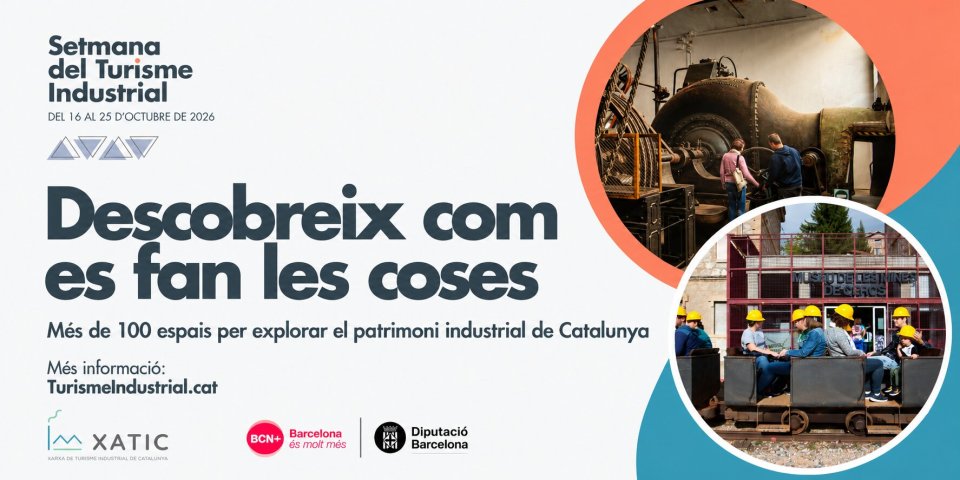
Catalonia Industrial Tourism Week 2026
From 16 to 25 OctoberSostibaix, the sustainable fortnight of Baix Llobregat
From 15 October to 1 November'La Moguda Gastronòmica' in Santa Perpètua de Mogoda
From 9 October to 8 NovemberPanoràmic Festival in Granollers, Barcelona, Terrassa and Vic
From 15 October to 27 DecemberThe Castañera in La Pedrera!
17 OctoberEfímera in Santa Perpètua de Mogoda
17 OctoberScenic programming in Gelida
17 October
News
Iron architecture: the light and steam of industrial Catalonia
In the 19th century, the Industrial Revolution not only changed the way people worked and lived, but also profoundly transformed architecture. The arrival of new materials, such as cast iron, wrought iron, and glass, opened up possibilities…
Gothic Architecture: The light and height of medieval Catalonia
Gothic architecture marks a turning point in the history of Catalonia. It was the style that transformed cities, places of worship, and the way people built collectively. A style that changed not only the stone itself, but also the way people…








 Sustainable turism
 Biosphere