


Museu Egipci de Barcelona
Municipalities
The Egyptian Museum of Barcelona is one of the most important private collections of Egyptian art and culture in Europe and an entity committed to research, study and dissemination of Ancient Egypt.
The Egyptian Museum of Barcelona includes more than 2,000 m2 of gallery space displaying almost a thousand pieces, including sarcophagi, mummies, jewelry and amulets, to provide visitors with a greater understanding of daily life and the prevailing customs of the ancient civilization of the pharaohs.
The Museum has three rooms of museum space: two house the permanent collection and another the temporary exhibitions.
In all these spaces , the elimination of physical barriers that hinder access and/or circulation through the different areas has been a priority. There is an elevator to access the different levels of the Museum and there is a visit script and a large number of tactile accessories that make it possible to offer a didactically valid product for blind people.
Introducing boys and girls to the knowledge of the ancient Egyptian civilization has been one of our priority milestones; That is why we offer a complete Educational Program aimed at infant, primary and secondary schools.
Under the name "Discovering Ancient Egypt", an educational program is offered that combines guided tours of the museum rooms with different complementary activities where students have the opportunity to learn, reinforce and deepen the contents of the museum space in a playful way., formative and very participative.
Schedules:
- From Monday to Friday, from 10:00 a.m. to 2:00 p.m. and from 4:00 p.m. to 7:30 p.m.
- Saturdays, from 10:00 a.m. to 3:00 p.m. and from 4:00 p.m. to 7:30 p.m.
- Sundays, from 10:00 a.m. to 2:00 p.m.
- Closed on January 1 and 6, December 25 and 26.
- Closed the afternoon of December 24 and 31.
Guided tours aimed at the general public and included in the ticket price on Saturdays at 11:00 a.m. (Catalan) and 5:00 p.m. (Spanish).
Nearby routes
From market to market in Barcelona
Barcelona
Barcelona's markets are filled with festive atmosphere of this time and offer their clients special moments that go beyond the purchase of an object. For this reason, since femTurisme, we encourage you to visit some of these venues in the city…
The Academy of the Distrustful
Barcelona, Els Hostalets de Pierola
During the early 18th century, the educated Catalan aristocracy organized themselves to defend and delve deeper into their history and culture. This was a common practice in other European cities, and in Barcelona, this institution was known,…
The cities of the dead, the most unique cemeteries in Catalonia
Arenys de Mar, Barcelona, Bausen, Olius, Portbou
Death is a defining aspect of human existence, and a stroll through a cemetery offers insight into how people understand and experience the end of life. These so-called cities of the dead are often unfamiliar and solitary spaces, far removed…
The coronelas and their battalions in 1714
Barcelona, Tortosa
The defending army Austrian faction that fought during the War of Succession was formed by different regiments. There were some who took orders from the coronelas of cities, being the most important, the Colonel of Barcelona. Coronelas These…
Gaudí's Modernism Route
Barcelona
Modernism, the Catalan form of Art Nouveau, had Antoni Gaudí as the main representative of this style in Barcelona. On this route we will review the emblematic places of this great architect in Barcelona and the not so well known but…
Barcelona's defenders guilds in 1714 (Part I)
Barcelona
The defense of the city of Barcelona during the Bourbon's 1714 was not only carried out by the army and the military, but the people of the city that had other professions, aside to support the Austrian cause. This is the case of artisans,…
Events
Catalonia Industrial Tourism Week 2026
From 16 to 25 OctoberSostibaix, the sustainable fortnight of Baix Llobregat
From 15 October to 1 November'La Moguda Gastronòmica' in Santa Perpètua de Mogoda
From 9 October to 8 NovemberPanoràmic Festival in Granollers, Barcelona, Terrassa and Vic
From 15 October to 27 DecemberThe Castañera in La Pedrera!
17 OctoberEfímera in Santa Perpètua de Mogoda
17 OctoberScenic programming in Gelida
17 October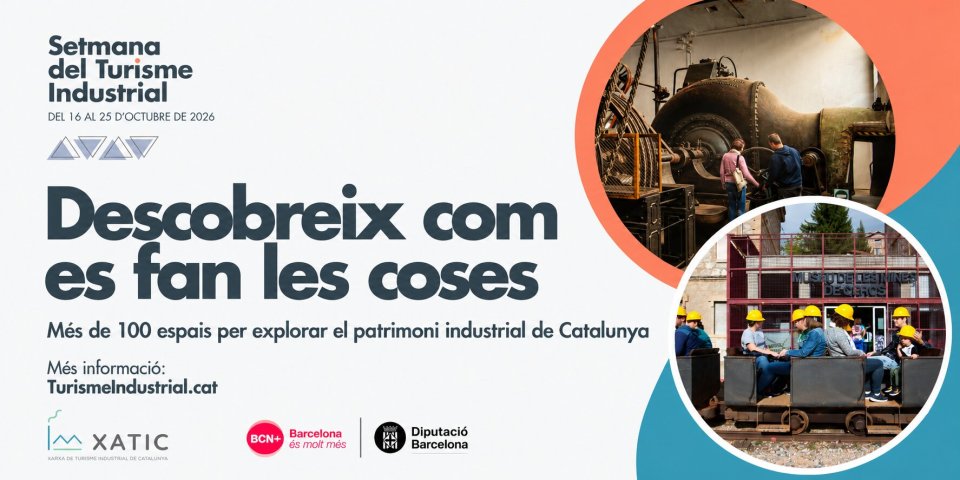
News
Iron architecture: the light and steam of industrial Catalonia
In the 19th century, the Industrial Revolution not only changed the way people worked and lived, but also profoundly transformed architecture. The arrival of new materials, such as cast iron, wrought iron, and glass, opened up possibilities…
Gothic Architecture: The light and height of medieval Catalonia
Gothic architecture marks a turning point in the history of Catalonia. It was the style that transformed cities, places of worship, and the way people built collectively. A style that changed not only the stone itself, but also the way people…








 Sustainable turism
 Biosphere