


Berga
Berga, the capital of Berguedà, is a city surrounded by nature, tradition, and mountain landscapes. Located at the foot of the Queralt mountain range and opening onto the Llobregat valley, it is an ideal starting point for discovering the region's attractions throughout the year, from hiking and excursions to ski trips.
Well-connected and a short distance from Barcelona, Berga combines the charm of a mountain town with a vibrant cultural life. Its main attraction is La Patum, a centuries-old celebration linked to Corpus Christi that transforms the town's streets and squares into an explosion of fire, music, and tradition each year.
History
The origins of Berga date back to ancient times, and the city has been linked to the possible Castrum Bergium mentioned by the Roman historian Livy. During the 8th century, the territory of Berguedà came under Muslim rule, until in the 9th century it became part of the County of la Cerdanya.
Over time, Berga became the center of its own county. In 1117, after the death without issue of Count Bernat Guillem, the County of Berga was definitively incorporated into the County of Barcelona under Ramon Berenguer III. During the Middle Ages, the town grew and consolidated itself as an important center of communications and commercial activity, although it suffered difficult periods such as the Black Death of 1347.
The following centuries were also marked by conflicts and transformations. Berga was occupied by French troops between 1654 and 1655 and, during the War of the Spanish Succession, supported Philip V. In the 19th century, the city suffered a serious cholera epidemic in 1854.
Over the years, Berga consolidated itself as the administrative, commercial and cultural capital of Berguedà.
The Patum
La Patum is Berga's most emblematic festival and one of the great symbols of Catalan popular culture. Celebrated annually to coincide with Corpus Christi, it transforms the streets, and especially Plaça de Sant Pere, into a vibrant spectacle of fire, music, dance, and tradition for several days. In 2005, it was recognized by UNESCO as an Intangible Cultural Heritage of Humanity.
Its origins are linked to the ancient medieval Corpus Christi celebrations. Over time, the religious reenactments that formed part of the procession acquired a more popular and festive character, eventually giving rise to the celebration we know today. In Berga, the Corpus Christi festival has been documented since at least 1454.
The Patum is celebrated from Wednesday to Sunday of Corpus Christi and combines different events, such as the past, the Patum of shining, the complete Patum and the Patum for children. Among its best-known troupes we find the Tabal, the Turcs i Cavallets, the Maces, the Àngels, the Guites, the Àliga, the Nans, the Gegants and the Plens.
One of the most spectacular moments is the Plens jump, when the square is filled with fire and hundreds of rockets light up the night, while the Tirabols put the end to the festival with a collective dance in which troupes and the public share the square.
More than a festival, La Patum is an experience deeply rooted in the identity of Berga, passed down from generation to generation and capable of turning the city, every Corpus Christi, into one of the great meeting points of Catalan popular culture.
Places of interest
Sanctuary of Santa Maria de Queralt
Located atop the Queralt mountain range, at an altitude of approximately 1,200 meters, the sanctuary is one of Berga's most emblematic landmarks. Its privileged location, with magnificent panoramic views over the city, the Berguedà region, and much of central Catalonia, has earned it the nickname "Balcony of Catalonia."
The complex comprises the sanctuary, where the Mare de Déu de Queralt is venerated, and the former guesthouse. The site may correspond to the area once occupied by the castle of Guillem de Berguedà. Nearby, one can also find the cave of Sant Ignasi and various paths and chapels linked to the pilgrimage tradition.
Queralt is also an excellent starting point for exploring the natural surroundings of Berga. It can be reached by road or on foot from the city center, following the old Queralt path, a traditional route that passes several chapels before arriving at the sanctuary. Long-distance trails such as the Camí dels Bons Homes (GR 107) also pass through this area.
Sant Pere Square
Sant Pere Square is the historic heart of Berga and one of the city's most emblematic spaces. Of medieval origin, it is best known as the main stage for La Patum during the Corpus Christi festivities. The square is dominated by the parish church of Santa Eulàlia, built from 1671 onwards in a classicist Baroque style, and by the Town Hall, inaugurated in 1930.
Sant Ferran Castle or Berga Castle
Located at the highest point of the old town, Sant Ferran Castle occupies a site inhabited since Iberian times and likely linked to the origins of Berga. Between the 16th and 18th centuries, it became an important fortress and played a prominent role during the Carlist Wars. It is currently protected as a Cultural Asset of National Interest.
Pedret Bridge
The Pedret Bridge is one of the most unique heritage sites in the Berga area. Documented since 1286, it is a medieval bridge that crosses the Llobregat River with its characteristic humpback shape. It consists of four arches of unequal dimensions and provides the natural access to the well-known church of Sant Quirze de Pedret.
Main street
Calle Mayor, officially Calle de la Ciutat, is one of the main thoroughfares of Berga's old town. Of medieval origin, for centuries it housed the residences of nobles, merchants, notaries, and other prominent figures of the town. The current paving, inaugurated in 1976, incorporates motifs inspired by La Patum.
Portal of Saint Magdalene
The Portal de Santa Magdalena is the only remaining gate from the late Middle Ages in the old walled town of Berga. Located in the northeastern part of the town, it connected to the old royal road that led to Bagà and Ripoll. Its name comes from an old chapel dedicated to Saint Mary Magdalene located near this site.
Walls and bastion of Sant Carles
In this area, fragments of the old walls of Berga can still be seen, built in 1375 as part of the fortification of the Catalan royal towns promoted by Peter III. The remains of the Sant Carles bastion are also preserved, an 18th-century fortification that had artillery batteries, a guardhouse, and a dungeon.
Trencacames and walls
The Trencacames is an old, steep path that connected the town with the castles of Berga and Queralt. Along the route, fragments of the old walls and the characteristic callissots —narrow passages between the walls that defined the orchards of the medieval and modern town—can still be seen.
Voltes d'en Claris
The Voltes d'en Claris, in a place popularly known as La Berruga, are part of one of the most historic corners of the old town. This area was once part of Berga's Jewish quarter, documented since the late 13th century. At the beginning of the 14th century, the quarter expanded with the so-called Call Nou, and there are indications that point to the possible existence of a synagogue.
Sant Joan Square
Sant Joan Square is another of Berga's important historical spaces. Its name is linked to the church and convent that the friars of the Hospital of Sant Joan began to build in 1220. The church retains part of its medieval past despite the various transformations it has undergone over the centuries.
Pi de les Tres Branques
The Pi de les Tres Branques (Three-Branched Pine) is one of Catalonia's most famous and symbolic monumental trees. Located in the Pla de Campllong, it has traditionally been associated with the unity of the Catalan-speaking territories. It was declared a monumental tree in 1987, and every third Sunday in July, its surroundings host a traditional gathering.
Blancafort Castle
The ruins of Blancafort Castle stand at an altitude of approximately 1,176 meters, in a privileged location within the Blancafort mountain range. Documented since 1174, it formed part of the territory's defensive system and allowed for visual communication with other fortifications in the area. Nearby, the remains of the old Romanesque church of Sant Miquel are also preserved.
Old Hospital and Mural of La Patum
This building had housed the Hospital of Sant Bernabé, founded at the beginning of the 14th century as a hospital for the poor and used as a health center until 1981. On the facade, the Mural of La Patum stands out, a large ceramic work by Joan Casas i Ortínez installed in 1992 and dedicated to the troupes and figures of the festival.
Plaza de les Fonts
Plaça de les Fonts is one of the characteristic corners of the old town. At its center stands a fountain with the sculpture known as El nen de l'espina (The Boy with the Thorn). The square occupies the space where the Sallagossa or Barcelona gate once stood, one of the main entrances to the walled city of Berga.
Palau Peguera
The Palau Peguera is a stately building linked to the Peguera family, a noble family documented since the 12th century, and to the Saga family of Berga. Throughout its history, it has served as a county and royal palace, lodging for dignitaries, a casino, and a Carlist center. It is also popularly known as Cal Negre.
The Four Corners
Els Quatre Cantons is the popular name for the intersection of several streets in the historic center. At number 2 Carrer de la Ciutat stands a medieval building that, from the mid-14th century, housed the Town Council.
Fountains and park of Lledó
Covering approximately three hectares, Lledó Park is the largest urban park in Berga. It features gardens on different levels, fountains, plazas, a pond, and an open-air auditorium. It's an ideal place for a stroll and a relaxing break after visiting the historic center.
Torre de la Petita
The Torre de la Petita was built in 1838, during the height of the Carlist rule, and formed part of the fortress of Maria Luisa Fernanda. It served as a lookout and defensive outpost, and today it still retains the tower, part of the powder magazine, and some fragments of the perimeter wall of the old fort.
The Balma
La Balma is a unique structure that directly incorporates the vertical mountain face as part of its design. Its origins are believed to date back to the 9th century, making it an interesting example of ancient land use.
Molí de la Sal
The Molí de la Sal (Salt Mill) is one of the remnants of Berga's milling past. The lintel above the door dates the current building to 1651, although it is believed that the mill may have medieval origins. It is one of the oldest mills in the city for which documentary evidence exists.
Gratella and Brillant Mills
In the Pinsania area, several mills were concentrated, harnessing the water of the Metge stream through a channel documented since medieval times. The Gratella and Brillant mills serve as reminders of the importance of hydraulic power to Berga's economy.
Clock Tower
The Clock Tower is located in a historic area linked to the use of water from the Metge stream and the town's old mills. In medieval times, there was also a gateway to the town, and the name of the place suggests the former existence of a clock tower.
Tomàs Pujol House and Barons House
Located opposite each other on Carrer de la Ciutat, Casa Tomàs Pujol and Casa Barons are two interesting examples of Modernist architecture in Berga. Casa Tomàs Pujol, built in 1925, is notable for its exposed brick and colorful ceramic tiles, while Casa Barons, dating from 1904, features an attractive façade and wrought-iron balconies.
Martin's House
The Casa de Martín is a Modernist building designed in 1913 by the architect Ignasi Maria Colomer. The corner tower and the decorative elements of the façade are particularly noteworthy. It was the residence of the painter and writer Josep Maria de Martín, from Bergamo.
The Casino - Theatre
The Casino-Theater was inaugurated in 1913 by a private society. The building, designed by the architect Ignasi Maria Colomer, is one of the outstanding examples of early 20th-century urban architecture in Berga and has historically been linked to the city's cultural activity.
Cal Cuberes
Cal Cuberes is a building designed by the Bergamo-born architect Emili Porta. Its façade is notable for its balconies and windows, as well as the upper tower crowned by a compass rose. Vaulted spaces, formerly used as a wine cellar, are preserved in the basement.
The Valley
El Vall is an area linked to the growth of Berga outside the medieval center. The first suburbs were formed between the 16th and 17th centuries, and later the area was transformed to create spaces such as Viladomat Square and the Passeig de l'Indústria.
Maragall Square
Formerly known as Fonts de Dalt, Plaça Maragall preserves elements that recall the milling past of this area of Berga. Several mills once stood in the surrounding area, harnessing the water that flowed through this part of the city.
Lledó Washhouse
The Lledó Washhouse is a reminder of the importance that water once held in the daily life of Berga. The area around Lledó had been an important zone of orchards since medieval times, thanks to the abundance of water.
Washhouse on Pietat Street
The washhouse on Carrer de la Pietat is one of the old washhouses still preserved in Berga. Along with those in La Gratella and Lledó, it bears witness to the daily life of bygone eras, when these spaces were also important meeting points for the inhabitants.
Buxadé Street
Buxadé Street, formerly known as Canals Street, is named after Marcel·lí Buxadé, an engineer from Berga who spearheaded the construction of the Berga Industrial Canal in the 19th century. The textile workshop where Saint Anthony Mary Claret worked was also located on this street.
Calle dels Àngels
Carrer dels Àngels was formerly known as Carrer de les Fonts Fondes and, for part of the 19th century, Carrer del Golfo. It was also the scene of an episode in the Second Carlist War, when in 1848 the Carlist general Joan Castells i Rossell was seriously wounded.
Calle dels Banys
Carrer dels Banys is a steep street opened at the end of the 19th century to connect the Lledó area with Plaça de la Creu. Its name commemorates the old public baths that once stood in this part of the city.
Plaza Catalunya
Plaça Catalunya, inaugurated in 1987, is one of Berga's most modern urban spaces. At its center stands a monument with several reliefs depicting episodes from Catalan history.


Events
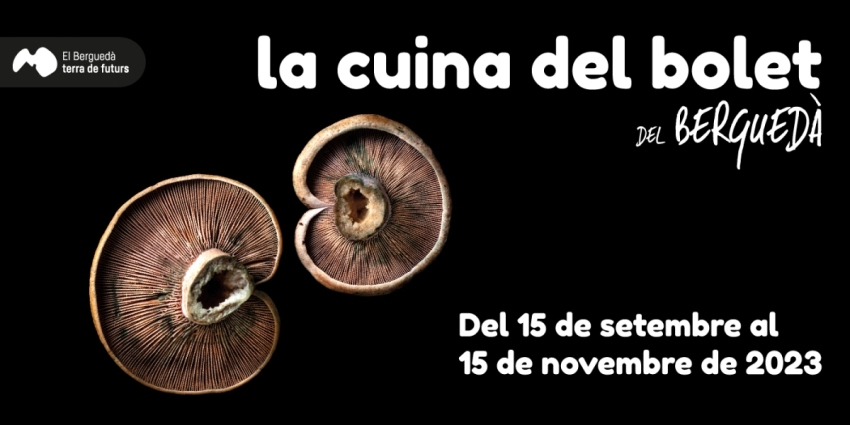
The Berguedà mushroom kitchen
From 18 September to 22 NovemberFeast of Sant Galderic de Avià
From 17 to 18 OctoberMushroom Festival in Guardiola de Berguedà
From 17 to 18 OctoberNovemberfest - The Hops and Craft Beer Festival of Avià
24 OctoberBerga Mushroom Festival
25 OctoberCycle of Healthy Walks in Guardiola de Berguedà
26 OctoberSaldes Craft Fair
31 OctoberSant Martí Fair in Puig-reig
From 7 to 8 NovemberReturn to La Maria, the Avià Mountain Race
From 14 to 15 NovemberThe Tractor Race in Casserres
28 NovemberGaming and Christmas Fair in Berga
6 DecemberNearby routes
The Romanesque in Alt Berguedà
Condal Pyrenees: a tour of the medieval Catalan identity
The Llobregat textile colonies by electric car, a world to discover
Looking for mushrooms in Berguedà and Solsonès
The Patum of Berga
The Way of the Cathars
Berga during the Civil War
Textil colonies in Berguedà
Picnic in Barcelona area
AviART: Art in the streets of Avià
News








 Sustainable turism
 Biosphere