


Els Pastorets de Berga
Municipalities
The Christmas story is brought to life here by shepherds from our own community: humble people. A people in sheepskin coats and berets, with their small daily struggles that embody the greatness and misery of our human condition: love, greed, friendship, and so on.
A slightly different Pastorets where angels and demons coexist with the small passions and migrated virtues of the different characters who live in well-known environments: Pedraforca, Queralt, the Fuente del Guiu, San Quirce de Pedret or the Portal de Santa Magdalena.
Since 1900
It was at Christmas 1900, when the Foment's own premises hosted the first performance in Berga of the Pastorets, a play entitled " The Cradle of Jesus" written by the Catalan author Frederic Soler ( Serafí Pitarra ). These Pastorets had premiered in Barcelona on December 23, 1891. Pitarra had conceived the character of Satan specifically for Enric Borràs, a great actor, who gave a truly remarkable performance, according to contemporary reviews. The play also stood out from the general mediocrity that characterized the genre in those years. Josep Coma, known as Andreu Borràs, director of the Foment's theater section, saw these Pastorets in Barcelona and convinced his fellow cast members to perform them in Berga. He entrusted the music to Ramon Reig, son of Torelló and nephew of the organist of Berga at that time.
"The Catalan sage"
Since 1900, the Pastorets have been performed in Berga without interruption, with the exception of the three Christmases during the war (1936-1939). From their inception, the Pastorets have boasted important figures among their actors, directors, and set designers. The list would be very long, but it is worth highlighting the figure of the second director the play had in our city, the poet and playwright Ramon Vinyes i Cluet, the Catalan scholar who was a friend of Nobel laureate Gabriel García Márquez.
Our organization has been responsible for this since 1958. It has been the result of the effort and enthusiasm of many people. Special mention must be made of the tenacity and determination of Daniel Tristán y Soler, who was the director and driving force behind AT La Farsa almost from our beginnings until his death in 2006. Without him, we wouldn't be where we are today. From there, the current project began, which was introduced to us and directed in its early years by Frederic Roda i Fàbregas, a good friend and a great expert on Pitarra's text.
The homemade Shepherds
The Shepherds of Berga, like all the others, have a biblical background. But they are neither a representation of a mystery play nor a biblical nativity scene. They are homely shepherds. A humble, domestic nativity scene. It is not the Jewish people who go to worship the Messiah, but our people. A people of sheepskin coats and berets with whom we all feel completely identified. And the action does not take place in the classic biblical settings, but in the most characteristic and representative places of our town: at the foot of the majestic Pedraforca, under the symbolic Three-Branched Pine, in front of the extraordinary church of San Quirze de Pedret, in the medieval Berguedeño square of Santa Magdalena, where Josep...
Carob beans
Today, the carob pods of Els Pastorets are one of the most anticipated Christmas traditions. Even in Serafín Pitarra 's original text, they constitute a biting critique of Barcelona at the time; of that Barcelona that was tearing down walls and growing towards the Eixample district at the end of the 19th century.
The premise is quite simple: Garrofa—as mayor—after returning from Hell with his assigned, and ultimately unsuccessful, mission to convince Satan to leave them alone, answers everyone's questions and explains what he's like, what he's seen, and what surprised him. This is the moment used to review local events and figures, both local and otherwise, with a particular fondness, of course, for politicians from Berguedà. This tradition continued even during the dictatorship, when the opportunity was seized to add a last-minute anecdote, thus circumventing the inevitable and inflexible censorship.
From 1973 to 2015, the text of the 44 poems recited in the Pastorets (Christmas pageants) was chosen through an open competition, with the winners announced at a dinner usually held a few days before Christmas. In 2022, this tradition was revived with the aim of revitalizing the literary competition and returning to its origins.
Winter Patum
These are our Shepherds. Little shepherds where we find, evidently, the theological struggle between angel and devil. However, parallel to this main action, we find other stories; small struggles that personify the virtues and vices of our human condition: greed, love… In our Shepherds, then, two different worlds coexist: the theological world of angels and demons and the less lofty world of men driven by petty passions and migrating virtues that personify them.
Father Josep Armengou i Feliu, a distinguished native of Berguedà, defined our Pastorets in the most accurate way possible. "The Pastorets of Berga," he said, "are our winter Patum, without the frenzy, of course, that comes with a street festival like our annual Corpus Christi celebration. The Pastorets are something more intimate and homey, as is fitting for winter celebrations."
Nearby routes
Textil colonies in Berguedà
Berga, Gironella, Puig-reig
On this route, from femturisme.cat, we invite you to visit an important part of our heritage: industrial colonies. Specifically this route focuses on textil colonies located along the Llobregat River came to be built up to 15 different textile…
Picnic in Barcelona area
Barcelona, Berga, Fogars de Montclús, Lluçà, Mataró
Has picnic gone? Catalonia has many designated areas and free use unknown to many of the citizens; You can find them in almost all populations, located in some really nice places of great architectural, scenic or historic interest. Today 5…
The Romanesque in Alt Berguedà
Berga, Borredà, Guardiola de Berguedà, La Pobla de Lillet, Sant Jaume de Frontanyà, Vilada
Alt Berguedà area is known for its natural environment: mountains, forests, mushrooms, etc., but this time we will look at us with new eyes. We will do a historical and artistic look is that this space also includes an important and…
Condal Pyrenees: a tour of the medieval Catalan identity
Berga, Besalú, Cardona, Castell de Mur, El Brull, Girona, Isona i Conca Dellà, La Guingueta d'Àneu, La Seu d'Urgell, La Vall de Boí, Ripoll, Sant Joan de les Abadesses, Seva
Condal Pyrenees route is the path of Catalan history, because it is not understood one without the other. He haunted medieval times when Catholics were struggling to halt the Muslim advance through the peninsula. This confrontation made the…
The Llobregat textile colonies by electric car, a world to discover
Berga, Gironella, Puig-reig
This route is designed to be done by electric vehicle, although it can be done with any other car. Along the route we will suggest municipalities that have charging points and places of interest to visit while we charge batteries. Electric…
Looking for mushrooms in Berguedà and Solsonès
Avià, Bagà, Berga, Capolat, Casserres, Castellar de n'Hug, Cercs, Gironella, Guardiola de Berguedà, L'Espunyola, La Pobla de Lillet, Olvan, Prats de Lluçanès, Puig-reig, Saldes, Sant Llorenç de Morunys, Solsona, Vilada
Mushroom hunting has become a national sport in its own way and we have to enjoy our forests. Go to look for mushrooms and is a general obsession, and this is great news because it means that citizens of this country appreciates and loves the…
Events
The Berguedà mushroom kitchen
From 18 September to 22 NovemberTest Festival in Navàs
17 OctoberFeast of Sant Galderic de Avià
From 17 to 18 OctoberMushroom Festival in Guardiola de Berguedà
From 17 to 18 OctoberNavàs Autumn Fair
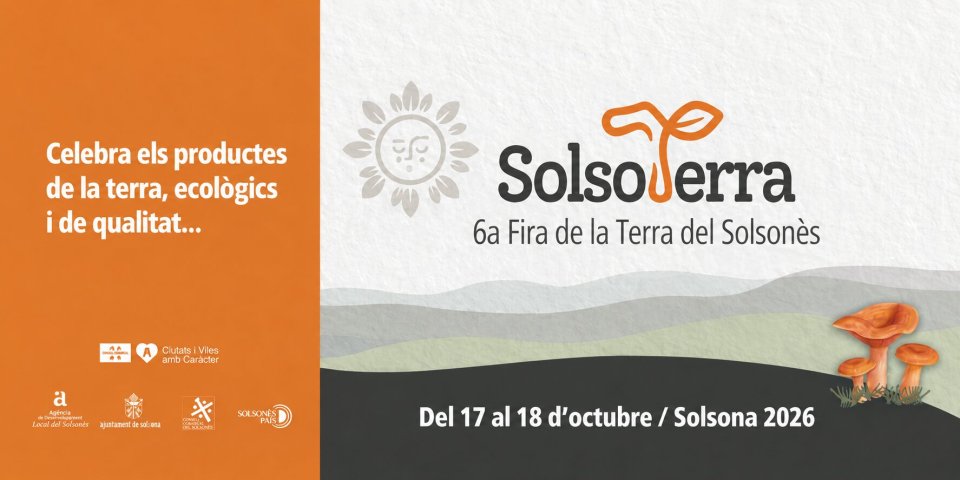
From 17 to 18 OctoberSolsonès Land Fair. Solsoterra
From 17 to 18 OctoberNovemberfest - The Hops and Craft Beer Festival of Avià
24 October
News
Gothic Architecture: The light and height of medieval Catalonia
Gothic architecture marks a turning point in the history of Catalonia. It was the style that transformed cities, places of worship, and the way people built collectively. A style that changed not only the stone itself, but also the way people…
Iron architecture: the light and steam of industrial Catalonia
In the 19th century, the Industrial Revolution not only changed the way people worked and lived, but also profoundly transformed architecture. The arrival of new materials, such as cast iron, wrought iron, and glass, opened up possibilities…








 Sustainable turism
 Biosphere