


Aiguafreda
Within the area of the Montseny Natural Park, with a significant part of the municipality covered by lush pine and holm oak forests. Streams and springs bring visitors closer to riverside vegetation, with extensive poplar groves that change colour to dress each season in renewed light, in a landscape dotted with small architectural traces of the past.
Nature tourism
Aiguafreda, located between the Montseny Natural Park and the Cingles de Bertí (PEIN), is recognised as an essential starting point for lovers of nature and sport in Catalonia. Since the beginnings of the Centre Excursionista de Catalunya in the 19th century, Aiguafreda has been a key departure point for numerous expeditions and discoveries. Today, it offers an extensive network of trails that make it possible to explore a diverse environment close to Barcelona. Aiguafreda is a crossroads for several long-distance trails, such as the GR-2 and GR-5, and the starting point of emblematic routes such as the Matagalls-Montserrat and the Travessa del Montseny. In addition, from here visitors can discover outstanding places in Catalan hiking, such as the turó de Tagamanent, the mirador de la Trona and Puigfred, the highest point of the Cingles de Bertí.
Finally, its strategic location is reflected in its proximity to the regional capitals, half an hour from Barcelona and the beach, and just over an hour from the ski resorts of the Pyrenees.
Ramon Margalef Park
A 1000 m2 space, which had been unused until 2023, has been converted into a walking and leisure area. This transformation has benefited the community with the installation of benches and trees, providing a place of rest for the residents of the nearby care home for the elderly. The park, dedicated to the scientist Ramon Margalef, is located near the Riera de Martinet, where he carried out many of his studies on nature. Its three sculptures, "Fros, Silanis, Tirsi", donated by the artist Albert Cruells, form part of a collection that symbolises the effervescence of Mediterranean culture and blends with Margalef's scientific legacy, creating a symbiotic relationship between public space and naturalist research.
Avencó and Martinet valleys
The Martinet and Avencó valleys, located to the west of Montseny, are cut through by streams that give the valleys their names and serve as traditional entrances to the heart of the massif. Their ecological value, from riverside forests to the highest peaks, makes them places of natural interest. The Avencó valley, a space that has long been inhabited, and the more secluded Martinet valley offer a contrast that makes them well worth exploring. Aiguafreda, surrounded by these two valleys, becomes an ideal starting point for discovering them and for exploring Montseny in general.
Permanent Orienteering Circuit of Aiguafreda de Dalt
Created in 2013 on the initiative of Aiguafreda Town Council, it is a permanent circuit for practising orienteering. Made up of around fifteen fixed checkpoints, which are extended with additional mobile ones during races or competitions, it is ideal both for training and for organising walks and excursions following the checkpoints. The checkpoints are located in areas of natural or cultural interest, making it possible to discover emblematic places in the municipality and enjoy impressive landscapes. The maps for completing the circuit can be purchased at affordable prices at Aiguafreda Town Council, during weekday office hours; at the Tourist Information Office, at weekends; and at the Youth Information Service "El Punt", on weekday afternoons.
Cultural tourism
Prehistoric origins
The Dolmens of the Serra de l'Arca, dating from 2500-2000 BC, are prehistoric witnesses to the first communities in Aiguafreda.
Iberian, Roman and Early Medieval periods
Despite the lack of information about these periods, the presence of the Roman road of the Congost is an important indicator. Notable elements include the cave-crypt of Aiguafreda de Dalt and related archaeological finds.
The medieval origins of Aiguafreda
The consecration of the parish of Sant Martí in the year 898 marks the beginning of Aiguafreda's documented history. The church of Sant Martí d'Aiguafreda de Dalt and the Romanesque chapels of the Avencó valley bear witness to this period.
Urban and architectural evolution
The urban development of Aiguafreda was consolidated in the 19th century, with the relocation of the town centre to Les Ferreries. The construction of new infrastructure, such as the Ribes road and the railway, marked this evolution, with a significant impact on urban architecture. The farmhouses of the municipality can be reached via the GR-5 trail between Aiguafreda and El Brull.
The town centre of Aiguafreda
The town centre of Aiguafreda began to take shape in the 16th century, around the royal road from Barcelona to Vic. With the arrival of the train and the road in the 19th century, the neighbourhood of Les Ferreries became the main urban centre. From then on, it underwent significant urban development, with the construction of modernist villas and other architectural styles. Today, a signposted route makes it possible to explore Aiguafreda's old town, with a wide variety of shops offering services to visitors, many of them with a long history of serving the community.
The church of Santa Maria d'Aiguafreda
The parish church of Santa Maria is a modern building inaugurated in 1970 and consecrated by the Bishop of Vic, Ramon Masnou. Its construction was promoted by a parish committee and received strong popular support through campaigns and donations. Designed by the architecture studio of Joan Antoni Cendoya, the building follows the principles of the Modernist movement and the Second Vatican Council (1962-1965), combining materials and architectural solutions with theological discourse. It thus becomes a functional space full of symbolism.
Capital of mountain sports in Montseny
Aiguafreda's strategic location, surrounded by geographical diversity such as the Plana de Vic, the Cingles de Bertí and Montseny, makes it a perfect destination for lovers of mountain sports.
Interest in these sporting activities dates back to the first scientific hikers in the late 19th century, especially with the arrival of the railway.
The Cursa de Muntanya de la Vall del Congost mountain race, held in March, stands out among other events such as popular walks, crossings and mountain races.
Aiguafreda is an important connection point in the network of long-distance trails (GR-2 and GR-5).
Every weekend, more and more people set off from Aiguafreda to go on hiking or mountain biking excursions.
The municipality also offers a permanent circuit for orienteering races, starting at the monumental site of Aiguafreda de Dalt.
Events
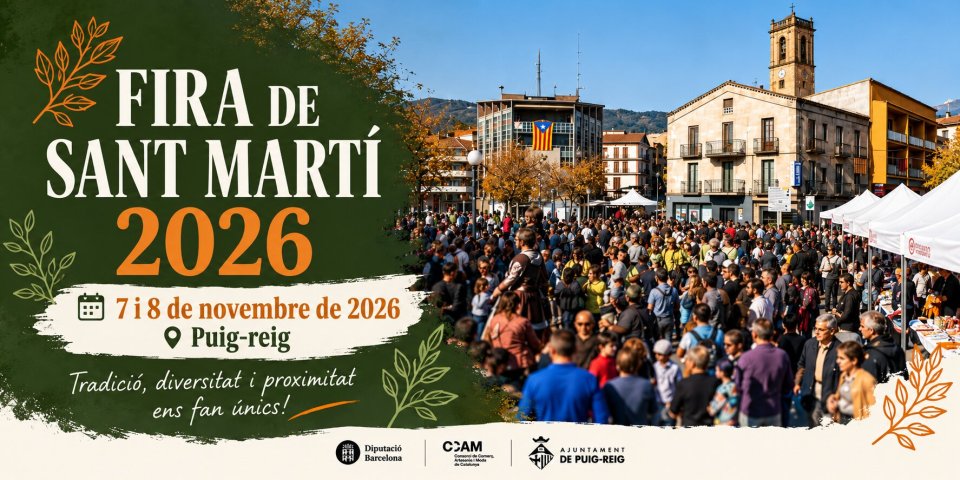
Montseny Autumn Fair
31 OctoberThe Witches' Dance of Viladrau
31 OctoberChestnut Festival in Sant Pere de Vilamajor
31 OctoberPopular chestnut tree in Sant Julià de Vilatorta
31 OctoberThe Houses and Streets of Fear in Sant Julià de Vilatorta
31 OctoberChestnut tree and Halloween in Lliçà d'Amunt
From 31 October to 1 NovemberMountain Fair in Vic
From 6 to 8 NovemberSecond-Hand and Antiques Market in Tona
7 NovemberNight of terror in Lliçà d'Amunt
7 NovemberMedieval Vilamagore in Sant Pere de Vilamajor
From 7 to 8 NovemberGuided Visit to the Church of Santa Eugènia de Berga
8 NovemberNearby routes
Tagamanent from the wells of Avencó de Aiguafreda
Path of the natural parks
The route of the 3 mountains
A walk up the hill of Tagamanent
Sanctuary of the Virgin of Help of Balenyà
Route through Santa María de Sauva Negra in Balenyà
Condal Pyrenees: a tour of the medieval Catalan identity
Route of the Iberians Ausetans
Route Forest of Casanoves - El Querol in Collsuspina
Route to the hermitage of Sant Cugat de Gavadons in Collsuspina









 Sustainable turism
 Biosphere