


Monestir de Sant Feliu de Guíxols
Municipalities
The Monastery of Sant Feliu de Guíxols, located in the heart of the municipality that gives it its name, is one of the heritage jewels of the Costa Brava. Its origins date back to the early 10th century, although the complex is built on remains from the Roman period. Among its most emblematic elements is the Porta Ferrada, a pre-Romanesque monumental structure that over time has become an iconic symbol of the city and a distinctive element of its urban landscape.
This Benedictine monastery complex is a vivid reflection of the architectural evolution over the centuries, with the presence of different styles ranging from pre-Romanesque to Baroque, the result of numerous extensions and renovations carried out until the 18th century.
Spirituality and defense
In addition to its religious function, the monastery also played an important defensive role. This is evident in the two Romanesque towers flanking the church façade: the Torre del Fum and the Torre del Corn. These structures allowed the population to be alerted to any danger by means of smoke signals or the sound of a sea bugle. This dual function demonstrates the strategic importance the building had in the urban and social structure of the time.
Already in the 10th century, and especially from the year 968, the monastery became the nerve centre around which the town of Sant Feliu de Guíxols began to grow and organise itself.
A cultural space full of life
Currently, the monastery complex houses the City History Museum and is part of the Rural Doctor's Space. Also noteworthy is the Abbot's Palace, home to the Carmen Thyssen Space 's temporary exhibitions. The tour allows you to discover unique spaces such as the Romanesque towers, the Porta Ferrada, the palace, and even the base of a Roman mausoleum integrated into the Torre del Fum, with spectacular views of the city and the sea.
During the visit, you will be able to enjoy both the building and its cultural contents. In addition, educational and family activities are organized that will bring you closer to monastic life and will allow you to discover the most hidden corners of the complex.
Nearby routes
Fair of Indians
Begur, Palafrugell, Sant Feliu de Guíxols
In the late sixteenth century to about the beginning of the twentieth century experienced significant movements of people crossing the Atlantic, embarking on a journey overseas, going to America to seek his fortune. These people are known today…
Path through the Capçana lock in Cassà de la Selva
Cassà de la Selva, Sant Feliu de Guíxols
Difficulty level: Easy Overall distance: 5.9km Starting point: Station It is an ideal route to do with the family in the hottest months. The Capçana or Verneda lock is a small reservoir that captured water from the Verneda stream to…
Route through the Romanesque of Empordà: Stone, wind and memory
El Port de la Selva, La Bisbal d'Empordà, Palau-Sator, Rabós, Roses, Sant Feliu de Guíxols, Santa Cristina d'Aro, Ullastret, Vilabertran
When we think of the Empordà region, coastal landscapes, charming villages, and figures like Dalí and Josep Pla often come to mind. But beyond that, there's a heritage that stands the test of time almost silently: the Romanesque…
Garden route on the Costa Brava
Blanes, Lloret de Mar, Sant Feliu de Guíxols, Tossa de Mar
This itinerary covers magnificent floral and landscape gardens on the Mediterranean coast located on the Costa Brava. You will discover viewpoints and balconies that offer spectacular views of the sea. Can you come with us?
Carrilet II adapted route: from Girona to Sant Feliu de Guíxols
Cassà de la Selva, Castell - Platja d'Aro, Girona, Llagostera, Llambilles, Quart, Sant Feliu de Guíxols
With almost 40 kilometers in total and a constant gentle slope from Girona to Sant Feliu de Guíxols, the Ruta del Carrilet transports us from the capital of Gironès to the Baix Empordà following what were once the tracks…
Coves and beaches of Sant Feliu de Guixols
Sant Feliu de Guíxols
Sant Feliu de Guixols has many coves and beaches of outstanding features, among which are the Bay of Sant Feliu and Sant Pol beach, with its bathing huts features. They are beaches to live them: where you will enjoy bathing and sun, we invite…
Events
Xavier Miserachs Photography Biennial in Palafrugell
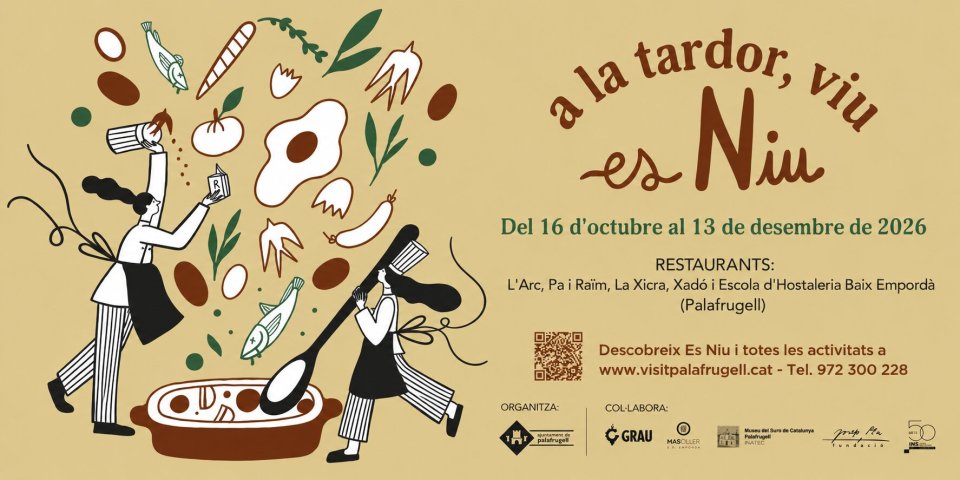
From 2 August to 18 OctoberGastronomic days "Es Niu" in Palafrugell
From 16 October to 13 DecemberGuided walking tour through Tossa historic centre in English
17 OctoberAutumn Theater Season in Caldes de Malavella
17 OctoberGuided visit to Confluencia de la Tordera and the Santa Coloma stream
18 OctoberSant Narcís Fairs in Girona 2026
From 23 October to 1 NovemberSant Narcís castle day in Girona
25 OctoberNews
Gothic Architecture: The light and height of medieval Catalonia
Gothic architecture marks a turning point in the history of Catalonia. It was the style that transformed cities, places of worship, and the way people built collectively. A style that changed not only the stone itself, but also the way people…
Iron architecture: the light and steam of industrial Catalonia
In the 19th century, the Industrial Revolution not only changed the way people worked and lived, but also profoundly transformed architecture. The arrival of new materials, such as cast iron, wrought iron, and glass, opened up possibilities…








 Sustainable turism
 Biosphere