


Sant Feliu Sasserra Witches' Fair: a journey into the darkest past of Lluçanès
When All Saints' Day arrives, Sant Feliu Sasserra takes on a different appearance. The streets of the old town fill with characters, stalls, music and theatrical performances, and for a few hours this small town in the Lluçanès symbolically returns to the 17th century. This is no ordinary re-enactment: behind the Sant Feliu Sasserra Witches' Fair lies a real history of persecution, trials and women unjustly condemned.
The main event takes place every year on 1 November, while the previous evening, 31 October, is when the Fes-ta Bruixa takes place. In 2026, the Fair will once again be held on 1 November, turning the town into a vast open-air stage.
Street theatre, crafts, dance, music and characters inspired by witchcraft folklore come together throughout the day. But the celebration also has a much deeper purpose: to recover the memory of women who, centuries ago, were accused of witchcraft in a climate of fear, superstition and social conflict.
A fair rooted in a true story
To understand this celebration, we need to go back some four hundred years.
In the early 17th century, Catalonia experienced intense persecution of women accused of witchcraft. Sant Feliu Sasserra held considerable administrative importance at the time, as it was the seat of the court of the Lluçanès subvegueria, a historical administrative district. This meant that trials for ordinary crimes were held there, alongside proceedings against women labelled as witches.
Surviving records shed light on some of these events. Between 1618 and 1648, twenty-three women accused of witchcraft were tried in Sant Feliu Sasserra, six of whom were hanged. The ordinary courts, rather than the Inquisition, played a decisive role in these proceedings in the Lluçanès.
One of the figures who appears in this history is Cosme Soler, known as Tarragó, who acted as a witch-finder. In 1618, he identified several local women as alleged witches, including Felipa Gallifa, Marquesa Vila and Montserrat Fàbregas, known as la Graciana. These accusations set in motion proceedings that we now know fell far short of any standard of due process.
The persecution must be understood in the context of a society shaped by superstition, social tensions and the need to find someone to blame for everyday misfortunes. Women who prepared remedies, healers or simply people in vulnerable circumstances could become targets of suspicion.
Today's Witches' Fair seeks precisely to reclaim this memory. Rather than glorifying the persecution, it remembers its victims and turns tragic episodes from the past into a way of learning about the area's history.
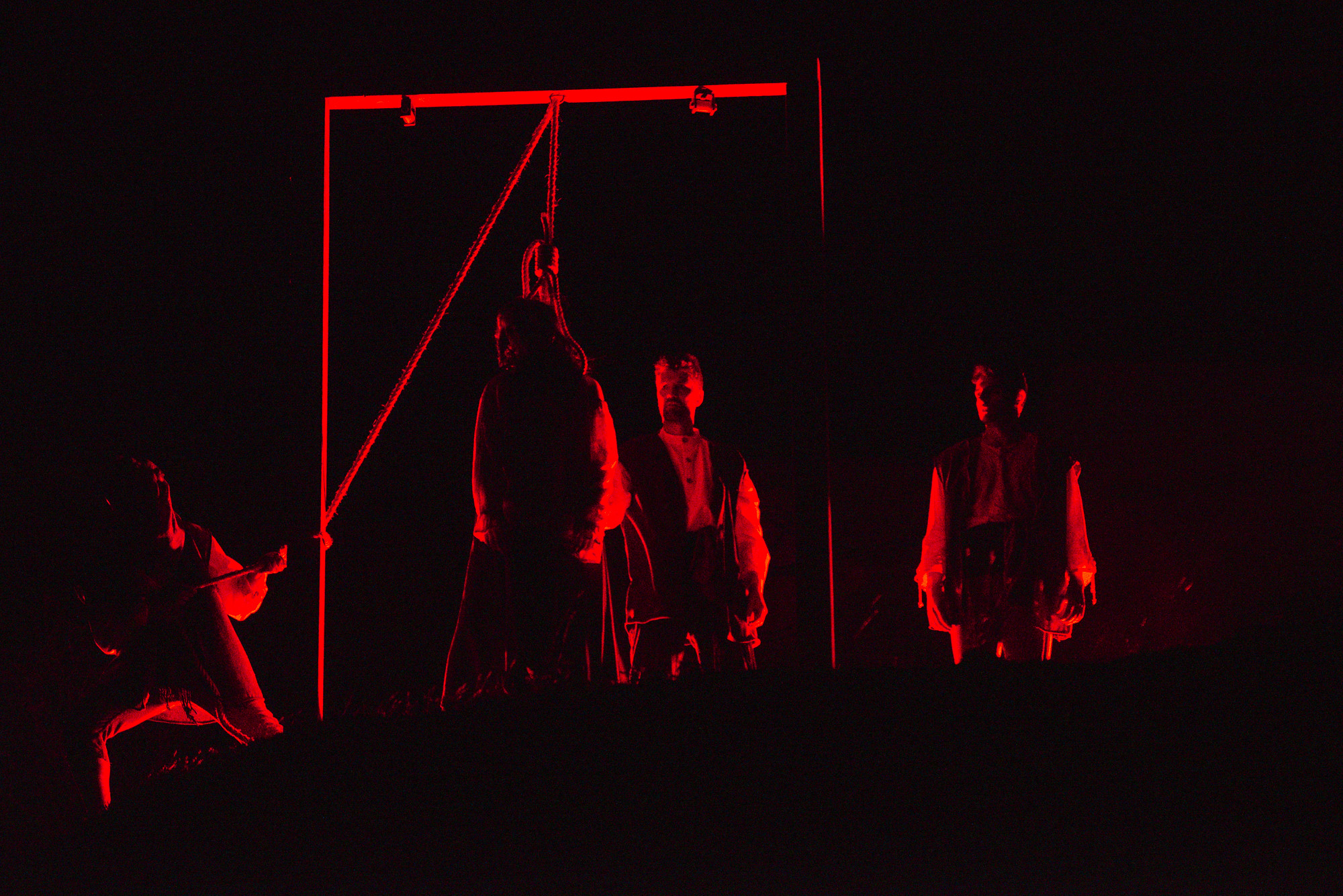
An entire town transformed into a stage
The Witches' Fair has been held in Sant Feliu Sasserra since 2000 and, over time, has become one of the town's most distinctive events. The involvement of local residents has played a major part: theatrical performances, dances and activities have been passed down from one generation to the next, making the celebration part of the local cultural heritage.
On All Saints' Day, a walk through the old town brings encounters with craftspeople, costumed characters, music and scenes that evoke life in the 17th century.
The theatrical performances are one of the main features of the day. Each edition builds a story around persecution for witchcraft, transporting audiences to the rural society of the time. The story unfolds in different locations around the town, so visitors cease to be mere spectators sitting in front of a stage and instead move through the very setting where the historical events took place.
The market also helps create the atmosphere. Crafts, local products, medicinal herbs and items associated with witchcraft folklore fill the streets, while different characters interact with visitors.
One of the most symbolic moments is connected with the Serrat de les Forques, on the edge of town. Its name, meaning “Gallows Ridge”, already hints at its past: it was the site associated with the execution of people condemned by the court. Tradition also places the execution of Maria Pujol, known as la Napa, at this spot in 1767.
In this way, the town itself becomes part of the story.
The Fes-ta Bruixa, a magical eve
The celebration begins before the main day.
On the night of 31 October, Sant Feliu Sasserra hosts the Fes-ta Bruixa, organised by the Associació Cultural Q-FOIS. This event combines performing arts disciplines and offers a more contemporary and provocative interpretation of stories connected with witchcraft.
In a way, it is the gateway to a weekend in which history, folk culture and performance constantly intertwine.
The following day, in daylight, the Fair takes over with a more family-oriented programme. The combination of performances, market stalls and historical atmosphere offers different ways to explore this episode in history.
A visit that can continue all year round
Sant Feliu Sasserra's connection with the history of witchcraft does not end on 1 November.
The town is home to the Witchcraft Interpretation Centre, a space dedicated to explaining folk beliefs, customs and, above all, the persecution suffered by many women during the 16th and 17th centuries.
The exhibition combines explanations with audiovisual resources, exploring both witchcraft folklore and the harsher reality of trials, torture and sentences. One option allows visitors to complete the experience with a tour of the town that reaches the Serrat de les Forques.
It is a good option for anyone wishing to explore the history in greater depth after experiencing the Fair, as well as for those who want to discover this heritage at any other time of year.
Much more than witches, broomsticks and potions
Magic, legends and traditional witch imagery make the Fair visually appealing. But focusing only on this aspect would mean missing much of its significance.
Behind every re-enacted trial and every story lies the memory of a phenomenon that had very real consequences. The celebration turns this memory into folk culture, allowing it to be shared with new generations while still embracing performance, music and entertainment.
Perhaps this is why the Witches' Fair has become so firmly established in Sant Feliu Sasserra. It is not a celebration that could take place just anywhere: it is deeply rooted in the place where it is held, Sant Feliu Sasserra.
This 1 November, walking through its streets once again will also be a way of exploring a difficult chapter of our history. Among craftspeople, music, theatre and characters drawn from folklore, Sant Feliu Sasserra reminds us that behind the legends of witches were, first and foremost, real women of flesh and blood.
And that is, perhaps, the most important story the Fair tells.
Published by Youssef Haouriqui on 12 of october of 2026 at 08:01h
Events
Amateur Theatre Showcase in Sant Gregori
16 OctoberEuropean Heritage Days in Collbató
16 OctoberAlfaro Year in Sant Andreu de Llavaneres
16 OctoberZim Zam Cassà - Cassà de la Selva Urban Art Festival
From 16 to 17 OctoberRACC Costa Dorada Rally in Salou
From 16 to 17 OctoberFish and Rice Gastronomic Days
From 9 to 18 OctoberModernist Conferences in la Garriga
From 16 to 18 October
Experiences







 Sustainable turism
 Biosphere