


Castell Palau de la Bisbal d'Empordà
Municipalities
La Bisbal boasts numerous heritage treasures, including the wall of the parade ground of the Castle Palace, the Portal de la Riera, the Pont Vell, the Call (the old Jewish quarter), the churches of La Piedad and Santa Maria, the porticoed complex of Les Voltes, and the modernist building El Mundial.
The Castell-Palau of the Bishops of Girona is a prominent example of Catalan civil Romanesque architecture, dating from the 11th and 12th centuries. It is the city's most representative building and a true symbol for its inhabitants. Throughout its history, it has had a wide variety of uses and has been the scene of sieges and armed conflicts. At certain times, it even served as a prison, most recently during the Civil War and the postwar period.
Today, the Castell Palau is part of the Route of the Origins of Catalonia. An audiovisual presentation explains the clashes between feudal lords and vassals in medieval times, and the main floor can be explored with the help of unique virtual historical figures. From the upper terrace, and even more so from the tower, you can enjoy splendid views of the Empordà.
Itinerary through the Castell Palau
1. Inner courtyard
The castle is arranged around a small central courtyard connected to the two floors by a staircase. In this space, there was a well, built in the 11th century, which provided water in case of siege. It was covered over in the 15th century.
2. Stable room
In the past, it was used to house transport animals, especially horses and donkeys. Archaeology has uncovered the original floor, sloping for drainage, a feeding trough attached to the west wall, and a drinking trough. It currently houses an audiovisual presentation of the Catalan Pyrenees route entitled Tierra y sangre: la guerra feudal en el Empordà (Land and Blood: Feudal Warfare in the Empordà ).
3. Prison room and cellar
A plan from 1823 shows that this room was divided into two parts: a prison to the west and a cellar to the east. Excavations have confirmed this structure and brought to light several historical elements and remains, displayed in glass cases.
4. Wine press room
Originally a stable, it was used for wine production in the 18th century. The 14th-century wooden door above the arch that divides the space still remains. Excavations uncovered vats and a basin. In the 19th century, it was used as a fire station and notarial archive.
5. Punishment cell or dungeon
Located beneath the main staircase, this is the castle's oldest prison. Documented in the 11th century as "Lo canó."
6. Chapter House
Main space for meetings and solemn events, such as the bishop's receptions. The door lintels display the coats of arms of the bishops who owned the building. Smoke vents in the ceiling heat the space.
7. Main chamber
Small room connecting the chapter house with the dining room. It was probably the bishop's room. It contains a secret staircase leading to the terrace chapel.
8. Dining room
Banquet hall, probably with a long table and benches. The Romanesque windows are notable, providing plenty of natural light.
9. Chamber attached to the kitchen
A small room that connects the kitchen and dining room. It still has a wooden coffered ceiling that allowed for an upper floor and improved comfort. The 1329 inventory mentions beds, mattresses, and slats for prisoners.
10. Kitchen
It has a large Renaissance fireplace with the coat of arms of Bishop Francisco Arévalo de Zuazo, built in the 17th century.
11. Chamber attached to the chapter house
Originally part of the chapter house, it was separated in later renovations and ended up integrated into the jailers' house when the castle served as a prison.
12. Terrazzo
It offers sweeping views of the historic center and surrounding area. It retains battlements and loopholes for defense, as well as a machicolation above the main gate.
13. Chapel
Romanesque, dedicated to Sant Miquel, located below the double tower.
14. Hallway
From the chapel there is a corridor with stairs leading to the main chamber, allowing the bishop to get there without passing through the courtyard.
15. Master Tower
The castle's highest defensive point, with two levels. It was the last refuge in case of attack. Access is via an exterior staircase protected by a fortified gate. The walls end in battlements.
Nearby routes
Route through the Romanesque of Empordà: Stone, wind and memory
El Port de la Selva, La Bisbal d'Empordà, Palau-Sator, Rabós, Roses, Sant Feliu de Guíxols, Santa Cristina d'Aro, Ullastret, Vilabertran
When we think of the Empordà region, coastal landscapes, charming villages, and figures like Dalí and Josep Pla often come to mind. But beyond that, there's a heritage that stands the test of time almost silently: the Romanesque…
The Medieval architecture of the Empordà
Forallac, La Bisbal d'Empordà, Palau-Sator, Ullastret
The Baix Empordà region is a territory that, during the 8th century, was already part of the "brand" of the Carolingian empire against the Muslims, the so-called Old Catalonia. Therefore, it is logical that medieval architecture has…
Route through the stone villages of Girona
Besalú, Girona, Madremanya, Santa Pau, Torroella de Montgrí - L'Estartit
Since the beginning of civilization, stone has been a material used and present to make life easier for humans; We can remember how the Romans used this raw material to build their recreational spaces as the prehistoric ones, specifically during…
Route at the foot of the Gavarres in Madremanya
Madremanya
Join us through a pleasant and easy walk through the plain that surrounds the charming little village of Madremanya. The distance of the route is 7.5 km, with 103 meters of altitude difference. Let's go!
The Triangle Dalinià, following the genius footsteps using the electric car
Cadaqués, Figueres, La Pera
This route is designed to be done by electric vehicle, although it can be done with any other car. Along the route we will suggest municipalities that have charging points and places of interest to visit while we charge batteries. Electric…
The Dali Triangle
Cadaqués, Figueres, La Pera
The route offers you femturisme.cat is a tribute to a historical Catalan, international, rebel, maverick, eccentric, indiscreet, malicious ... and many other adjectives that describe him as a unique character that has marked the history of…
Events
Zim Zam Cassà - Cassà de la Selva Urban Art Festival
From 16 to 17 OctoberXavier Miserachs Photography Biennial in Palafrugell
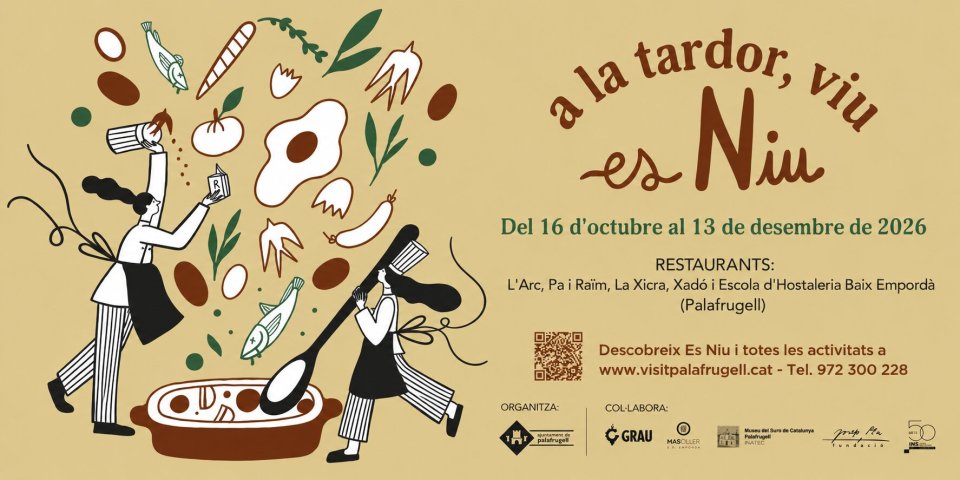
From 2 August to 18 OctoberGastronomic days "Es Niu" in Palafrugell
From 16 October to 13 DecemberAutumn Theater Season in Caldes de Malavella
17 OctoberGuided walking tour through Tossa historic centre in English
17 OctoberSant Narcís Fairs in Girona 2026
From 23 October to 1 NovemberSant Martirià Festival in Banyoles
From 24 to 26 October
News
Gothic Architecture: The light and height of medieval Catalonia
Gothic architecture marks a turning point in the history of Catalonia. It was the style that transformed cities, places of worship, and the way people built collectively. A style that changed not only the stone itself, but also the way people…
Iron architecture: the light and steam of industrial Catalonia
In the 19th century, the Industrial Revolution not only changed the way people worked and lived, but also profoundly transformed architecture. The arrival of new materials, such as cast iron, wrought iron, and glass, opened up possibilities…








 Sustainable turism
 Biosphere