


La Teva Ruta
Municipalities
La teva ruta is the name behind M. Carme Granados, a Tourist Guide authorized by the Generalitat of Catalonia. I offer guided tours of various monuments and towns in the Camp de Tarragona region. I also create themed, personalized routes and creative experiences for people who love the cultural heritage, landscapes, and gastronomy of the area.
Some of the routes you can do with me are:
Tarragona
Discover the World Heritage Archaeological Site, which will bring you closer to what was one of the great cities of the Roman Empire.
Check availability to schedule a date.
Reus
Vermouth and shops with history
Guided tour to discover the oldest shops in Reus. Includes two vermouth tastings.
- Summer schedule: Fridays at 5:30 pm in Catalan.
- Prices: €12.50 for ages 15 and up, and €7 for ages 8-14.
Family shopping trip to the historic stores
On this guided tour, we'll discover some of the most historic shops in the city of Reus. We'll use a 19th-century map and, together, we'll find the shops by following a series of clues.
- Summer schedule: July 3, 17 and 31; August 14 and 28. 11:00 in Catalan.
- Prices: €45 per family up to 4 members + €10 per extra member.
Reus Secret
We'll explore the history of Reus, explaining its buildings, people, and spaces through curiosities, anecdotes, facts, and little-known and surprising elements. The tour includes a visit to the Priory Church of Sant Pere, its bell tower, and the Vermouth Museum, where we'll enjoy a vermouth tasting with potatoes and olives.
- Schedule: 2nd and 4th Saturday of the month at 5:00 PM.
- Prices: €16/adults and €7/children (8-14 years).
Vermouth and cuisine in modernist Reus
We will discover modernist cuisine, the life and food of the workers and the bourgeoisie, their cafes, restaurants, shops, markets and food factories, the recipes of the time and the Vermouth of Reus.
- Schedule: 1st and 3rd Saturday of the month at 6:00 PM.
- Prices: €15/adults and €7/children (8-14 years).
Reus, Gaudí & Domènech i Montaner
We will visit the Gaudí Centre, an interpretation center dedicated to Gaudí's architecture and the Modernism of Reus. Following this, the route will take us to see the works of Domènech i Montaner: Casa Navàs, Casa Rull, and Casa Gasull (exteriors only), as well as learning about Gaudí's childhood.
- Check availability to schedule a date.
- Prices: €17.50/adults and €10/children (8-14 years).
Parc Samà (Cambrils)
We will explore this historic garden from the late 19th century with colonial flair, where we also find examples of local and exotic flora and fauna.
Check availability to schedule a date.
Other places to visit
You can also visit other emblematic places such as the Cistercian monasteries, Montblanc, the Priorat and Prades.
Activities for schools
Teva Ruta also offers guided tours for schools and colleges, adapting its content to the specific school group.
Guided tour of Roman Tarraco
A 2.5-hour tour of the main monuments of Roman Tarraco: the Archaeological Promenade, the Upper Forum, the Roman Circus, and the Amphitheater. The tour can also be combined with a visit to the Les Ferreres Aqueduct, located on the outskirts of the city, or other monuments in the area such as the Roman Villa of Els Munts in Altafulla or the El Mèdol Quarry.
The visit focuses on discovering the Roman past through urban planning and architecture, daily life, entertainment, Roman society, and the legacy that remains with us today.
The content is adapted to different levels for primary and secondary school groups.
Guided tour of modernist Reus
A 2.5-hour visit that includes the Gaudí Centre Reus and a walk through the main modernist buildings of the city.
The Gaudí Centre Reus is an interactive interpretation center with models and audiovisual displays that allow visitors to understand the genius of Gaudí's architecture. The center also offers an introduction to Reus's Modernist movement and Gaudí's connection to his city. The tour then explores the techniques and decorative themes typical of Modernism by observing the facades, while also learning about Modernist society, the socioeconomic changes, and the industrial transformation of the era.
Guided tour for secondary school groups.
Guided tour of the Santes Creus monastery
The visit will transport us back to the Middle Ages as we learn about society, the role of monasteries in the context of repopulation efforts, the daily life of the monks, and the Cistercian order. We will explore the monastery's structure, its different rooms, and the activities that took place within them. We will also discover the royal tombs of Peter the Great and James II, and learn about the surprising forensic studies that reveal various fascinating details about these royal burials.
The visit includes the audiovisual presentation "The World of the Cistercians".
The visit lasts approximately 1.5 hours. Suitable for primary and secondary school groups.
Guided tour of the Poblet Monastery and, optionally, the town of Montblanc
The visit will transport us back to the Middle Ages as we learn about society, the role of monasteries in the context of repopulation efforts, the daily life of the monks, and the Cistercian order. We will explore the monastery's structure, its different rooms, and the activities that took place within them. We will also see the royal tombs and discuss some of the kings buried there. Afterwards, and as an optional extra, we will visit Montblanc and its main monuments, such as the city walls, the Hospital of Santa Magdalena, the Church of Santa Maria, and the main square. We will discuss the various social classes, the function of each building, and the legend of Saint George, which is reenacted every year during Montblanc's Medieval Week festival.
The complete visit lasts approximately 3 hours. The visit is suitable for primary and secondary school groups.

Nearby routes
Route of Modernism in Reus
Reus
If you are of those that you love Art Nouveau architecture, a walk in Reus will leave you well satisfied! As you know, there are doubts about whether Antoni Gaudí was born in the capital of Lower Camp or in the nearby town of Riudoms.…
Boca de la Mina Route in Reus
Reus
The Boca de la Mina promenade is closely linked to the city's festive calendar and to the traditional customs of family leisure and festivals. Going on excursions, eating the mona at Easter, watching the sun rise over San Juan or on special…
Oil cycling route in Mont-roig del Camp
Cambrils, Mont-roig del Camp, Montbrió del Camp, Reus, Riudoms, Vilanova d'Escornalbou, Vinyols i els Arcs
This route runs through seven oil-producing towns; Reus, Riudoms, Montbrió del Camp, Vilanova d'Escornalbou, Mont-roig del Camp, Cambrils and Arcos. Take the bike we started pedaling!
Gaudí route in Reus
Reus
The big question when we talk about characters in the height of Antoni Gaudí is: the genius born or made? Surely there are more than enough arguments to defend either of the two approaches, although intuitively tend to believe that both…
3 routes through some of the most beautiful towns in Tarragona
L'Espluga de Francolí, Miravet, Pratdip, Riudoms, Siurana, Tivissa
With a privileged geographical location, Tarragona became a point of passage and settlement of different civilizations. In addition, it has an invaluable historical legacy, embodied in the unique towns that make up the province. Delving into…
Route through the historic center of Vila-seca
Vila-seca
Discover Vila-seca through its heritage. This is what this interesting route allows to travel through the historic center of the city, where you will know the points of interest of its cultural heritage. This itinerary can be visited freely…
Events
Santa Ursula Fair in Valls
From 16 to 25 OctoberGastronomic rice days in Mont-roig del Camp and Miami Platja
From 9 to 25 OctoberInternational Day of Rural Women race and walk in Riudecanyes
17 OctoberVent Fair of El Pla de Santa Maria
From 17 to 18 OctoberLes Garrigues Amateur Comic Theatre Showcase
From 17 to 18 OctoberFICVI - Vila-seca International Short Film Festival
From 17 to 25 OctoberFree guided tours of the Vila-seca Canal Mayor
18 October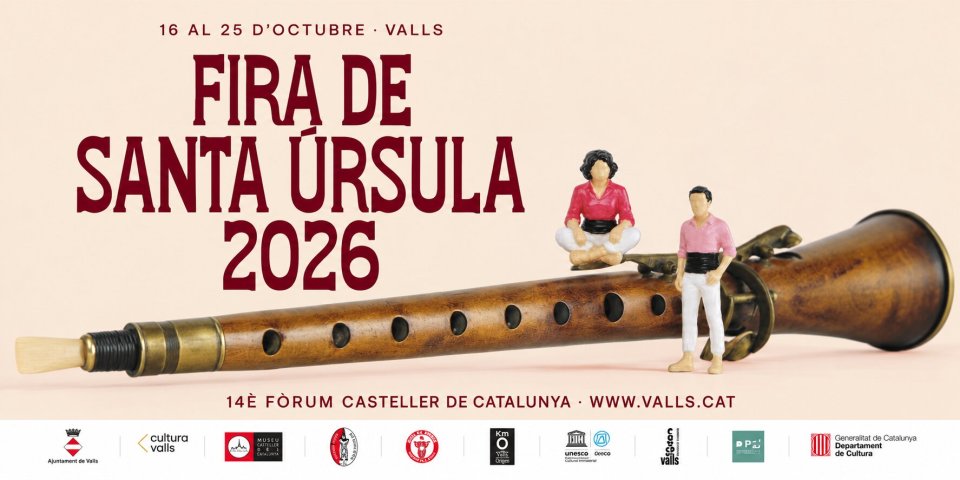
News
Gothic Architecture: The light and height of medieval Catalonia
Gothic architecture marks a turning point in the history of Catalonia. It was the style that transformed cities, places of worship, and the way people built collectively. A style that changed not only the stone itself, but also the way people…
Iron architecture: the light and steam of industrial Catalonia
In the 19th century, the Industrial Revolution not only changed the way people worked and lived, but also profoundly transformed architecture. The arrival of new materials, such as cast iron, wrought iron, and glass, opened up possibilities…








 Sustainable turism
 Biosphere