


Fundació Palau
Municipalities
Inaugurated in May 2003, the Palau Foundation aims to preserve, exhibit and disseminate the artistic and documentary collection of Josep Palau i Fabre.
Josep Palau i Fabre (Barcelona, 1917 – 2008) is considered one of the great figures of Catalan literature of our time. Thanks to his relationship with personalities such as Picasso, Artaud, Octavio Paz, Cocteau, Lorca, Alberti, etc., he connected Catalan culture with the most important artistic movements of the 20th century.
Poet, playwright, short story writer and essayist, he has been a scholar of art, and especially of the work of Pablo Picasso. He has dedicated more than twenty books (some translated into a dozen languages) to the analysis and commentary of the painter's work, culminating in four volumes of a monumental biography, with hundreds of illustrations, which has been translated into many languages.
The Palau Foundation displays the most important part of its art collection, while illustrating the life and intellectual career of Josep Palau i Fabre. It also houses an important documentary and bibliographic collection on Picasso, contemporary art and Catalan and French literature, open to the public. It also organises temporary exhibitions, educational activities and other cultural events around art and poetry, such as the Poesía y + festival with a range of shows around poetry (music, theatre, performances, etc.). The Foundation also publishes publications that are not limited to the publication of catalogues but also reissues of Palau i Fabre's work.
The permanent collection of the Palau Foundation is exhibited in two rooms: “A painter father and a poet son” and “Dear Picasso”.
Completely renovated in 2020, “A painter father and a poet son” brings together the collection of Josep Palau Oller, the father of Josep Palau i Fabre, who was a painter, art collector, furniture designer and decorator. Palau i Fabre completed the collection with works by artists such as Joaquim Torres-García, thus continuing his father's work. This room incorporates the testimony of Palau i Fabre's collaboration with artists such as Albert Ràfols Casamada or his relationship with painters such as Antoni Tàpies and Joan Ponç, and with the more recent Miquel Barceló and Perejaume.
Josep Palau i Fabre and Picasso had a relationship of admiration and, in the last years of the artist's life, of friendship. The “Dear Picasso” room contains the works of Picasso that Palau i Fabre collected with the idea of exhibiting them in his Foundation, as a tribute to the most important artist of the 20th century and as a testimony of their friendship.
This space permanently exhibits a very varied collection of Picasso's works from very diverse periods and styles, from the painter's beginnings at the Lonja school in Barcelona to the last years of his life.
The academic studies, the collection of graphic works and a small theatre that Picasso made for his daughter Maya are particularly noteworthy. Also on display are some books dedicated by Picasso that contain drawings.
Educational proposals
The Palau Foundation also offers an activity that consists of a visit to the Foundation and a route through the town of Caldes de Estrac led by the poets Josep Palau i Fabre, Jacint Verdaguer, Joan Maragall and Apel·les Mestres, poets who spent time in the municipality. We also have tourist packages that combine menus in restaurants, thermal baths and visits to the Foundation. We adapt to all types of public when it comes to visits to both the collection and the itineraries through the town.
Schedules
Check schedules on the Fundació Palau website www.fundaciopalau.cat/.
Nearby routes
Caldetes' literary route
Caldes d'Estrac
Have you been algunz time in Caldes d'Estrac and know its literary past? Did you know that Catalan artists, big name, spent some time in this town? And that, they inspired by the people,? Wrote and dedicated several works in Caldes? A literary…
Route of Catalan art in the 18th century
Arenys de Mar, Barcelona, Les Masies de Voltregà, Mataró, Sant Celoni
Since ancient times, know different ways of living, as well as ways to express and experience the artistic reactions of people. We can travel to the cave, where different types of pigments used to recall the hunt they had done that day or we…
A walk through Sinera, Salvador Espriu itinerary
Arenys de Mar
Sinera is one of the great literary myths in the work of Salvador Espriu. Sinera is a symbol of the lost paradise, of the happy world of the writer. And Sinera is also what Salvador Espriu called Arenys de Mar, a town to which he felt very…
Grand Tour de Catalunya - Section 5. From Surrealism to Modernism. From Figueres to Barcelona
Arenys de Mar, Barcelona, Begur, Blanes, Cadaqués, Caldes de Malavella, Canet de Mar, Figueres, Girona, L'Escala, Lloret de Mar, Manlleu, Mataró, Palafrugell, Palamós, Pals, Rupit i Pruit, Tossa de Mar, Vic, Viladrau
I want to do this route by electric vehicle! This route is designed to be done by electric vehicle, although it can be done with any other car. Along the route we will suggest municipalities that have charging points and places of interest…
The cities of the dead, the most unique cemeteries in Catalonia
Arenys de Mar, Barcelona, Bausen, Olius, Portbou
Death is a defining aspect of human existence, and a stroll through a cemetery offers insight into how people understand and experience the end of life. These so-called cities of the dead are often unfamiliar and solitary spaces, far removed…
Route for adventure parks in Catalonia
Arenys de Munt, Barcelona, Cerdanyola del Vallès, Dosrius, Esterri d'Àneu, Llívia, L’Esquirol, Mataró, Molló, Porrera, Prullans, Salou, Sant Hilari Sacalm, Santa Susanna
Jumping from one tree to another, fly like a bird, feel the air and caress the cheeks, seeing everything from above, feel that indescribable feeling of living a unique experience and realize that all this have only the possibility of repeating…
Events
Catalonia Industrial Tourism Week 2026
From 16 to 25 OctoberCalamarenys - Arenys de Mar Squid Gastronomic Days
From 9 October to 8 November'La Moguda Gastronòmica' in Santa Perpètua de Mogoda
From 9 October to 8 NovemberPanoràmic Festival in Granollers, Barcelona, Terrassa and Vic
From 15 October to 27 DecemberTransmaresme Bike
24 OctoberAutumn Festivalet in Santa Susanna
24 OctoberGuided tour of Hostalric Castle
24 October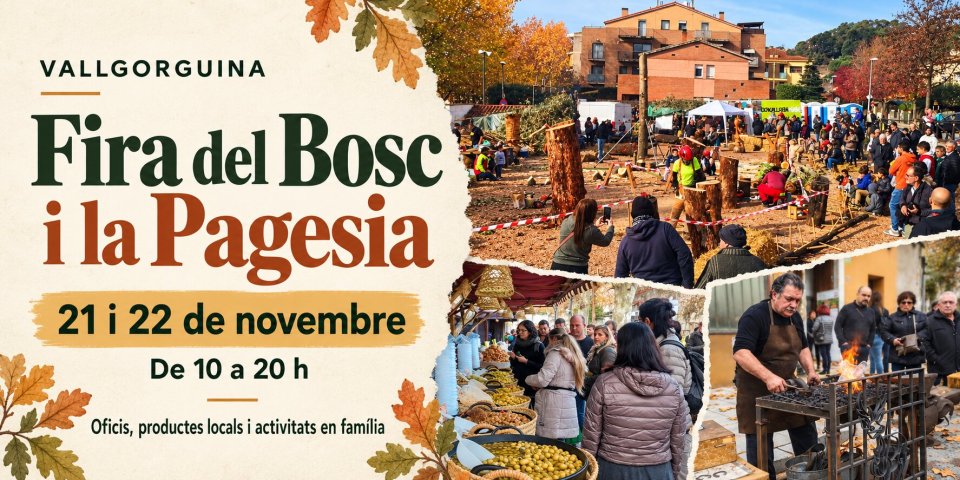
News
Iron architecture: the light and steam of industrial Catalonia
In the 19th century, the Industrial Revolution not only changed the way people worked and lived, but also profoundly transformed architecture. The arrival of new materials, such as cast iron, wrought iron, and glass, opened up possibilities…
Gothic Architecture: The light and height of medieval Catalonia
Gothic architecture marks a turning point in the history of Catalonia. It was the style that transformed cities, places of worship, and the way people built collectively. A style that changed not only the stone itself, but also the way people…







 Sustainable turism
 Biosphere