


Casa Museu Nuria Pla
Municipalities
The Nuria Plan house museum: from laboratory to museum of Baroque furniture
The Nuria Pla House Museum, located in the former Ravetllat-Pla Tuberculosis Research Institute in Barcelona, now houses one of the most unique collections of antique furniture in Spain. Thanks to the passion and dedication of Nuria Pla Monseny (1916-2011), this collection has become an invaluable vestige of Spanish furniture from the 16th to the 18th centuries. The diversity, quality of the pieces, and rarity of their typology reflect the owner's love for the history and craftsmanship of the Iberian Peninsula. But the house offers more than just furniture.
A rural estate considered a cultural asset of local interest
Around the 1920s, Dr. Ramon Pla Armengol (Lleida 1880 - Barcelona 1956), father of Nuria Pla, after years of research and the development of a theory together with the veterinarian Joaquim Ravetllat (1871-1923), had what would become his family residence, Rabillado-Plan, built.
Inspired by the traditional Catalan farmhouse, but also by the Noucentista movement, the house designed by architect Adolf Florensa (1889-1968) boasts two façades in completely different architectural styles due to its dual use until the late 1980s: as a family residence and also as a pharmaceutical laboratory. This laboratory produced antituberculosis reconstituting serums that were exported to more than 20 countries, allowing Nuria Pla to amass a considerable fortune which she later invested in her true passion: furniture collecting.
A tour of the Nuria Plan collection
Such was her passion that for over six decades , the collector personally amassed more than 800 objects through travels and visits to antique dealers. Her discerning eye and extensive knowledge allowed her to assemble a collection distinguished by the authenticity and excellent state of preservation of most of its pieces. The collection currently comprises Renaissance and Baroque pieces from the Spanish period, with a particular emphasis on traditional styles and furniture of both vernacular and more sophisticated character. Although the collection's initial aim was always to achieve a comprehensive representation of Spanish art, it eventually expanded to include a number of foreign pieces of equally extraordinary quality.
A legacy for the future
The Nuria Pla House Museum invites you to discover a different way of approaching art and culture. It does so through something as everyday and representative as furniture; because through materials, techniques, and decorations, we can find a reflection not only of tastes, but also of the values and ideals of past societies.
The house, managed by the Ramon Pla Armengol Foundation, houses not only Nuria Pla's collection of Spanish furniture, but also the space occupied by the pharmaceutical laboratory of her father, the doctor and researcher in infectious respiratory diseases, Ramón Pla Armengol.
Schedules and visits
Thursday and Saturday from 10:30 a.m. to 2:00 p.m.
Ground floor tours | 10:30 and 12:30
Includes a guided tour of the following spaces:
- The bloodletting room and the old laboratory.
- Four rooms with pieces of popular peninsular and Catalan furniture art from the 17th and 18th centuries.
- The open-plan room with luxury furniture and art pieces.
Visits on the first floor | 11:30 am
Includes a guided tour of the following spaces:
- The library of the former Institut Ravetllat-Pla with original furniture and instruments from that era.
- The office of Dr. Pla y Armengol.
- The rooms of the furniture art collection with peninsular and foreign pieces.
- The rooms with bargueños, cabinets and buffets, among other pieces.
Practical information
- To ensure your visit, it's best to book tickets in advance through our website.
- The tours are always accompanied and explained by a guide.
- Duration: Approx. 50 minutes
- Languages: Catalan/Spanish/English (on request).
- More information and reservations: [email protected] - 93 170 17 97.
- Private visits for groups (10 or more attendees): [email protected] - 93 170 17 97.
Don't miss it!
Nearby routes
After the Nova Planta laws
Barcelona, Girona, Lleida, Solsona, Tarragona, Tortosa, Vic
After a war there are always catastrophic: people killed, injured, destruction of buildings, etc. But we should not consider only tangible harm. Also keep in mind all that is not seen, but felt that over the years the catastrophe left clear…
Charming corners of Barcelona
Barcelona
Barcelona is presented to the traveler as a Mediterranean, multicultural and cosmopolitan city with an impressive historical and cultural heritage. Not in vain, every year it receives more than seven million tourists, making it one of the most…
Following the work of Puig i Cadafalch along the coast
Argentona, Barcelona, Canet de Mar, El Prat de Llobregat, Lloret de Mar, Mataró, Viladecans
The cultural movement of modernism made ??his mark in Catalonia and, unlike other artistic movements, presented a special dimension since spread throughout Catalonia and not just in big cities. At the time that was experienced and spread this…
Trying the 1714 food
Barcelona, Cardona, Cervera, Els Prats de Rei, La Seu d'Urgell, Lleida, Manresa, Moià, Sant Boi de Llobregat, Talamanca, Vic
The 1714 was a year that marked the Catalan region: culture, traditions, people and also gastronomy. This was important because it was the fuel that gave strength to the fighters of the battles. It gave them strength or weakened, the carrying…
May 18: International Museum Day in Barcelona
Barcelona, Cornellà de Llobregat
This time a very different route, a route that you will do yourself according to your interest! As you already know, May 18 is International Museum Day (organized by ICOM), which is why different activities are carried out (workshops, guided…
Route of Catalan art in the 18th century
Arenys de Mar, Barcelona, Les Masies de Voltregà, Mataró, Sant Celoni
Since ancient times, know different ways of living, as well as ways to express and experience the artistic reactions of people. We can travel to the cave, where different types of pigments used to recall the hunt they had done that day or we…
Events
Catalonia Industrial Tourism Week 2026
From 16 to 25 OctoberSostibaix, the sustainable fortnight of Baix Llobregat
From 15 October to 1 November'La Moguda Gastronòmica' in Santa Perpètua de Mogoda
From 9 October to 8 NovemberPanoràmic Festival in Granollers, Barcelona, Terrassa and Vic
From 15 October to 27 DecemberThe Castañera in La Pedrera!
17 OctoberEfímera in Santa Perpètua de Mogoda
17 OctoberScenic programming in Gelida
17 October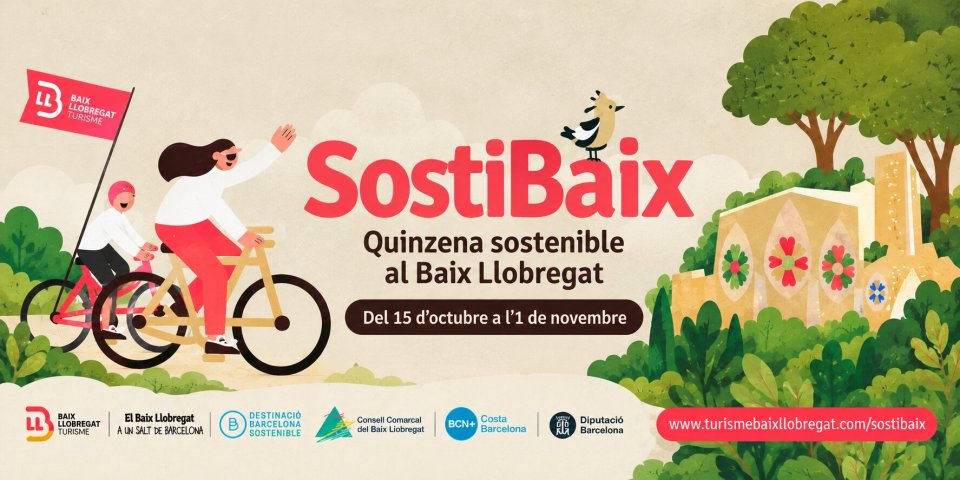
News
Iron architecture: the light and steam of industrial Catalonia
In the 19th century, the Industrial Revolution not only changed the way people worked and lived, but also profoundly transformed architecture. The arrival of new materials, such as cast iron, wrought iron, and glass, opened up possibilities…
Gothic Architecture: The light and height of medieval Catalonia
Gothic architecture marks a turning point in the history of Catalonia. It was the style that transformed cities, places of worship, and the way people built collectively. A style that changed not only the stone itself, but also the way people…








 Sustainable turism
 Biosphere