


Mont-Ras
Located in a privileged setting in the Baix Empordà region, Mont-ras is a town nestled between the plains, the mountains, and the sea. It preserves the essence of the Empordà villages: a gentle landscape, a history spanning millennia, a rich cultural life, and a welcoming population.
Its municipal area stretches from the foothills of the Gavarres mountains to the natural corridor that connects Palafrugell and Palamós. Among forests, fields, old farmhouses, and rural paths, the landscape unfolds until it meets the Mediterranean Sea along a stunningly unspoiled stretch of coastline.
A small town with a great history
The origins of Mont-ras date back to the Middle Ages. The town was formerly known as Torroella de Mont-ras, probably in reference to a settlement located in the mountainous area near the current town center.
The first known documentary mention dates from 1062, in an agreement between the Count of Barcelona and Dalmau Bernat de Peratallada related to Begur Castle. A few years later, in 1065, the name Torredela de Monte Raso appears in documents.
During the following centuries, the territory passed through the hands of various lords. In 1280 it belonged to Sibil·la de Palau, Viscountess of Bas, while later documents place the church of Mont-ras within the territory of Palafrugell Castle, under the dominion of the priory of Santa Ana of Barcelona.
Montras remained linked to the priors, who held the title of Barons of Palafrugell, until the abolition of the feudal system. Subsequently, it formed part of the municipality of Palafrugell until, in 1858, it achieved independence as a municipality.
From the Gavarres mountains to the most hidden coves
Montras occupies an area of 12.23 km² in a contact zone between three very different landscapes: the Empordà plain, the Gavarres mountains and the Costa Brava coastline.
The Aubi stream flows through and drains a large part of the territory, while the forests and mountainous terrain conceal evidence of significant mining activity. For many years, granite and minerals such as barite and galena were extracted in the municipality. Even today, old extraction shafts and mine entrances can still be found among the vegetation.
The area also has access to the sea through some of the wildest and most secluded corners of the Empordà coastline. Cala del Crit, Cala de la Font Morisca, and Cala del Vedell form a collection of stunning natural spaces, surrounded by cliffs, pine forests, and crystal-clear waters.
These are coves far from the major tourist centers, ideal for people looking for tranquility, nature and an authentic Costa Brava.
A heritage that explains the past
The territory of Mont-ras has been inhabited since ancient times. Roman-era remains have been found in different parts of the municipality, including fragments of amphorae, roof tiles, terra sigillata, and common pottery dating from between the 1st and 3rd centuries AD.
In the center of the village stands the parish church of Sant Esteve, built in 1599 on the site of an earlier temple. The building is primarily in the Late Gothic style, although it incorporates elements from other periods and architectural movements, such as the Neoclassical portal. It also retains a machicolation and part of the old gate.
Another characteristic element of the local heritage is the defensive towers that protected the farmhouses from pirate attacks. Among them, the Torre Simona stands out, a rectangular structure built with well-squared granite blocks. Dating from between the 14th and 15th centuries, it is considered one of the oldest and most architecturally significant towers in the Baix Empordà region.
Culture, traditions and community life
Montras is a dynamic municipality that has successfully combined its traditional identity with a forward-looking approach. Over the years, popular celebrations have been revived, new activities have been promoted, and support has been given to both long-standing organizations and newly formed associations.
Community life is particularly vibrant. The municipality boasts numerous organizations dedicated to nativity scene making and modeling, crafts, commerce, folk culture, sports, education, health, hunting, blood donation, and neighborhood associations.
This citizen involvement keeps the cultural calendar alive and helps to reinforce the friendly and welcoming character of Montras.
The flavors of Empordà
The gastronomy is another great reason to discover the town. Its location between the sea and the mountains allows you to enjoy the great diversity of products that define Empordà cuisine: fresh fish, meats, vegetables, herbs, and seasonal ingredients.
The restaurants in Mont-ras offer something for everyone, from traditional home cooking to creative and sophisticated dishes. You can also find international specialties, pizzas, grilled meats, and artisanal sweets.
This variety makes the municipality an interesting gastronomic stop to complete a day of nature, heritage and discovery of the territory.
The legend that gives its name to the cove of Crit
Among the popular stories of Mont-ras, the legend of the Cal Gall Peric farmhouse stands out, linked to the pirate raids that threatened the Empordà coast for centuries.
The story explains that a group of pirates, disoriented by the fog, took refuge in the cove of Font Morisca. As they were preparing to head back out to sea, they heard a rooster crow. The sound revealed the presence of a nearby house: the farmhouse of Cal Gall Peric.
A family with two daughters lived in the farmhouse. One of them, very beautiful, caught the eye of the pirate captain, who tried to take her aboard his ship. The young woman resisted with all her might and bit his finger. Enraged, the pirate killed her with a blow of his sword.
According to legend, the girl's scream was so loud it could be heard from afar. From that moment on, the place where the events occurred became known as Cala del Crit (Cry Cove).
Mont-ras, an Empordà to discover
Mont-ras is history, landscape, and the Mediterranean. It's a town of human scale, surrounded by nature and full of corners that invite you to stroll at a leisurely pace.
Its hidden coves, ancient defense towers, Roman remains, the paths of Les Gavarres, the Empordà cuisine and pirate legends make up a destination with its own personality.
A place where tradition is still alive and where every landscape tells a part of the history of the Baix Empordà.
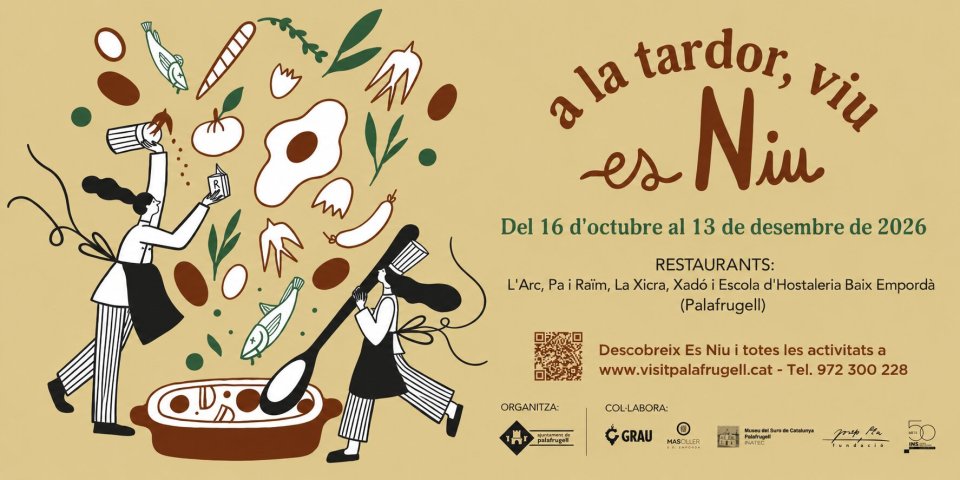
Events
Guided tour of the Castell-Palau and the Old Town of Bisbal d'Empordà
7 NovemberRomanyam - Gavarres Gastronomic and Artisan Market
7 NovemberLittle Sant Martí Festival in Palafrugell
From 14 to 15 NovemberGuided hiking routes in Santa Cristina d'Aro
22 NovemberSant Andreu Fair in Torroella de Montgrí
From 27 to 29 NovemberLiving Nativity Scene of Pals
26 DecemberNearby routes
The sea urchin route, a treat for the palate
Grand Tour de Catalunya - Section 5. From Surrealism to Modernism. From Figueres to Barcelona
Fair of Indians
Flower and garden fairs
Route of the Coves of the Costa Brava
Petit Train Route, a greenway for the whole family
Route with Josep Pla
Discovering the Palamós prawn
A tour for golf players in Catalonia
The red coral: a thousand-year-old history of Catalonia

News







 Sustainable turism
 Biosphere