


The legend of the witches of Montseny
In the Montseny massif, amidst dense forests and solitary hermitages, lies a story that has spanned centuries. It speaks not of haunted castles or pacts with the devil, but of women. Women from Viladrau who, in the 17th century, were accused of witchcraft.
In Montseny, as in so many other places in Europe, fear and superstition turned neighbors into enemies. And the silent mountain bore witness.
All Saints' night in Sant Segimon
Tradition explains that, many years ago, All Saints' Night was a time when the veil between the visible and invisible worlds thinned. On that night, women accused of witchcraft would gather at the hermitage of Sant Segimon, perched in a wild and solitary spot in the mountain range.
There, under the shimmering moonlight, they held a witches' sabbath, dancing in circles, invoking the forces of nature, and mixing forest herbs to make secret ointments. It was said that they knew the power of plants, that they spoke with the wind, and that they could unleash storms capable of ruining entire harvests.
According to local lore in Montseny and the Vic plain, these witches conspired with other women from the region, Collsacabra, and nearby villages to dismantle rocks and ruin crops. The ritual, they explained, involved mixing water with magical ointments and stirring it with herbs until a large, dark cloud rose, laden with thunder and lightning.
The mountain, thus, became the stage for an invisible battle between the peasantry who feared losing everything and female figures who symbolized the unknown.
From legend to persecution
But behind the legend lies a very real historical shadow.
Between 1618 and 1622, in Viladrau, fourteen women accused of witchcraft were persecuted, tried, and executed. They were not burned, as is often imagined , because the trials were not handled by ecclesiastical courts, but by civil justice. They were hanged.
They were accused of killing children, causing diseases like goiter (very common due to iodine deficiency), slaughtering livestock, and ruining crops with supernatural storms. In a time of famine, epidemics, and climate instability, it was necessary to find scapegoats. And often the victims were single, poor women, or women knowledgeable in natural remedies.
Over time, the memory of those events merged with popular narrative. Documented history and legend intertwined to become a single collective story.
Montseny, a land of mystery
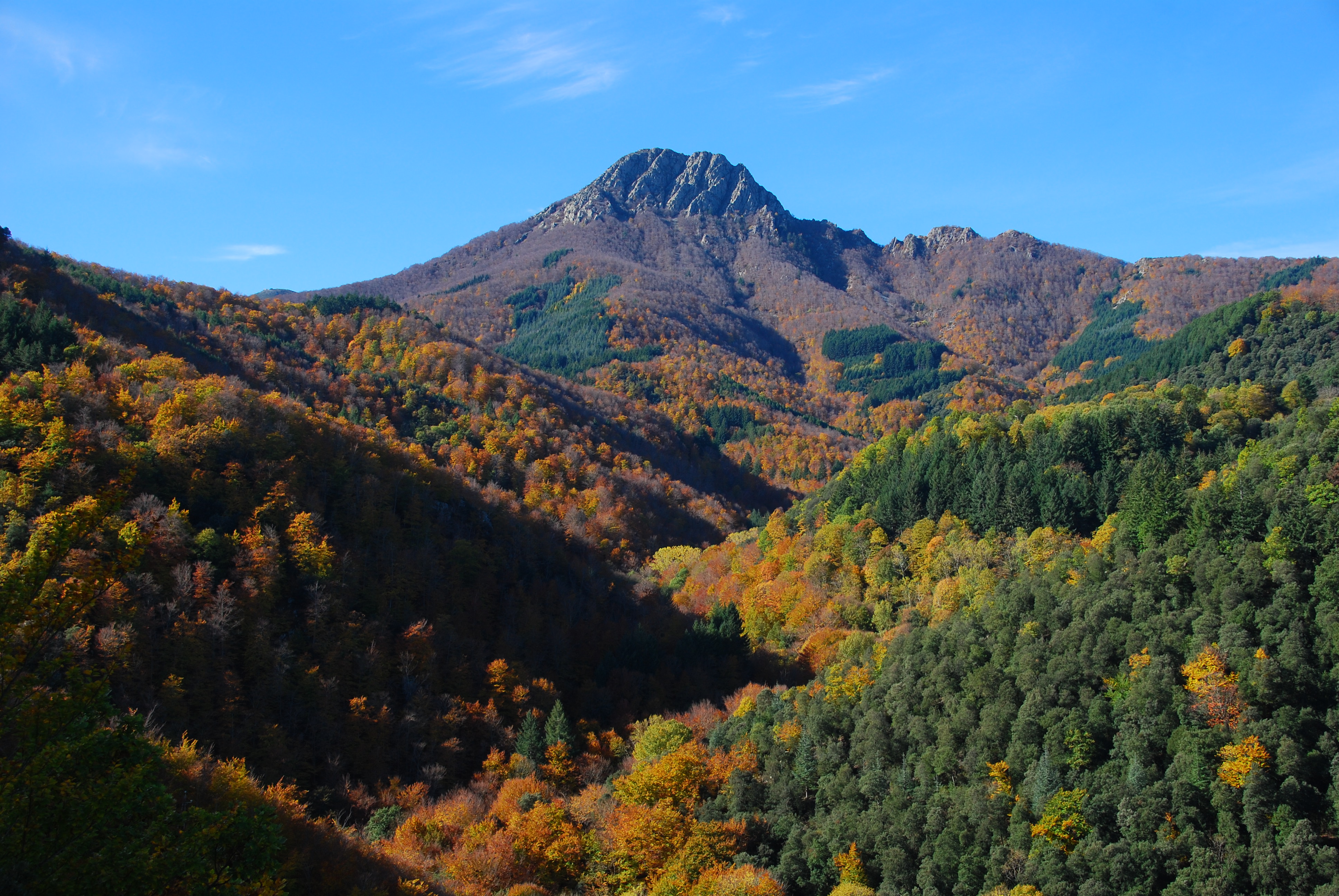
Montseny is not just a mountain range; it is a symbolic place. Its dense forests, hidden springs, and paths that vanish into the mist have fueled stories for generations of women who knew the secrets of nature.
Some say that even today, on stormy nights, whispers can be heard among the trees. That the wind that descends from Matagalls carries ancient echoes. That the witches were not evil beings, but women rooted in the land, custodians of ancestral knowledge that was frightening because it was not understood.
Living memory: the Chestnut Fair
Every year, on All Saints' Night, Viladrau commemorates this part of its past during the Chestnut Fair. The town relives the legend with the Ball de les Bruixes (Dance of the Witches), a performance that combines history, myth, and a reclaiming of memory.
The festival does not glorify persecution, but rather transforms the narrative: witches cease to be feared figures and become symbols of identity and remembrance. Fire, which once symbolized punishment, becomes light; dance, once suspected of malevolent spells, becomes culture.
And amidst shadows and light, Montseny continues to hold its secret: that there are places where legend is not only explained, it is felt.
Published by Youssef Haouriqui on 2 of march of 2026 at 10:40h

Events
Forest week in Sant Celoni
16 OctoberAmateur Theatre Showcase in Sant Gregori
16 OctoberEuropean Heritage Days in Collbató
16 OctoberRACC Costa Dorada Rally in Salou
From 16 to 17 OctoberZim Zam Cassà - Cassà de la Selva Urban Art Festival
From 16 to 17 OctoberEmbarrats Fair in Sant Joan de Vilatorrada
From 16 to 18 OctoberFish and Rice Gastronomic Days
From 9 to 18 October
Experiences







 Sustainable turism
 Biosphere