


La Roca dels Bous
Municipalities
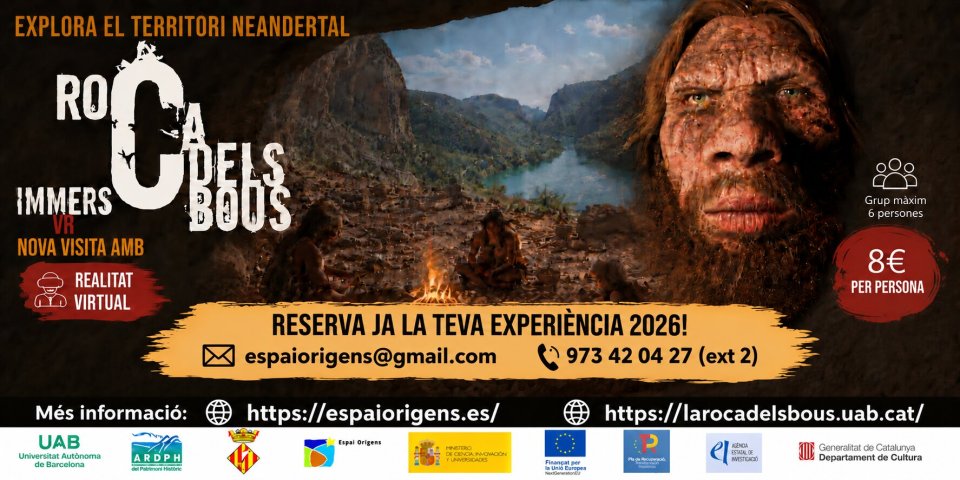
In Sant Llorenç de Montgai ( Camarasa ), in the heart of the Noguera region, there is a place where the landscape speaks with an ancient voice. Between the first foothills of the Pre-Pyrenees and the Segrià plain, the Cinglera de la Cascalda holds one of the most fascinating testimonies of Catalan prehistory: the Roca dels Bous, an archaeological site that transports us back some 50,000 years, when groups of Neanderthals stopped at this natural pass during their migrations.
What is today a site full of discoveries was, in a distant past, a place of refuge, activity, and daily life. Neanderthals lit fires, made tools, made use of the area's resources, and observed a landscape very different from our own, yet intimately connected to the paths, rivers, and mountains that still define this corner of the Noguera region.
La Roca dels Bous is not just an archaeological site: it is a window to the past. Thanks to the excavations and research carried out by the Center for Studies of the Archaeological Heritage of Prehistory at the Autonomous University of Barcelona, this site allows us to better understand how Neanderthals lived and how modern archaeology is able to reconstruct their history from small traces: fragments of tools, animal remains, combustion structures, and sediments that preserve the memory of thousands of years.
A living archaeological site in a spectacular setting
The visit to Roca dels Bous begins at Espai Orígens, the reception area where visitors receive the necessary instructions to start the tour. From there, a route begins that combines landscape, science, and emotion. The path leads to the base of the rock shelter, where the discovery of Neanderthal Territory begins.
The setting is one of the great attractions of the experience. Sant Llorenç de Montgai offers a unique combination of nature, water, and rock, with the Segre River as the main feature and the cliffs as the backdrop. This landscape, now ideal for walking and enjoying tranquility, was thousands of years ago a strategic point for prehistoric communities. Its location, between the mountains and the plains, facilitated the movement of human groups and access to essential resources.
During the tour, visitors can imagine what this territory was like in Neanderthal times. It's not a conventional visit, but an immersive experience that invites you to see the landscape with new eyes. Each stop along the route helps interpret the environment and understand why this place was repeatedly occupied during the Middle Paleolithic.
One of the most interesting aspects of Roca dels Bous is that it is an ongoing archaeological site. This means that research is continuous and that each archaeological campaign can yield new information about the past. Visitors are not simply looking at a museum space, but at a place where research continues to advance and where knowledge is built step by step.
Technology to understand prehistory
La Roca dels Bous also stands out for its innovative approach to bringing prehistory to the public. The visit incorporates digital touchscreens with audiovisual content that accompany the tour and help interpret the site. This resource allows visitors to see what is often not immediately apparent: how tools were made, how space was organized, the role of fire, and what activities Neanderthals might have carried out around the rock shelter.
The tablets can be used independently or with the support of a guide, adapting the experience to different audiences. Families, schools, groups of friends, or anyone interested in history will find here a clear, visual, and engaging way to delve into a period as distant as it is fascinating.
This combination of archaeological heritage and technology makes the visit a particularly appealing experience. Prehistory ceases to be an abstract concept and becomes a tangible, immersive experience. Images, videos, and explanations help bring to life an archaeological record that, without interpretation, might otherwise go unnoticed. Here, every stone, every remnant, and every layer of the site takes on meaning.
Neanderthals, closer than ever
Visiting Roca dels Bous is to get closer to ancestors often shrouded in clichés. Far from the simplistic image that has long been held of Neanderthals, this site reveals human groups with adaptability, knowledge of the territory, and mastery of complex activities.
Investigations have documented recurring occupations, hearths, and tools made from various raw materials, suggesting a well-organized settlement and intelligent use of available resources. Fire, in particular, plays a prominent role here: the hearths found at the site help us understand how daily life was structured and the role this element played in providing light, warmth, protection, and carrying out daily activities.
All of this makes Roca dels Bous an ideal visit for anyone wanting to discover the past in a different way. It's a place to learn, but also to imagine. To pause before the cliff and think that, 50,000 years ago, other humans occupied that same place, gazed upon that same territory, and left a mark there that we can only begin to understand today.
La Roca dels Bous is heritage, research, and landscape. It is a unique cultural offering in the Noguera region and a magnificent opportunity for meaningful tourism: walking through the present while opening a door to the distant past.
*Accessibility information: access to Roca dels Bous is not accessible for wheelchair users.
Nearby routes
The honey cooking
Àger, Camarasa, Os de Balaguer
Honey is a popular and consumed by the population for the many benefits it presents. Often this is one of the stars of the sweetest moments of our lives but in turn is an unknown. The route presents to you this month femTurisme you will rediscover…
Pala Alta from the Virgin of Montalegre
Camarasa, Les Avellanes i Santa Linya
This is a circular route through the Sierra de Mont-roig. We start the route at the hermitage of Montalegre. To get to this point, we will have made a forest track of almost 6 kilometers from the road that leaves Vilanova de Sal.
Urgell Canal pedal route
Arbeca, Balaguer, Castellserà, Juneda, Les Borges Blanques, Linyola, Mollerussa, Penelles, Preixana, Tàrrega, Torregrossa, Vila-sana, Vilanova de Bellpuig
Discover Lleida's plans by pedaling through the Urgell Canal, the most important hydraulic infrastructure work in the history of Catalonia, which changed the appearance of the landscape, the way of life of the people, promoting the development…
Grand Tour de Catalunya - Section 3. Heaven is very close. From Lleida to La Seu d'Urgell
Àger, Balaguer, La Pobla de Segur, La Seu d'Urgell, La Vall de Boí, Llavorsí, Lleida, Naut Aran (Salardú), Vielha e Mijaran
I want to do this route by electric vehicle! This route is designed to be done by electric vehicle, although it can be done with any other car. Along the route we will suggest municipalities that have charging points and places of interest…
A trip in the Lakes' Train
Balaguer, La Pobla de Segur, Lleida
Under the phrase "Seu, look i admire" ("Sit, watch and admire") the Lakes Train invites us to a journey time between land and water and connects Lleida and La Pobla de Segur , following a nostalgic way we go back in time. An atypical transport…
Wine Route: Costers del Segre
Alfarràs, Artesa de Segre, Balaguer, Foradada, Lleida, Penelles
As has been said repeatedly, Catalonia is a land of contrasts, while even the fruits it gives are varied and diverse as the geographical area where they are grown. The wine sector and exemplified. In all there are eleven Catalan territory designations…
Events
News
Gothic Architecture: The light and height of medieval Catalonia
Gothic architecture marks a turning point in the history of Catalonia. It was the style that transformed cities, places of worship, and the way people built collectively. A style that changed not only the stone itself, but also the way people…
Iron architecture: the light and steam of industrial Catalonia
In the 19th century, the Industrial Revolution not only changed the way people worked and lived, but also profoundly transformed architecture. The arrival of new materials, such as cast iron, wrought iron, and glass, opened up possibilities…








 Sustainable turism
 Biosphere