


Rococo architecture in Catalonia: lightness, light and celebration
After the intensity and drama of the Baroque, architecture took a new turn: it became lighter, more intimate, and festive. Rococo arrived in Europe during the 18th century as a reaction against Baroque grandeur, proposing a different way of understanding beauty: not to shock, but to please.
In Catalonia, this transformation coincided with a complex period: after the War of the Spanish Succession, the country was under a new Bourbon administration that stifled large-scale architectural projects. However, within this context, Catalan Rococo found its niche: not in grand facades or entire palaces, but in interiors, decoration, and small details that transformed the experience of a space without requiring a complete reconstruction.
What exactly is Rococo?
Rococo originated in France in the early 18th century, both as an evolution and a response to the Baroque. It retained a taste for ornamentation but freed it from heaviness and solemnity: straight lines and large columns gave way to soft curves, asymmetries, and motifs inspired by nature, such as shells, acanthus leaves, and flowers (the term "rococo" comes precisely from rocaille), and decoration with small stones.
The colors also changed: the dark contrasts of the Baroque were abandoned in favor of pastel tones, whites, and golds, which brought light and freshness to the spaces. It was a style designed for domestic and courtly interiors: drawing rooms, music rooms, dressing rooms... small, refined spaces, intended for conversation, games, and festivities, not for grand religious or political discourse.
A discreet Rococo, half-hidden within the Baroque
Unlike France, Austria, or Germany, where the Rococo style spawned entire palaces designed from scratch, Catalonia didn't produce many "purely" Rococo buildings. What we find is primarily a decorative layer added to existing Baroque structures, or one that coexists with the early influence of Neoclassicism.
It's a Rococo style that's content with less, but when it appears, it does so with a particular grace: on a plaster ceiling, in an altarpiece, in a stately hall. To find it, you have to look carefully, often beyond the facade.
The Vicereine's Palace: when a viceroy wants to flaunt his wealth
If there is one building in Catalonia that can be unequivocally called Rococo, it is the Palau de la Virreina, on the Rambla in Barcelona. It was commissioned by Manuel de Amat y de Junyent, former Viceroy of Peru, between 1772 and 1778, when he returned to Barcelona with a vast fortune and a desire to show it off to the world.
The façade blends classical French motifs (Ionic pilasters, garlands) with a more restrained Catalan Baroque style, but it is in the wrought-iron railing, with its Louis XV elements, and in the balustrade crowned by twelve large vases where the Rococo style becomes evident: light, decorative, designed to impress without being ostentatious. The result is so unique that the building has often been described as "halfway between Baroque and Rococo," and it remains one of the city's most elegant civil palaces. La Virreina now houses the Centro de la Imagen (Center for Image), so visitors can explore the interior and not just admire it from the street. 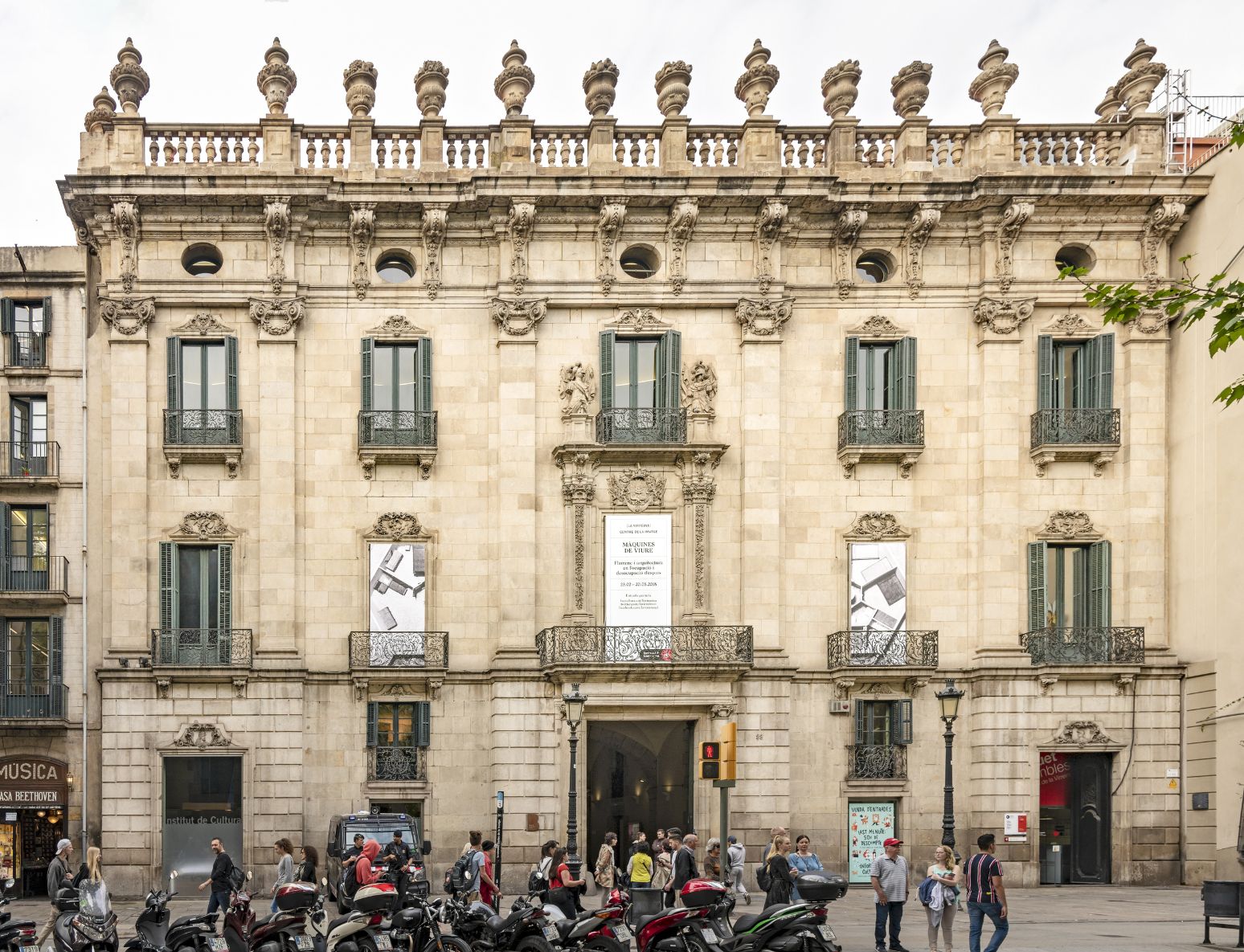
Vicereina Palace, façade to the Ramblas. Photo: Didier Descouens / Wikimedia Commons (CC BY-SA 4.0)
When Rococo enters the church
Although primarily associated with secular and festive spaces, Rococo also left its mark on religious architecture, usually blended with the language of the late Baroque. One of the most spectacular examples is the main altarpiece of the Sanctuary of El Miracle in Solsonès.
This altarpiece is so enormous that the unfinished church was too small to accommodate it. The sculptors abandoned the classic Solomonic column in favor of a bulbous one, as if sprouting from a bud, and incorporated French-inspired ornamentation typical of the Rococo repertoire. The result is a composition that combines the visual drama of the Baroque with the decorative delicacy of the new style. It is worth visiting at sunset, when the light enters horizontally through the church's oculus and illuminates the altarpiece's gold leaf with an almost magical effect. 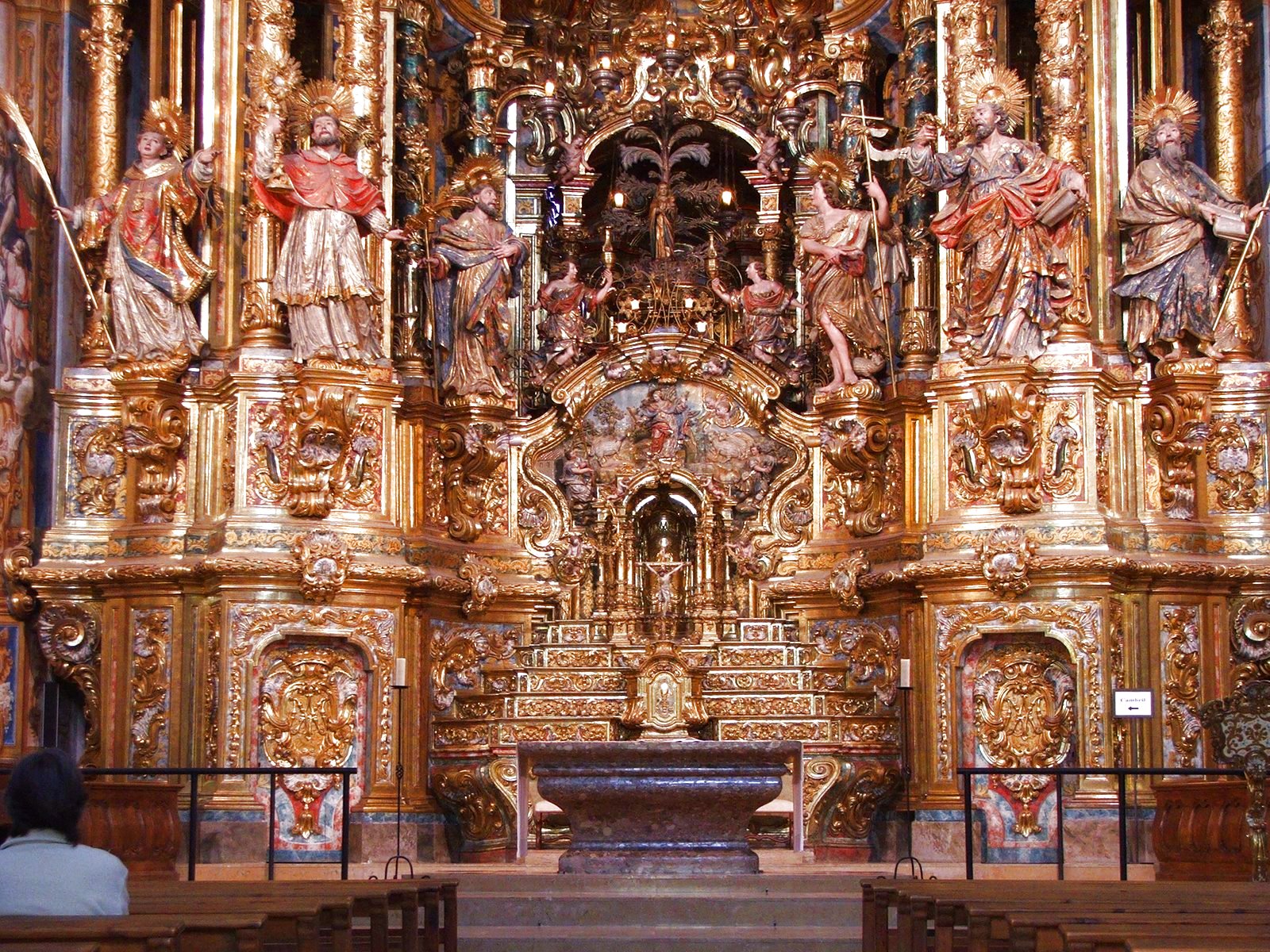
Baroque altarpiece from the Miracle Sanctuary (Solsonès), with Rococo-inspired decorations. Photo: Celsona / Wikimedia Commons (CC BY 3.0)
A transitional style, brief but luminous
The Rococo style in Catalonia didn't last long: towards the end of the century, the arrival of Neoclassicism, much more sober and rational, gradually displaced it, often openly criticizing it as "frivolous." But in this brief period, the region achieved something unique: softening the Baroque style without losing its soul, adding a touch of playfulness, light, and celebration.
Perhaps that's why Rococo is a style that invites close observation: there are no grand facades proclaiming it, but rather subtle details (a ceiling, an altarpiece, a room) that await someone's attention. And now that summer is upon us, perhaps it's the perfect time to do so: to seek out this lighter, more festive architecture, which reminds us that, sometimes, the greatest beauty lies in the smallest details.
Published by Oriol Rosselló Gil on 31 of august of 2026 at 10:00h
Events
Forest week in Sant Celoni
16 OctoberAmateur Theatre Showcase in Sant Gregori
16 OctoberEuropean Heritage Days in Collbató
16 OctoberRACC Costa Dorada Rally in Salou
From 16 to 17 OctoberZim Zam Cassà - Cassà de la Selva Urban Art Festival
From 16 to 17 OctoberFira Mediterrània de Manresa 2026
From 15 to 18 OctoberMoaré Terrassa Festival
From 16 to 18 October
Experiences







 Sustainable turism
 Biosphere