


Iberian architecture in Catalonia: the first stones of a country
Before the Romanesque churches, medieval castles, or great Roman cities were built, the territory of present-day Catalonia was already inhabited by peoples who constructed true urban centers. They had walls, streets, squares, cisterns, and places of worship. They also maintained trade relations with other peoples of the Mediterranean. These were the Iberians, a group of peoples that included the Indigets, settled mainly in the Empordà region, and the Ilergets, in the lands of Lleida.
Delving into Iberian architecture is like taking a journey to the very beginnings of our built history. It may not be the style we most readily recognize, nor the one that has left us with grand monuments, but it holds extraordinary value: it allows us to discover how communities lived, organized themselves, and interacted more than two thousand years ago. The remains of their settlements reveal a way of understanding the land in which housing, community life, and defense were inextricably linked.
How did the Iberians build?
Iberian settlements responded to two main needs: finding a suitable place to live and having good protection against potential attacks. Therefore, many settlements were established on hills and other elevated points, from where the territory could be visually controlled and the defensive advantages of the terrain could be exploited.
The walls, often reinforced with round or square towers, defined the boundaries of these settlements. Inside, the houses typically had a simple layout, with stone walls and a stone foundation upon which mud walls were built. The streets and squares structured daily life, while cisterns allowed for water storage and silos served to preserve grain.
This architecture did not develop in isolation either. Contact with other Mediterranean cultures, especially Greek and Phoenician, influenced construction techniques and the objects that reached the settlements. Thus, behind seemingly simple constructions, there were communities with increasingly complex organizations, deeply connected to the world around them.
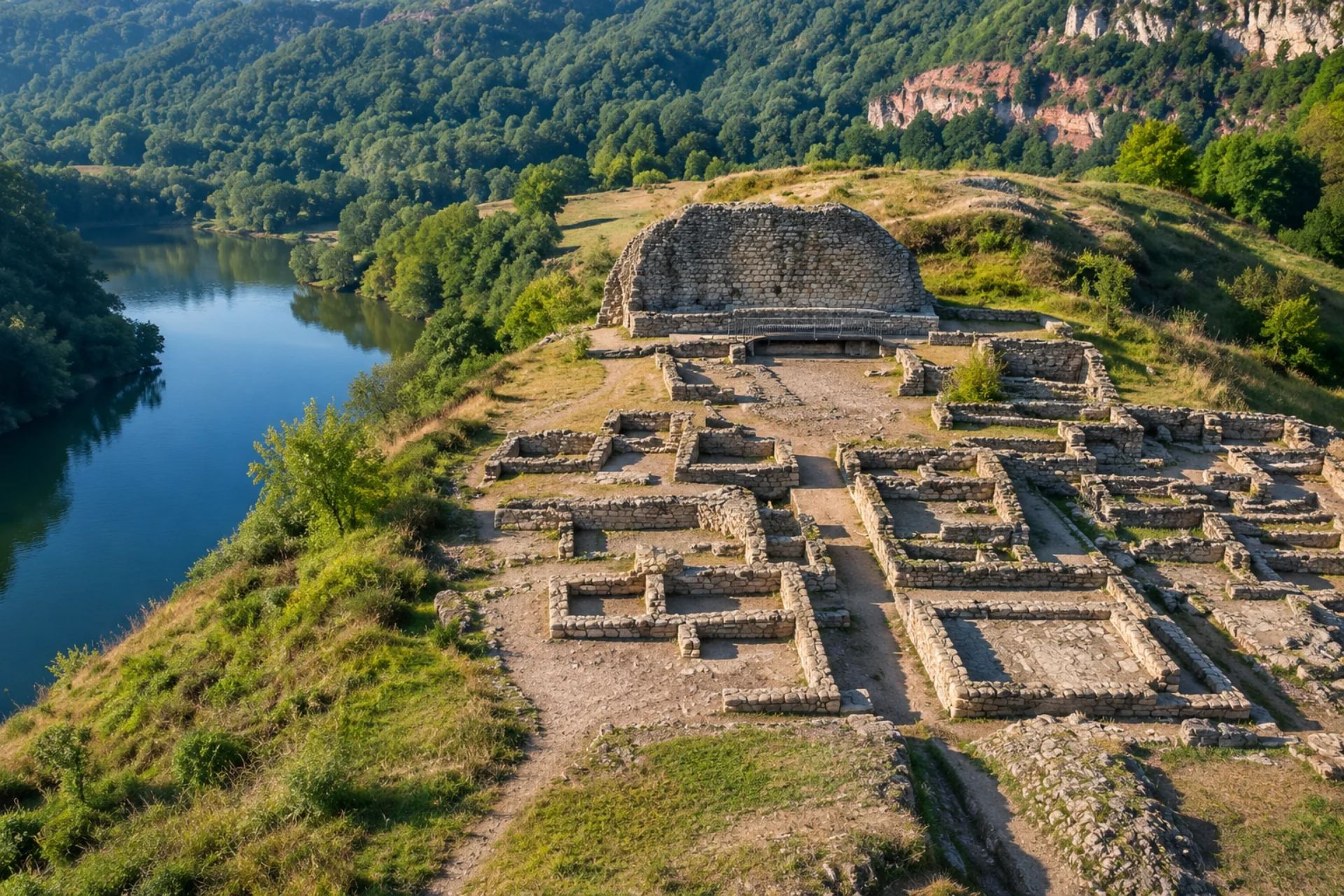
Ullastret: the great city of the indigets
In the Baix Empordà region, about two kilometers from the present-day town of Ullastret, rises Mount Sant Andreu, where the remains of one of the most important Iberian settlements in Catalonia are preserved. This is the Iberian settlement of Ullastret, one of the major centers of the Indiget people and an exceptional place to discover what an Iberian city was like.
Archaeological remains allow us to place contacts with the Mediterranean world around 600 BC, with a particularly abundant presence of Greek materials from the 6th century BC onwards. The settlement seems to have maintained its autonomy until the beginning of the 4th century BC, while its decline began from the 3rd century BC onwards.
The walls and towers: a city prepared to defend itself
One of the first things that catches your eye when you arrive at Ullastret is its defensive system. The enclosure consists of several sections of wall connected by truncated conical and rectangular towers, which protected the entrances and reinforced the perimeter of the settlement.
The round towers appear to correspond to the earliest phases of the fortification, while the sections of wall were added later. In fact, an initial wall dating from the 6th century BC was replaced by another in the 4th century BC, and the square towers are from a later period.
Among the best-preserved elements is the Frigoleta I tower, located on the west side of the enclosure and characterized by its truncated conical shape. Also worth noting are the gate on First Street and the defensive structures that protected its entrance.
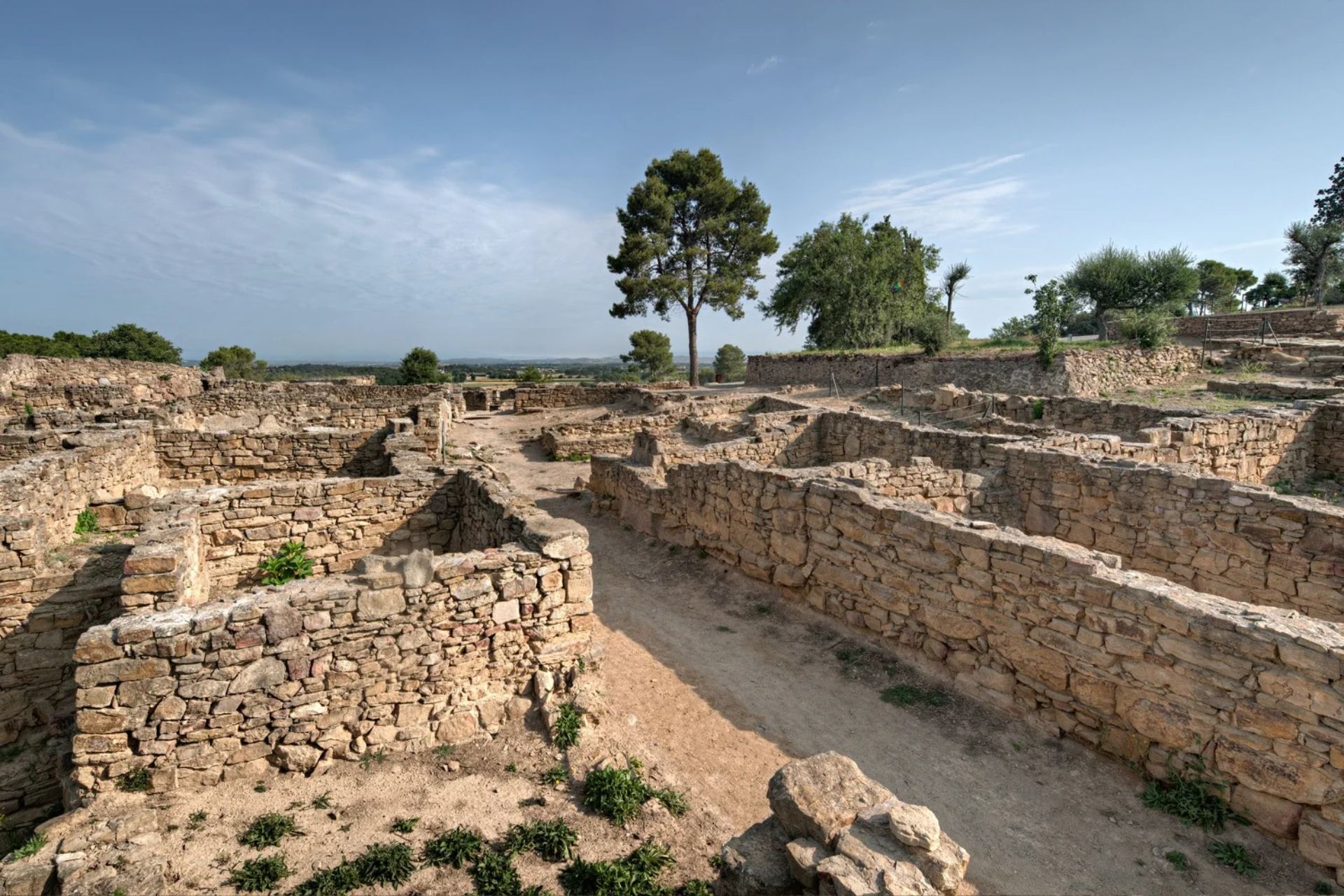
Daily life within the village
Beyond the city walls, excavations have allowed for the reconstruction of much of the internal layout of this ancient city. Dwellings from different periods have been documented, along with a paved street and a plaza with stone foundations that supported wooden columns. Hellenistic-era cisterns and numerous silos for grain storage have also been preserved.
At the highest point of the complex, the acropolis, the remains of a rectangular temple with mosaic floors can still be seen. These spaces, along with the residential areas and storage infrastructure, reveal a well-organized city with shared spaces and services that went far beyond basic survival needs.
However, the fate of Ullastret still raises some questions. For many years, the abandonment of the settlement was linked to Cato's military campaign of 195 BC. However, excavations have not provided evidence of widespread destruction. Currently, it is considered more likely that the depopulation was related to economic reasons. Another noteworthy detail is that no Roman remains have been found after the Scipio landing at Empúries in 218 BC.
Empúries: the meeting point between Iberians, Greeks and Romans
A short distance from Ullastret, along the coast of L'Escala, lies another of the country's great archaeological sites: Empúries. Here, the history of Iberian architecture intersects with the Greek presence and later with the Roman expansion.
The first settlers were the Phocaean Greeks, who founded a colony in 575 BC on a small island at the mouth of the Fluvià River. This first settlement was called Palaiapolis, meaning "old city." Around 550 BC, the inhabitants moved to the mainland and built a new settlement, known as Neapolis, or "new city."
The Greek presence coexisted with the indigenous communities of the territory. This relationship is precisely one of the most interesting aspects of Empúries: two cultural worlds that did not live in isolation, but rather maintained trade contacts and exchanged products, knowledge, and influences. This contact also had consequences for the ways in which spaces were built and organized.
Among the remains of Neapolis, several religious buildings stand out, such as the temple dedicated to Asclepius, the Greek god of medicine, and the temple of Zeus-Serapis. They bear witness to the presence and influence of Greek culture in this part of the Empordà coast.
The history of the site took a new turn in 218 BC, when the Romans landed and made Empúries one of the gateways for the conquest of Hispania. Later, after Pompey's defeat, a colony of veterans was established, which gave rise to the Roman city of Emporiae, alongside the Iberian settlement of Indika.
Large houses from this Roman period are still preserved in the eastern part of the site. Their rooms, decorated with mosaic floors and paintings, give us an idea of how the wealthiest families of the time lived.
Today, all this heritage can be discovered by visiting the Empúries archaeological site, which is part of the Archaeological Museum of Catalonia. Furthermore, a pedestrian walkway connects the archaeological site with L'Escala, allowing visitors to complete their visit with a pleasant stroll along the seafront.
A journey to understand the origins
There are few places where the coexistence of different civilizations is as clearly visible as in Empúries. Within the same landscape, we find traces of the Iberians, Greeks, and Romans—three cultures that left their mark on the history of the region. And just a few kilometers away, Ullastret offers us the chance to discover what a large Iberian city was like before the transformations brought about by Romanization.
Therefore, visiting these two archaeological sites is a great way to explore the origins of our architecture. In Ullastret, we can walk along the ancient walls, observe the defensive towers, and imagine how life was organized within the settlement. In Empúries, on the other hand, the seascape accompanies us as we discover the streets, temples, and houses of the ancient Greek and Roman cities.
These are visits that invite you to stroll at a leisurely pace and examine the archaeological remains with a bit more attention. Because, although today we only have vestiges of them, every wall, every street, and every foundation speaks to us of a way of building and inhabiting the land that began more than two thousand years ago. The history of architecture in Catalonia did not begin with the Romanesque period or with medieval castles: its first stones had already been laid by the Iberians.
Published by Oriol Rosselló Gil on 14 of december of 2026 at 11:00h
Events
NAVÀS T'APASSIONA!
From 5 to 22 NovemberAutumn of Cooking and Mushrooms in Terrassa
From 30 October to 22 NovemberL'Alternativa - Barcelona Independent Film Festival
From 12 to 22 NovemberAndorra Shopping Festival
From 6 to 22 NovemberThe Berguedà mushroom kitchen
From 18 September to 22 NovemberPrawn Gastronomic Days in La Ràpita
From 24 October to 22 NovemberNational Film and Video Competition in Navàs
From 16 to 29 November
Experiences







 Sustainable turism
 Biosphere