


The legend of the four bars
Some symbols are born from a decree. Others from a battle. And some, like the four red stripes on a golden background, are born from a legend that has crossed the centuries.
The Senyera, the flag of Catalonia, has its origin in the ancient coat of arms of the House of Barcelona. First documented in the 12th century, it is one of the oldest heraldic emblems in Europe. But popular tradition places its birth much earlier, on a battlefield in the 9th century.
A count without a coat of arms
The protagonist of the legend is Wilfred the Hairy, count of Barcelona, Girona, Osona, Urgell and Cerdanya. He ruled a frontier land, exposed to attacks and the uncertainties of a turbulent era. Although he was a vassal of the Frankish king, he began to act with autonomy, laying the foundations of what would later become Catalonia.
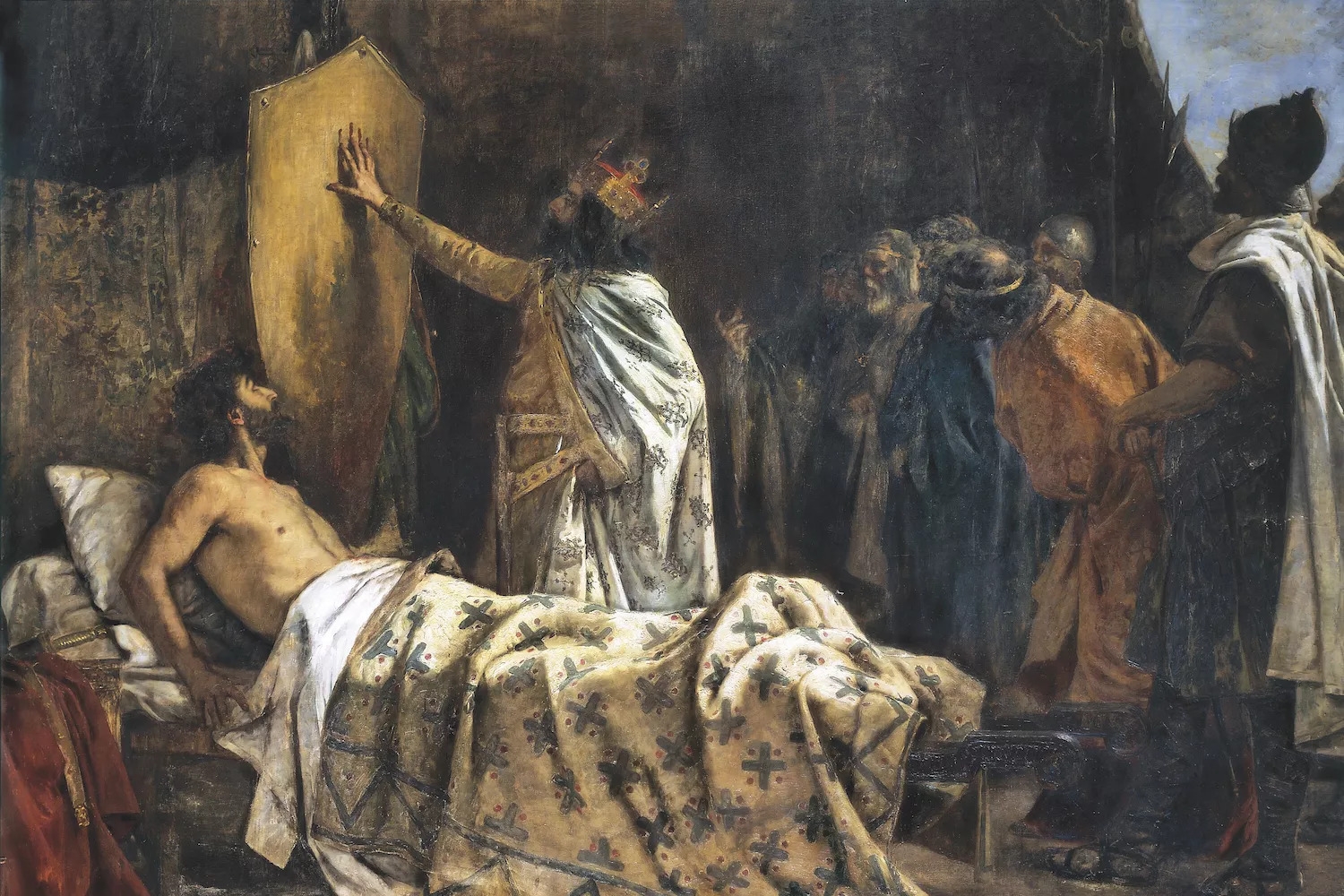
According to the story, Wilfred fought alongside the Frankish king —traditionally identified as Charles the Bald— in a war against the Normans. The battle was fierce. The enemies were retreating, but Wilfred fell gravely wounded, pierced by a spear.
He was carried to the royal tent, bleeding heavily, while victory was being secured.
The four stripes of blood
The king, grateful for his bravery, asked what reward he desired. Wilfred, looking at his smooth golden shield, replied that he wished for a coat of arms that would recognize his honor.
Then, according to the legend, the king dipped four fingers into the blood flowing from the count's wound and drew them from top to bottom across the golden shield. Four red marks were forever engraved.
-These shall be your arms- the monarch is said to have declared.
Thus, from a solemn and symbolic gesture, the four stripes were born.
From shield to flag
Over time, that shield became the emblem of the House of Barcelona and later the Catalan flag: the Senyera.
The image of the four stripes became especially established during the 19th century, during the Renaixença movement, when poets such as Jacint Verdaguer and Antoni Bori i Fontestà recreated the legend and turned it into a symbol of collective identity.
Between history and myth
Historically, however, the legend has gaps. Heraldry did not yet exist in the time of Wilfred, and the first documented evidence of the shield with the four stripes dates later, in the 12th century. Moreover, the chronologies do not match exactly.
But legends do not seek documentary accuracy; they seek meaning. The story exalts Wilfred as the founder of his own dynasty and as a symbol of the transition from a power delegated by Frankish kings to a hereditary authority rooted in the territory.
The blood marking the shield symbolizes sacrifice, legitimacy and the birth of an identity.
A symbol that endures
Today, the four stripes fly on public buildings, popular festivals and sporting events. They are part of the everyday landscape of Catalonia. But behind the simplicity of the red lines there is a story —or a legend— that speaks of war, honor and origin.
Perhaps we will never know whether a king truly drew those lines with the blood of a wounded count. But the tale has survived for centuries because it explains something deeper: the desire of a people to write their symbol with the strength of their own heart.
Published by Youssef Haouriqui on 14 of april of 2026 at 09:18h

Events
Forest week in Sant Celoni
16 OctoberAmateur Theatre Showcase in Sant Gregori
16 OctoberEuropean Heritage Days in Collbató
16 OctoberRACC Costa Dorada Rally in Salou
From 16 to 17 OctoberZim Zam Cassà - Cassà de la Selva Urban Art Festival
From 16 to 17 OctoberEmbarrats Fair in Sant Joan de Vilatorrada
From 16 to 18 OctoberFish and Rice Gastronomic Days
From 9 to 18 October
Experiences







 Sustainable turism
 Biosphere