


Renaissance Architecture: the harmony that transforms the city
After centuries of Gothic height and vertical spirituality, Catalan architecture underwent a profound change. The Renaissance transformed not only the way of building, but also the way of thinking. It was a time to rediscover classical antiquity, to order the world with proportion and symmetry, and to place humankind at the center of creation.
In Catalonia, this change didn't arrive suddenly or with the same intensity as in Italy. It came gradually, throughout the 16th century, and left a clear mark, especially on civil architecture. Urban palaces, noble houses, town halls, and institutional buildings reflect a new way of understanding power, aesthetics, and public representation. The Renaissance is, ultimately, a time of renewal, both literal and figurative, that marks the transition to modernity.
A new architectural language
The Renaissance revived the principles of classical Roman architecture: symmetry, proportion, order, and balance. Facades abandoned their medieval irregularity and were organized according to geometric principles, striving for a clear and comprehensible visual harmony. Semicircular arches made a strong comeback, classical columns and pilasters appeared naturally, and spaces were conceived with rationality in mind.
This new way of building also reflects a new way of thinking. The world is no longer solely theocentric and is becoming more humanistic, with a perspective that emphasizes proportion, beauty, and a rational understanding of space. Architecture thus becomes a direct reflection of this new cultural sensibility.
In Catalonia, this style didn't abruptly replace Gothic architecture, but rather coexisted with it for decades. Many buildings combine elements of both styles, creating a hybrid architecture that is particularly interesting. This gradual process is key to understanding the unique character of the Catalan Renaissance: more understated, more adapted to the local context, and less spectacular than its Florentine or Roman counterparts.
The prominence of civil architecture
If there is one area where the Catalan Renaissance is particularly visible, it is in civil architecture. Unlike Romanesque or Gothic styles, which were strongly linked to religious spaces, now it was institutions and wealthy families who drove the change.
Urban palaces became true symbols of power and prestige. They were organized around a central courtyard, often with a grand staircase connecting the different levels of the building. This courtyard was not only functional but also symbolic: it was the place where the order, hierarchy, and wealth of its inhabitants were displayed.
In Barcelona, this style can be seen in several buildings in the historic center, especially on Montcada Street. There, the palaces combine Gothic structures with fully Renaissance elements. One of the clearest examples is the Lieutenant's Palace (1549-1557), designed by Antoni Carbonell, which features a regular courtyard with semicircular arches, pilasters, and a balanced and understated composition, clearly aiming for monumentality without excessive decoration.
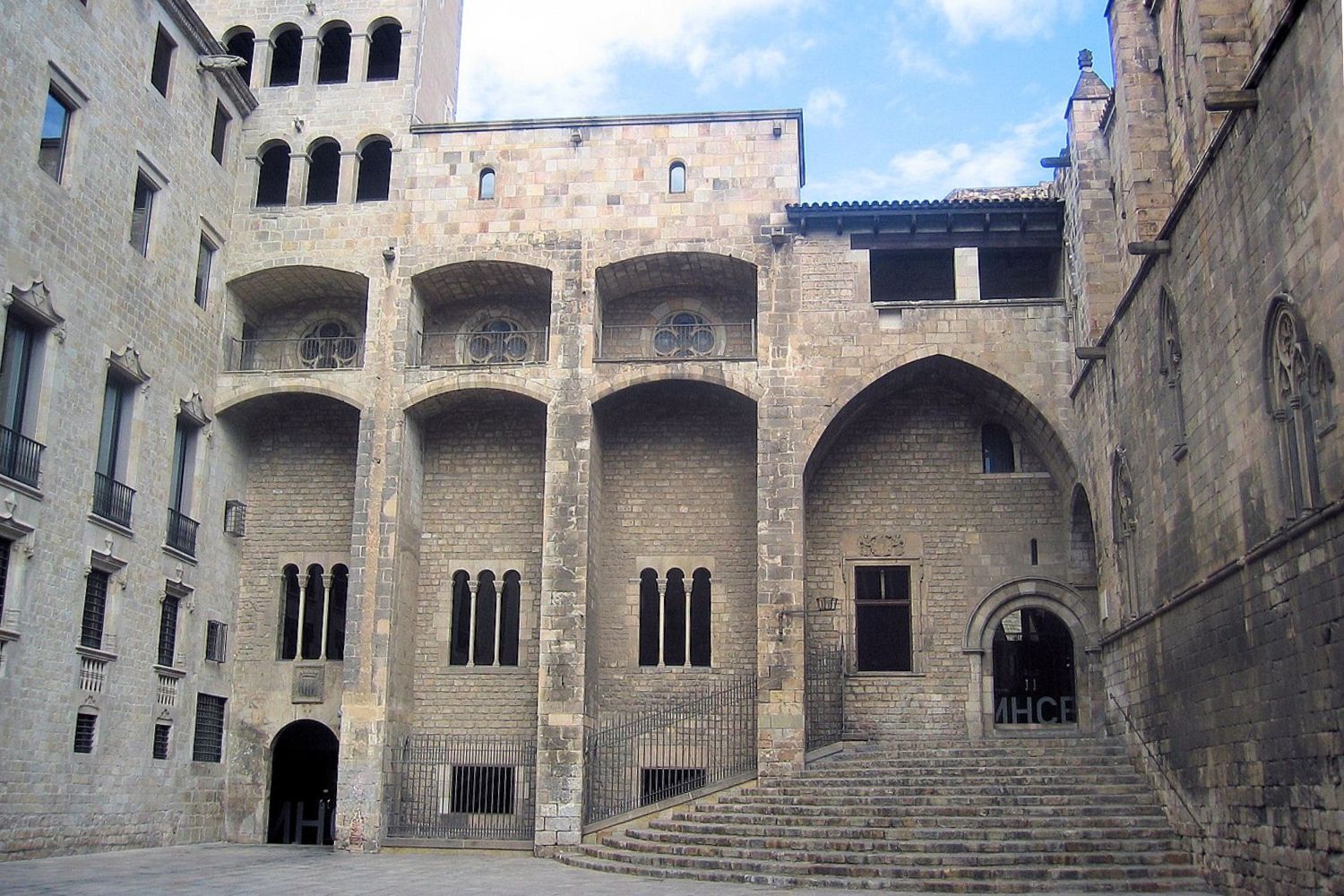
Author: Carquinyol (via Wikimedia Commons), CC BY-SA 2.0
Local councils and institutions: power is represented
The Renaissance is also the period in which civic institutions develop a new awareness of their symbolic role. Cities consolidate themselves as centers of power and organization, which translates into the construction or transformation of public buildings.
City halls, stadiums, and other institutional spaces adopt an architectural language that conveys stability, order, and authority. It is no longer simply a matter of constructing functional spaces, but of creating buildings that symbolize good governance and the solidity of political structures.
In Lleida, the Paeria, primarily Gothic, underwent some alterations incorporating Renaissance elements. In Tortosa, the Royal Colleges (promoted by Charles V) constitute one of the most remarkable complexes, with a regular square courtyard featuring two levels of arcades that superimpose classical orders. In Girona, Tarragona, and other cities, transformations reflecting this new sensibility can also be observed.
.jpg)
Author: Enric (via Wikimedia Commons) CC BY-SA 3.0
Noble houses and urban life
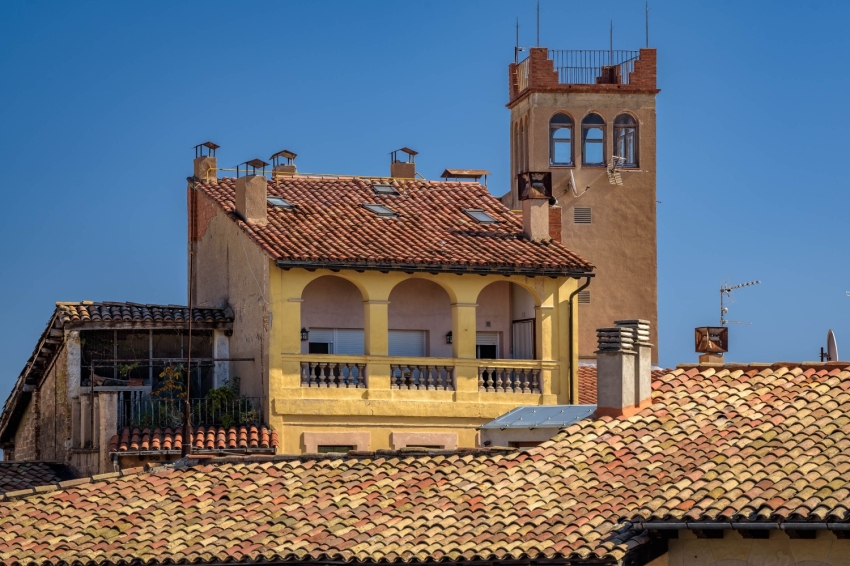
Beyond the grand palaces, the Renaissance also permeated the daily lives of the upper classes. Noble houses gradually adopted classical elements such as windows framed with moldings, semicircular doorways, and heraldic shields that reinforced family identity.
These transformations are not merely aesthetic. They reflect a new way of inhabiting the city, one that is more orderly, more representative, and more connected to European cultural trends. Architectural detail becomes a sign of refinement and belonging to a shared culture.
In cities like Tortosa, Vic, and Perpignan, this type of architecture blends seamlessly into the medieval fabric, creating a rich and diverse urban landscape where different eras and sensibilities coexist without abrupt breaks. Even today, in many urban centers, one can observe buildings and renovations that incorporate characteristic elements of the Renaissance style, such as galleries with semicircular arches or symmetrical compositions, demonstrating the enduring influence of this style beyond its historical period.
A Catalan Renaissance
The Renaissance in Catalonia is not as spectacular or grandiose as its Florentine counterpart. It is more discreet, more adapted, and more hybrid. But it is profoundly significant. It is a subtle yet constant transformation that modifies the way space is built and understood.
It is the transition from a spiritual and vertical architecture to a rational, human, and representative one. It is the moment when the city reaffirms itself, when civil power becomes visible, and when stone becomes an expression of order and modernity.
Exploring Catalonia's Renaissance buildings is to discover this transition. It's to understand how the country began to engage with Europe from a new cultural perspective. And it's to recognize that each architectural phase not only constructs spaces, but also mindsets.
Published by Oriol Rosselló Gil on 21 of april of 2026 at 10:55h
Events
Forest week in Sant Celoni
16 OctoberAmateur Theatre Showcase in Sant Gregori
16 OctoberEuropean Heritage Days in Collbató
16 OctoberRACC Costa Dorada Rally in Salou
From 16 to 17 OctoberZim Zam Cassà - Cassà de la Selva Urban Art Festival
From 16 to 17 OctoberEmbarrats Fair in Sant Joan de Vilatorrada
From 16 to 18 OctoberFish and Rice Gastronomic Days
From 9 to 18 October
Experiences







 Sustainable turism
 Biosphere