


Gaudí's must-sees in the province of Barcelona
Antoni Gaudí is undoubtedly one of the most important figures in world architecture. Throughout his career, he developed an innovative and personal vision of Modernism, fusing nature, structural innovation, and decorative arts in works that continue to fascinate millions of visitors each year. Seven of his creations—including the Palau Güell—are part of the "Works of Antoni Gaudí" group inscribed on the UNESCO World Heritage List for their outstanding contribution to the development of modern architecture and construction techniques.
The Barcelona Provincial Council, owner of the Palau Güell since 1945, dedicates efforts and resources to preserving the province's Gaudí heritage, which also includes works such as the Gaudí Crypt at the Colonia Güell, the Artigas Gardens, the Chalet del Catllaràs, and the Nau Gaudí. Exploring these spaces allows one to understand both the architect's personality and the social and economic context that shaped each of his projects.
The Palau Güell: a masterpiece next to the Rambla in Barcelona
In the heart of the Raval district, on Nou de la Rambla street, stands the Palau Güell. It was one of Eusebi Güell's first major commissions to Gaudí and is one of the most extraordinary buildings from his early period. Built between 1886 and 1890 as the urban residence of the Güell family, this palace reflected the social, economic, and cultural prestige of its owners.
The contrast between its austere façade and its surprisingly rich and organic interior is key to understanding Gaudí's creative evolution. From the outside, the building maintains an elegant and restrained appearance, integrated into the urban fabric. However, upon entering, a universe of parabolic forms, structural innovations, and noble materials unfolds, such as marbles and woods finely crafted by the best artisans of the time.
The grand central hall, crowned by a perforated dome that filters natural light like a starry sky, forms the symbolic heart of the building. The ground floor, designed to allow the entry of carriages and horses, demonstrates the perfect integration of functionality and aesthetics. On the roof, the ceramic-decorated chimneys foreshadow Gaudí's expressive use of color and trencadís (broken tile mosaic) in later works.
Declared a National Monument in 1969 and a UNESCO World Heritage Site in 1984, the Palau Güell represents a masterful synthesis of architecture, interior design, and applied arts. Visiting it is to discover a complete work of art where every detail—from the wrought iron of the doors to the interplay of light—reflects a revolutionary artistic vision.
The Palau Güell offers an exceptional gateway to Gaudí's world: intimate, innovative, and surprising. It's an open invitation to discover, with calm and curiosity, one of Barcelona's most extraordinary cultural treasures.
The Güell Colony: Modernism, Industry and Social Commitment
Beyond the great urban icons, the Colonia Güell —located in Santa Coloma de Cervelló—offers a complementary and profoundly revealing perspective on Gaudí's talent. This complex was built at the end of the 19th century as an industrial textile colony, also promoted by Eusebi Güell, and was conceived as an advanced model of social organization that integrated housing, services, and facilities for the workers.
In this context, Gaudí was commissioned to design the church for the complex. And, although the church remained unfinished, its crypt—known as the Gaudí Crypt of the Colonia Güell—was declared a World Heritage Site by UNESCO in 2005 for its extraordinary architectural value.
The Gaudí Crypt is considered a true experimental laboratory. Here, the architect tested innovative structural solutions, such as inclined columns, complexly shaped vaults, and walls that appear to grow organically from the ground. Many of these solutions would later be applied and perfected in the Sagrada Familia temple.
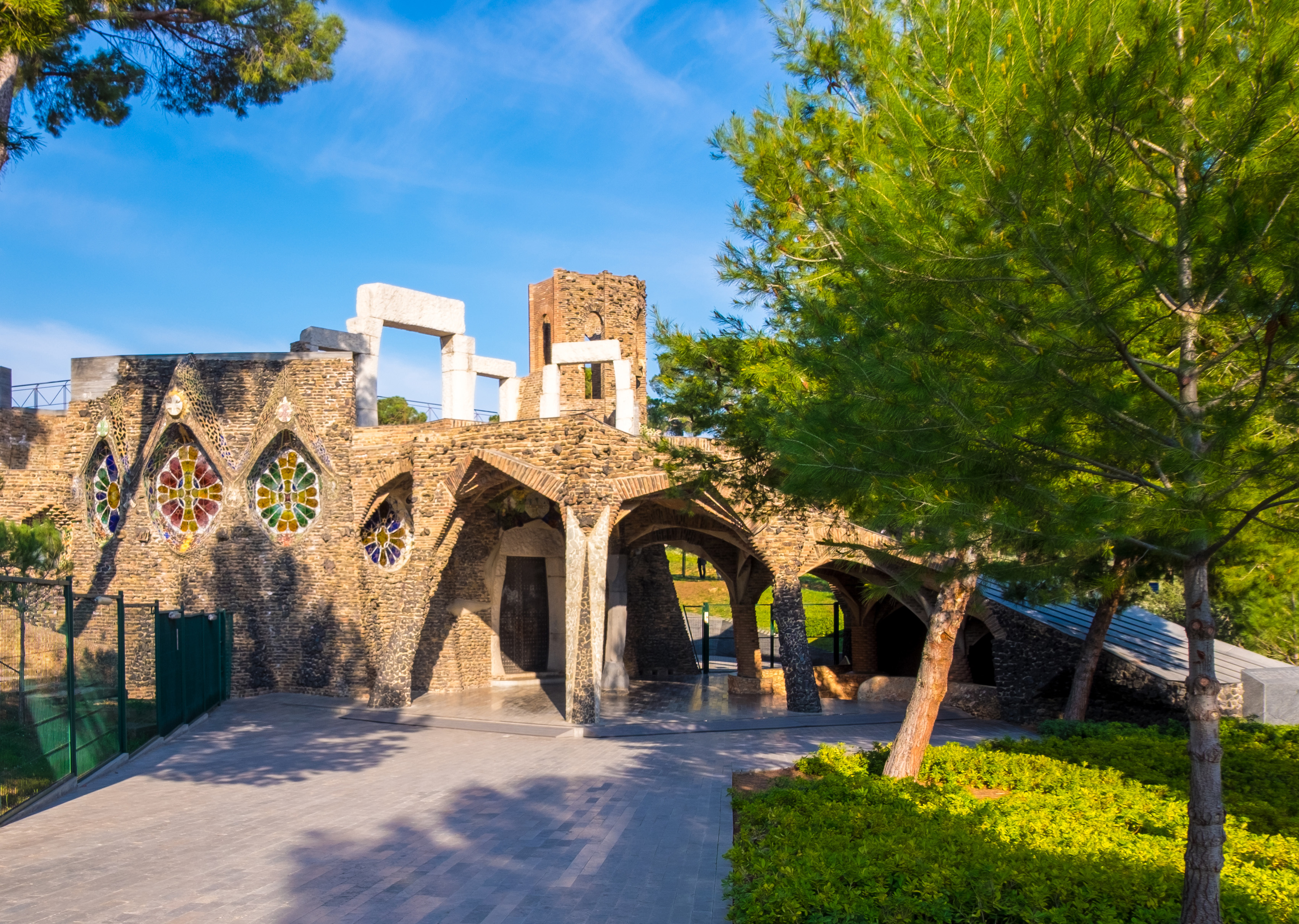
The Gaudí Crypt of Colonia Güell - Shutterstock
A stroll through the Colonia Güell is to delve into the memory of modernist industrial Catalonia: quiet streets, exposed brick facades and an environment that reflects how architecture can also be an instrument of social cohesion and the dignification of work.
La Nau Gaudí: the origins of a visionary language
Less well-known to the general public, but of enormous historical significance, the Nau Gaudí in Mataró is one of the first works built by the architect. Constructed between 1878 and 1883 for the Mataró Workers' Cooperative—founded by the textile industrialist Salvador Pagès—this Nau stands out for its early use of parabolic arches as a structural solution.
This system, which allows for efficient and elegant weight distribution, would later become one of the most characteristic features of Gaudí's architectural style. In the Nau Gaudí, one can perceive his desire to experiment with geometry and constructive rationality, laying the foundations for his future creative evolution.
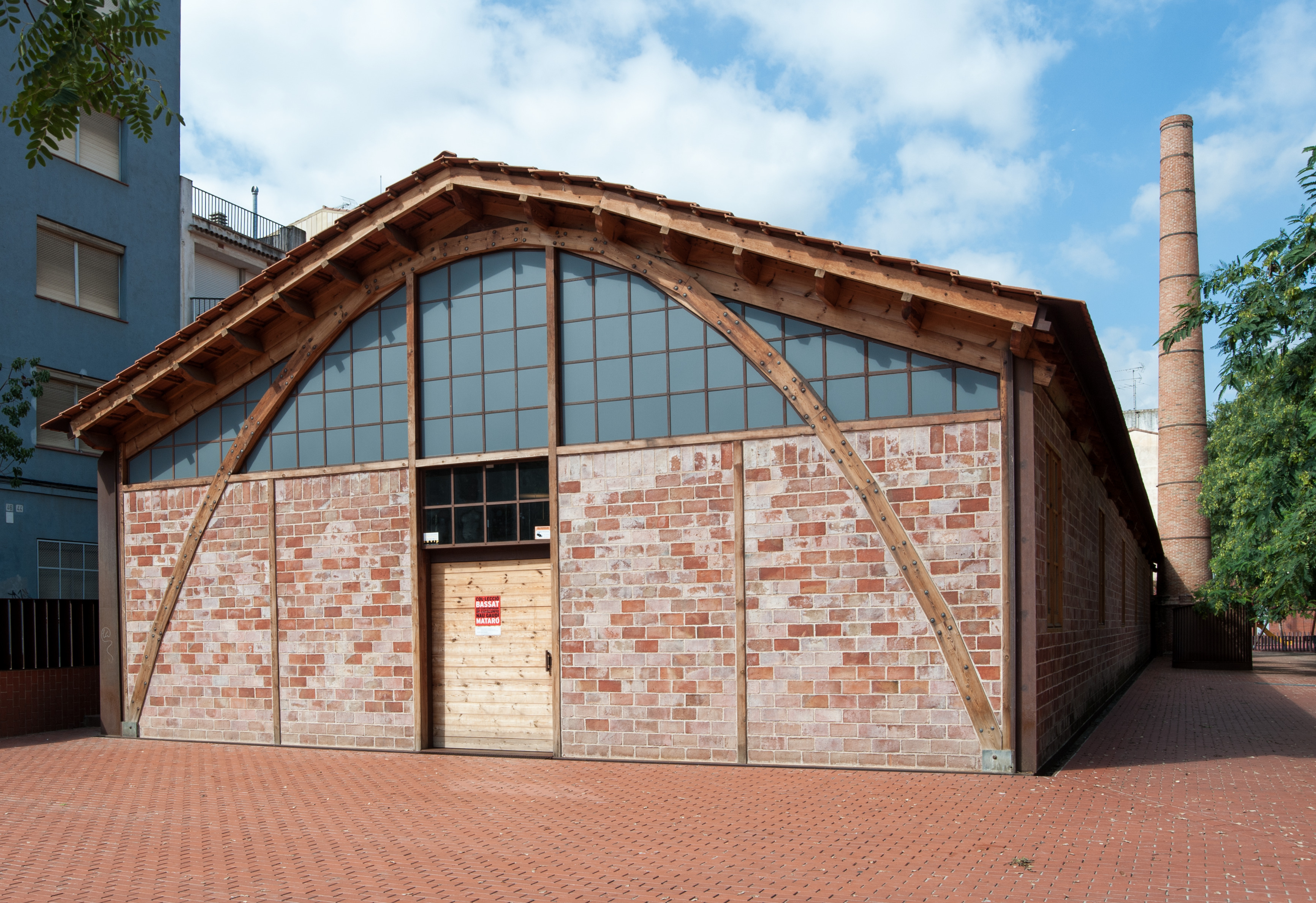
Nau Gaudí - Bassat Museum in Mataró - ©Gonzalo Sanguinetti / Barcelona Provincial Council
Currently, the building serves as an exhibition space and venue for contemporary art shows, facilitating a dialogue between past and present within the same architectural space. Visiting the Nau Gaudí reveals how the early steps of an exceptional creator already contained the seeds of his later greatness.
The Artigas Gardens: nature and architecture in harmony
In the natural surroundings of La Pobla de Lillet, in Berguedà, are the Artigas Gardens, a unique work created between 1905 and 1906. Unlike his large urban projects, here Gaudí worked in the heart of nature, integrating architecture and landscape into a harmonious composition.
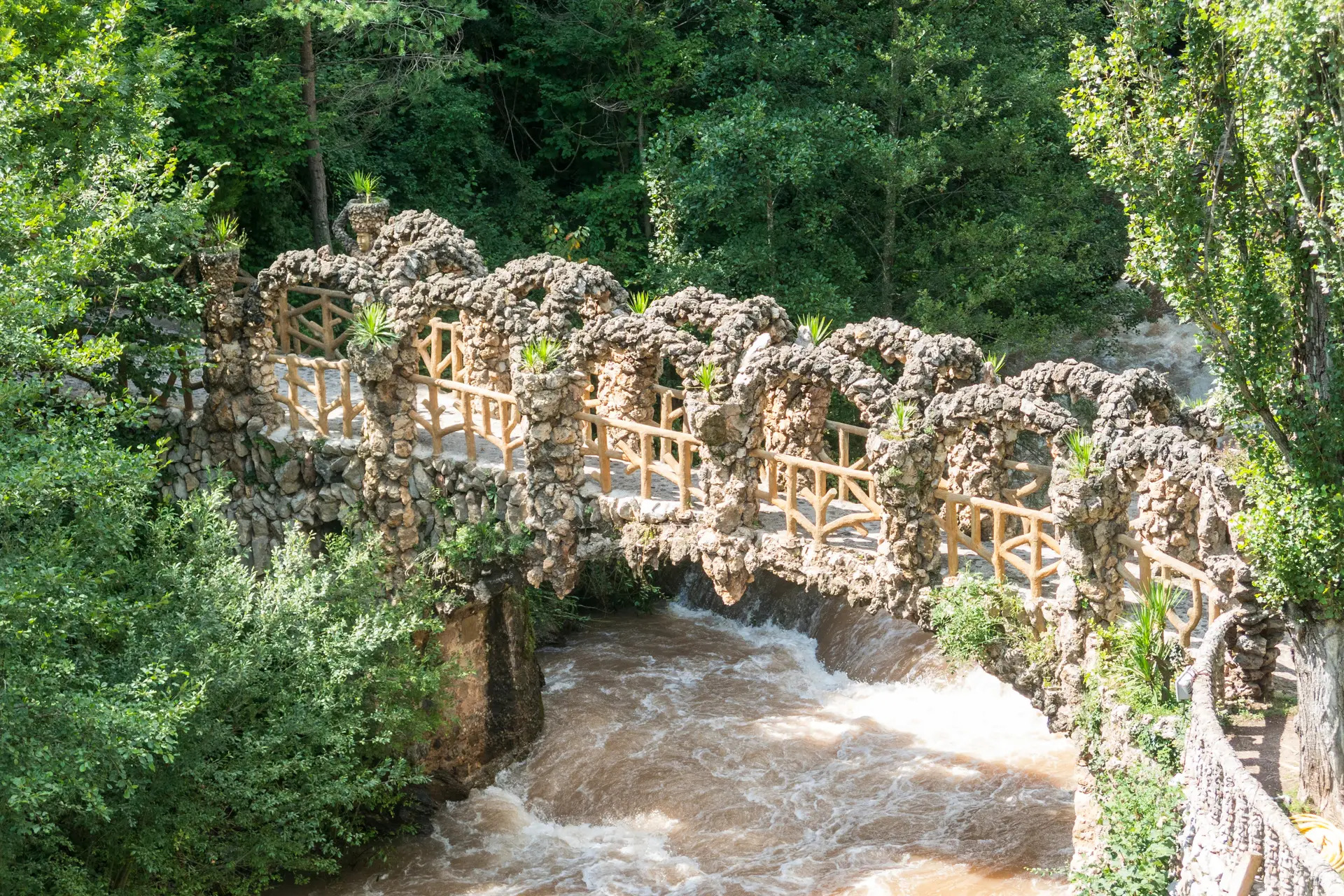
The Artigas Gardens in La Pobla de Lillet - Shutterstock
The project arose as a gesture of gratitude towards Joan Artigas, a textile industrialist who had hosted the architect during his time in the area. In these gardens, bridges, fountains, sculptures, and architectural elements seem to emerge from the rock and engage in a dialogue with the river and the surrounding vegetation.
Stone, water, and vegetation combine to create a sensory journey rich in nuances. More than a conventional garden, it is a dynamic aesthetic experience, where each step reveals shifting perspectives and symbolic details. A leisurely visit invites contemplation and the discovery of Gaudí's most organic and poetic side.
And just a few kilometers from La Pobla de Lillet, we can admire the unique Chalet del Catllaràs—currently under restoration—which served as accommodation for the technicians and engineers of the Catllaràs mountain range coal mines, exploited at the beginning of the 20th century by the Portland cement company Asland. Gaudí designed this building in 1902, and in 1932 the Asland company donated it to the City Council.
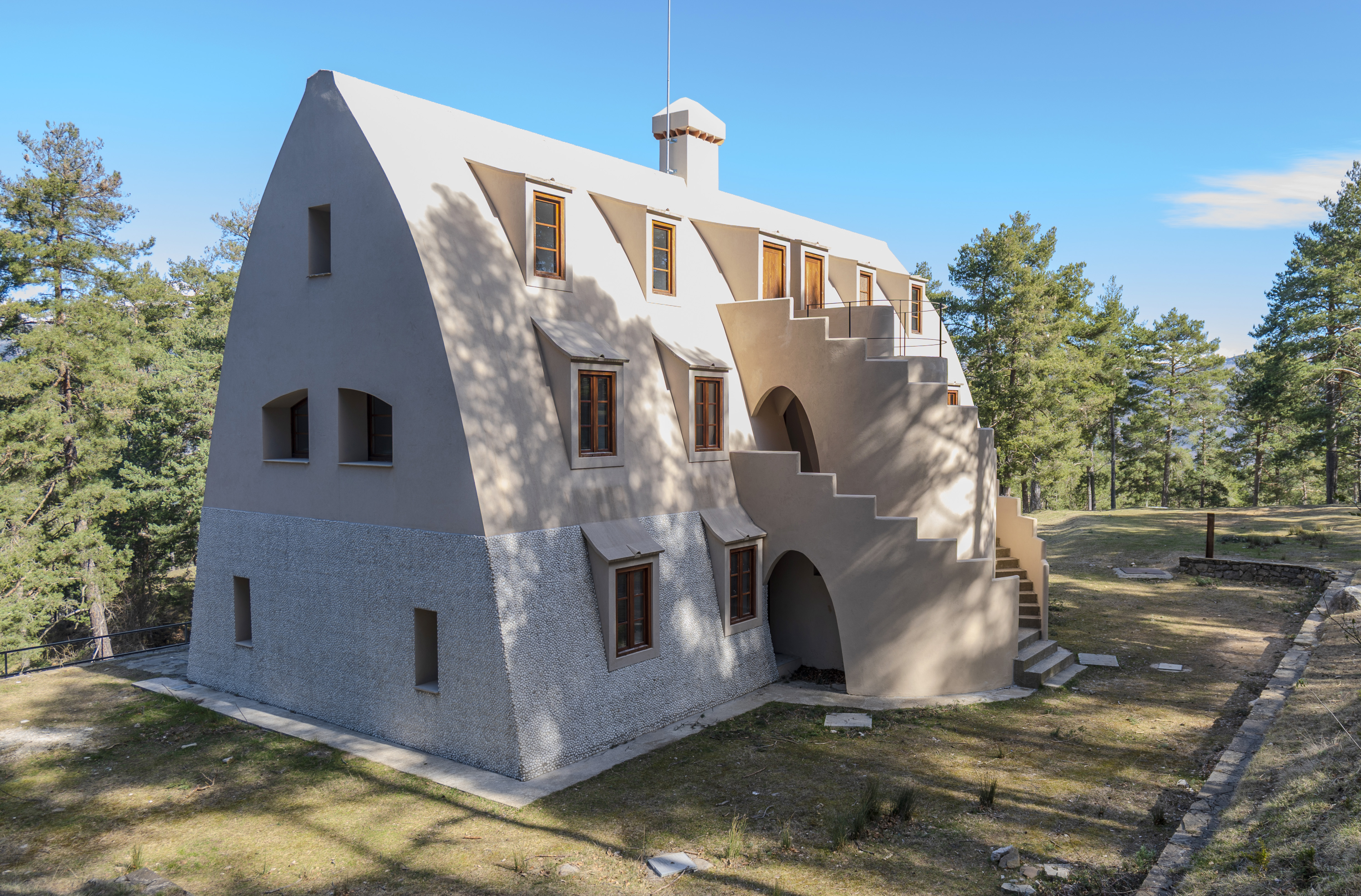
Catllaràs chalet in Berguedà - ©Albert Miró / Barcelona Provincial Council
By the 1940s, the building was already in a state of disrepair, and in 1971 it was renovated to become a holiday camp, with its most distinctive feature, the spiral staircase, being replaced by a metal one. In the late 1980s, due to changes in regulations, it fell into disuse and was in a considerable state of disrepair. Its exterior has now been restored with the support of the Barcelona Provincial Council.
This year the Chalet del Catllaràs has been officially confirmed as a Gaudí work.
An invitation to discover Gaudí's cultural heritage
Discovering Gaudí by visiting the Palau Güell and completing the experience with the Gaudí Crypt at the Colonia Güell, the Nau Gaudí, the Artigas Gardens, and the Chalet del Catllaràs is to explore different stages and dimensions of the brilliant architect's creative universe. From the urban and bourgeois sophistication of the Barcelona palace to the structural experimentation of the industrial colony; from his visionary beginnings in Mataró to his complete fusion with nature in Berguedà; each space offers a different perspective on his legacy. Exploring them is a unique opportunity to rediscover a heritage that is close, accessible, and of universal significance in the province of Barcelona.
**Content provided by the Barcelona Provincial Council**
Published by Diputació de Barcelona on 28 of may of 2026 at 08:11h
Events
European Heritage Days in Collbató
16 OctoberAlfaro Year in Sant Andreu de Llavaneres
16 OctoberForest week in Sant Celoni
16 OctoberRACC Costa Dorada Rally in Salou
From 16 to 17 OctoberZim Zam Cassà - Cassà de la Selva Urban Art Festival
From 16 to 17 OctoberEbrencas Letters Days in Amposta
From 16 to 18 OctoberFirauto Balaguer
From 16 to 18 October
Experiences







 Sustainable turism
 Biosphere