


Roman architecture in Catalonia: cities, roads and water for an empire
Long before medieval castles and grand cathedrals were built, the Romans had already begun to transform the landscape of present-day Catalonia. Their arrival on the coast, around 218 BC, marked the beginning of a presence that would extend far beyond military conquest. To consolidate their rule, they built cities, walls, roads, bridges, and large public buildings that changed the way the territory was organized and inhabited.
Roman architecture is one of the greatest testaments to this transformation. Its buildings were not merely designed to impress, but to address very specific needs: facilitating mobility, ensuring the water supply, protecting cities, and creating spaces for public life. This combination of engineering, functionality, and monumentality left a profound mark that, more than two thousand years later, we can still discover in numerous corners of Catalonia.
Architecture designed to last
The Romans drew inspiration from many elements of Greek architecture, but adapted and combined them with their own construction techniques. In this way, they were able to erect large buildings, cover vast spaces, and build infrastructure capable of spanning considerable distances.
Among the most characteristic elements were the semicircular arch and vaults, which allowed for better weight distribution in buildings. They also used columns, capitals, and entablatures inspired by the classical orders, often with an ornamental function. In the most monumental works, the use of large, well-squared stone blocks was also prominent, while cities were planned around orderly streets, forums, and public buildings.
This method of construction had a very clear purpose: to put architecture at the service of the city and the surrounding territory. Aqueducts, bridges, roads, theaters, circuses, and amphitheaters were all part of the same system, facilitating the functioning of the towns and consolidating their Roman presence.
Tarraco: the great Roman center of Catalonia
If there is one essential place to understand Roman architecture in Catalonia, it is Tarraco, present-day Tarragona. Its origins date back to a military camp established during the war against Carthage, but its strategic location on the coast and its connections to inland routes fostered rapid growth. Over time, it became the capital of Hispania Citerior and one of the most important cities in the western Mediterranean, covering an area of between 80 and 90 hectares.
The importance of this ancient city is reflected in its extraordinary archaeological complex, declared a World Heritage Site by UNESCO in 2000. This designation includes fourteen monuments spread throughout Tarragona and the Tarragonès region, most notably the city walls, the provincial forum, the circus, the theater, and the amphitheater. Each of these sites offers a glimpse into a different aspect of urban life during the Roman era.
The walls: a defense that has stood the test of time.
The walls of Tarraco are one of the oldest surviving Roman constructions on the Iberian Peninsula. The first phases of construction date back to the 2nd century BC, and at its peak, the defensive enclosure reached a length of approximately 4,500 meters. Currently, about 1,100 meters remain, surrounding the upper part of Tarragona.
One of the most striking aspects is its initial construction, made with large, almost cyclopean-looking stone blocks. Its base long generated various hypotheses about the possible existence of an earlier wall. But its value lies not only in its antiquity: these structures continued to serve a defensive function for centuries. Medieval Tarragona reused them and kept them in use until the 19th century, making them an exceptional example of architectural continuity.
The amphitheater: spectacle and memory by the sea
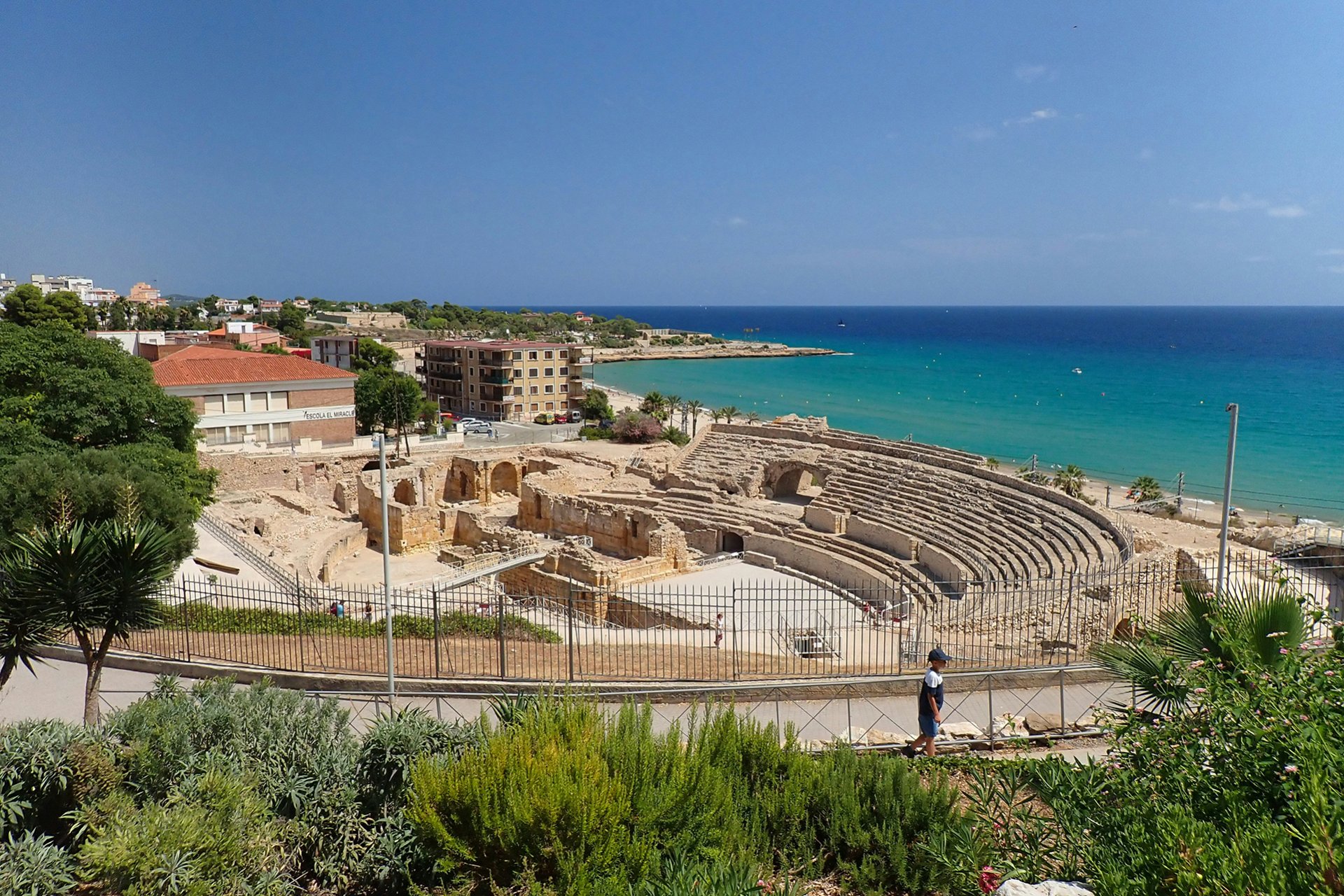
One of Tarraco's most iconic landmarks is the Roman amphitheater, located near the sea. Built in the early 2nd century AD, the building was a donation from a high-ranking provincial official and was intended to host public spectacles. Its arena measures 62.5 by 38.5 meters, and the seating was divided into three sections. Gladiator fights, wild animal hunts, and executions were all held there.
This space is also closely linked to the history of Christianity in Tarragona. On January 21, 259, Bishop Fructuosus and his deacons Augurius and Eulogius were burned alive in the arena, an event remembered as their martyrdom. Over the centuries, the amphitheater lost its original function and became a site of religious memory. In the 6th century, a basilica dedicated to the martyrs was built, and later, in the 12th century, the Romanesque church of Santa Maria del Miracle was erected. Today, the remains of these structures coexist in the same place, allowing us to observe how different eras have left their mark on the city.
Beyond Tarraco: bridges, arches and funerary monuments
The Roman presence was not limited to large urban centers. The Romans also transformed the territory with an extensive network of roads and infrastructure that connected towns and facilitated the transport of people, goods, and resources. Some of the most outstanding examples of this engineering are still preserved near Tarragona.
The Devil's Bridge: engineering at the service of water
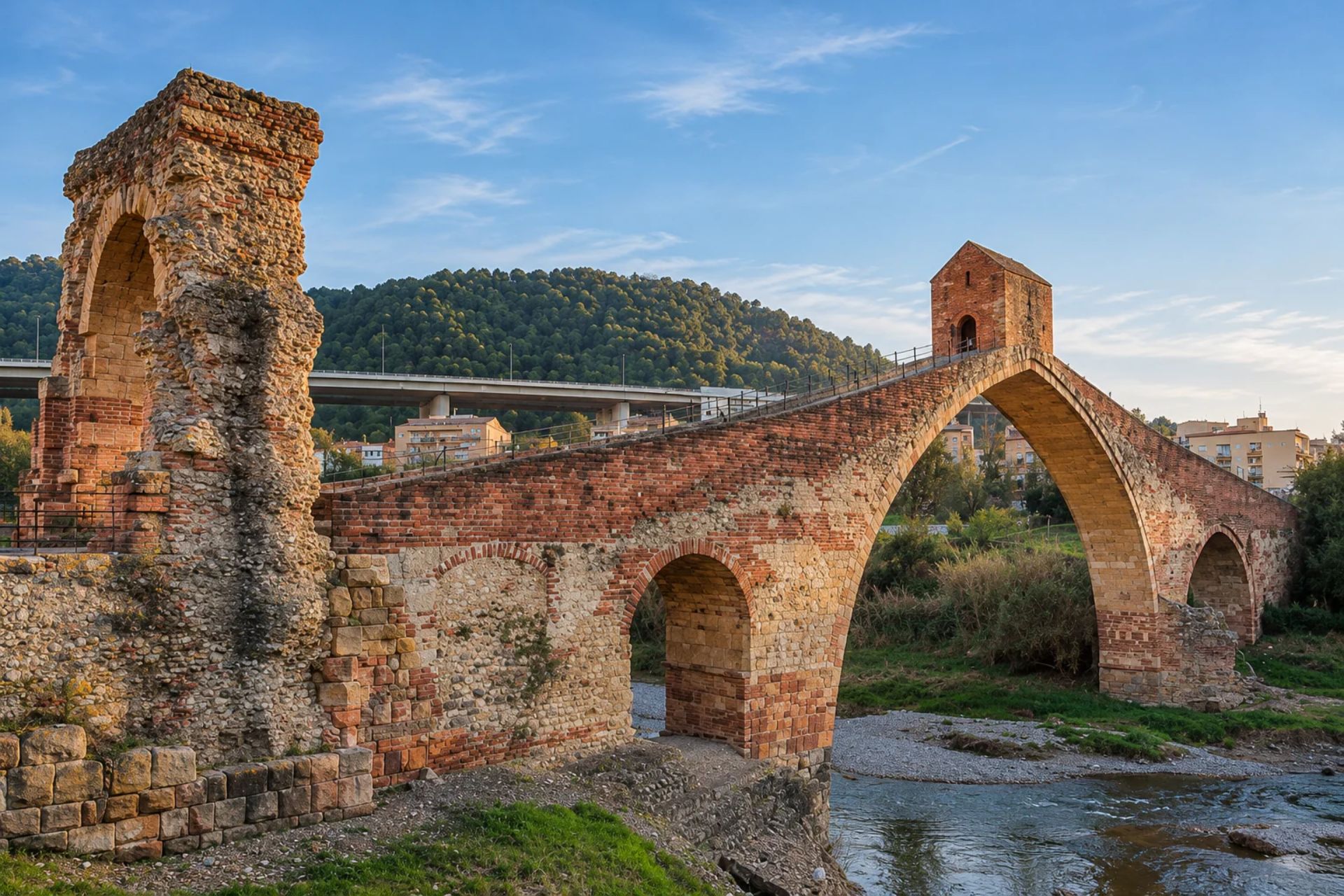
One of the most impressive examples is the Les Ferreres aqueduct, popularly known as the Devil's Bridge. This structure allowed water to be transported from the Francolí River to Tarraco and is an exceptional example of the Romans' technical skill.
The aqueduct is 217 meters long and reaches a height of 27 meters. Its structure consists of two superimposed levels of arcades, with eleven arches on the lower level and twenty-five on the upper. Most historians date it to the 1st century AD, during the reign of Augustus, and it remained in use until the Middle Ages. Its silhouette, integrated into the landscape, continues to impress with its combination of practical function and monumental structure.
The Arco de Berà: a door to the ancient Via Augusta
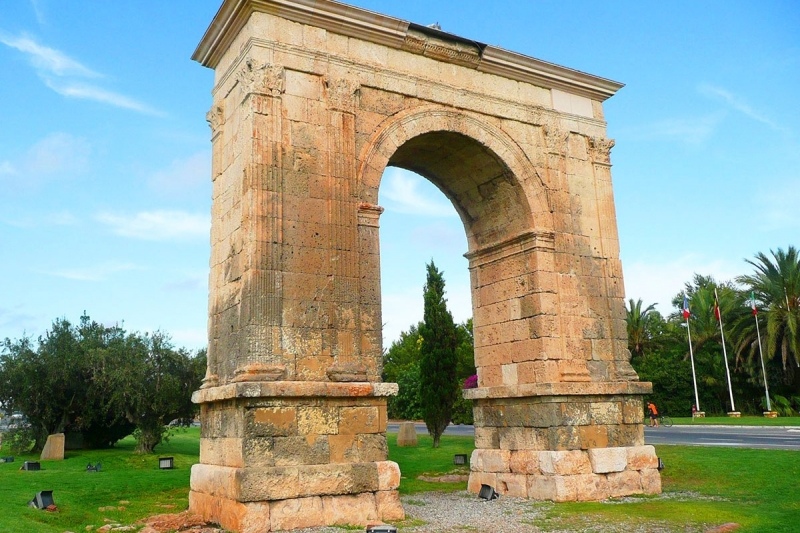
In Roda de Berà, on the route of the ancient Via Augusta, we find another outstanding Roman monument: the Arch of Berà. Built around 10 BC, this monumental arch measures approximately 12 meters in height and was erected, according to the inscription, by testamentary disposition of Lucius Licinius Sura.
The structure is built of large stone blocks and features a single central opening, flanked by fluted pilasters with Corinthian capitals. Its presence marked the passage of the Via Augusta through the area and served as a reminder of the importance of this major Roman road.
The Tower of the Scipios: a funerary monument with a curious history
Also near Tarragona, next to the ancient Via Augusta, stands the Tower of the Scipios, a funerary monument built during the first half of the 1st century AD. It currently stands about 9 meters tall and is organized into three square sections. In the central part are two relief figures representing the Phrygian god Attis.
Its popular name hides a historical curiosity: for a long time, it was believed that the figures represented the Scipio brothers. This interpretation was incorrect, but the name has persisted to this day. It is a good example of how Roman monuments also preserve small stories about how later generations have interpreted their past.
Centcelles: a dome between two worlds
Roman architecture continued to evolve as the Empire changed. Traditional building methods coexisted with new influences and artistic expressions, especially in the later centuries of the Roman era. In Catalonia, one of the most outstanding examples of this transition is the Mausoleum of Centcelles, located in Constantí, about six kilometers from Tarragona.
The building originated as a Roman agricultural villa, but in the 4th century part of the complex was transformed into a funerary monument. Its most spectacular feature is a circular hall over ten meters in diameter and about thirteen meters high, crowned by a large dome decorated with mosaics.
These compositions are especially valuable for the scenes they depict. Hunting scenes and biblical episodes appear, while in the section closest to the summit, the four seasons can be observed, represented by figures seated on red thunderbolts. Even today, it is not known for certain who was buried in this space, a mystery that has given rise to various interpretations regarding its function and origin.
Centcelles is a unique place because it combines a Roman-inspired architectural structure with decoration that hints at the early Christian world. This building allows us to glimpse a moment of change and understand how architecture also evolved with the cultural and religious transformations of the time.
A legacy that is still part of the landscape
One of the most fascinating aspects of Roman architecture in Catalonia is that its legacy is not isolated from the present. In many cases, the buildings and infrastructure have continued to serve different purposes throughout the centuries. The walls of Tarraco were reused during the Middle Ages, the amphitheater housed Christian buildings, and the ancient Roman roads continued to influence communications in the region.
The Romans left behind more than just monuments: they established a way of organizing cities and connecting landscapes that we can still recognize today. To discover it, all you need to do is explore some of these places at a leisurely pace. Strolling through the upper part of Tarragona, walking along the ancient walls, admiring the amphitheater by the sea, or pausing under the arches of the Devil's Bridge are all different ways to connect with that history.
More than two thousand years later, these constructions continue to explain to us what a society was like that made engineering and architecture two fundamental tools to transform the world around it.
Published by Oriol Rosselló Gil on 9 of november of 2026 at 13:00h
Events
Experience opera in Vilallonga del Camp!
10 NovemberNovember 10, World Science Day for Peace and Development
10 NovemberSant Menna, Sentmenat Winter Festival
From 10 to 11 NovemberWinter Festival in Vilallonga del Camp
From 5 to 11 NovemberGastronomic Days with New Extra Virgin Olive Oil in Cambrils
From 30 October to 15 NovemberSant Martí Festival in Altafulla
From 10 to 15 NovemberCurtÀneu - Valls d'Àneu International Short Film Exhibition
From 7 to 15 November
Experiences






 Sustainable turism
 Biosphere