


Viver i Serrateix
The municipality of Viver i Serrateix is located in the Berguedà region and belongs to the bishopric of Solsona.
It consists of three villages: Serrateix, which is the main town, Viver, and Sant Joan de Montdarn. All of them have a settlement made up of scattered farmhouses with the parish church as the center; only Serrateix has a small nucleus around the Cal Fuster restaurant.
The current municipality was formed in the first half of the 19th century, when the municipalities of Viver, which included San Juan, and Serrateix were merged.
A territory inhabited since prehistoric times
The areas that now comprise Viver and Serrateix have been inhabited since ancient times. The first farmers settled there as early as the Neolithic period, taking advantage of the area's natural resources.
From the Iberian-Roman period, several archaeological sites have been located, including small farmhouses, which form the basis of the medieval settlement and also of the present day. The dispersed settlement pattern, typical of this area, has its roots in these remote periods.
The medieval legacy and the role of Wilfred the Hairy
The present-day villages took shape during the High Middle Ages, between the 8th and 10th centuries. Count Wilfred the Hairy played a significant role in repopulating central Catalonia during the 9th century. In Serrateix, he commissioned the construction of the parish church of Sant Pere and a defensive tower, known as the Abbot's Tower, which is now part of the Serrateix Monastery. He also founded a monastery for clergy in Sant Joan. The present-day town of Viver traces its origins to an 8th-century Frankish castle.
The municipality preserves many traces of the medieval period: roads, farmhouses, flour mills, watchtowers, tombs carved into the rock, Romanesque churches.
Historic roads and rural landscape
The municipality also preserves remnants of ancient paths, some of which still bear the marks of animals etched into the rock. The path that runs alongside the Navel stream is particularly noteworthy, a testament to centuries of rural traffic and farming activity.
Currently, the municipality is well connected to neighboring towns by paved roads, which facilitates access to a quiet territory, rich in heritage and surrounded by rural landscape.
Places of interest
Monastery of Santa Maria de Serrateix
A monastic complex of medieval origin, with significant pre-Romanesque and Romanesque elements, as well as later additions. It is a key site for understanding the history of the municipality and a unique complex along the entire Llobregat and Cardener river basin. Guided tours are currently available, managed by the Friends of Serrateix Foundation.
Church of San Pedro de Serrateix
Old parish church linked to the monastery, founded in the time of Guifré el Pelós. It preserves architectural elements of high historical value and is an inseparable part of the monumental complex of Serrateix.
Church of San Miguel de Viver
The parish church has its origins in a 10th-century pre-Romanesque temple, of which anthropomorphic tombs carved into the rock remain in the surrounding area. The current church, consecrated in 1187, is a remarkable example of Romanesque architecture transitioning to Gothic, a style uncommon in the region.
Church of St. John of Montdarn
A temple of early medieval origin, located in a place with a history of eremitic life in the 6th and 7th centuries. In the 9th century, a monastery was founded there, promoted by Wilfred the Hairy, which was suppressed in the 11th century, at which point San Juan became a simple parish church.
Ancient paths and Navel stream
Historical trails wind through the municipality, offering a glimpse into the rural landscape and the traces of human presence over the centuries. The section near the Navel stream is particularly interesting for observing the markings etched into the rock.
Farmhouses and rural heritage
The municipality preserves a rich collection of farmhouses, flour mills and traditional agricultural structures, which explain the importance of farming activity and the dispersed settlement that characterizes Viver i Serrateix.
Events
Popular Chestnut Festival dinner in Avià
31 October'Trenca 3 Pics' in Navàs
1 NovemberNAVÀS T'APASSIONA!
From 5 to 22 NovemberPlaza Saturdays in Santpedor
7 NovemberLocal market in Santpedor
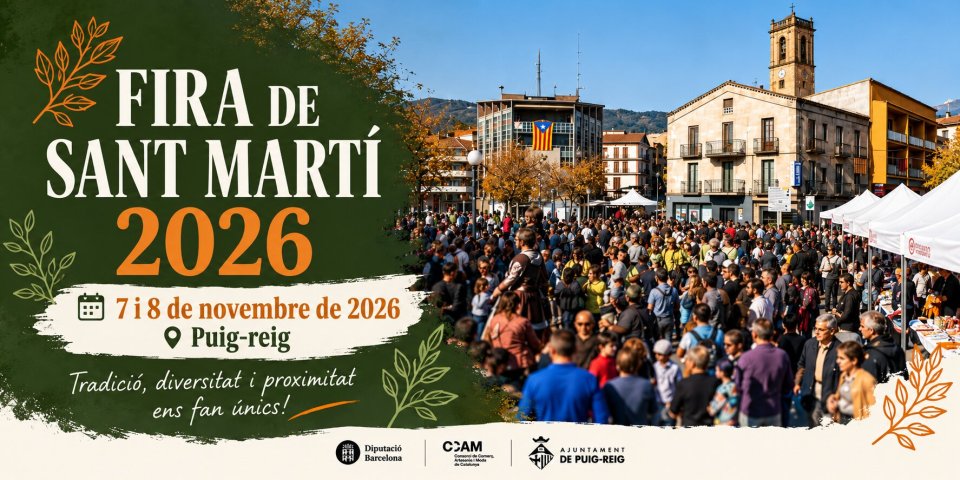
7 NovemberSant Martí Fair in Puig-reig
From 7 to 8 NovemberFamily Medieval Gymkhana in Súria
8 NovemberMatiners Fair in Avinyó
8 NovemberSúria Medieval Crafts Fair
From 14 to 15 NovemberReturn to La Maria, the Avià Mountain Race
From 14 to 15 NovemberNational Film and Video Competition in Navàs
From 16 to 29 NovemberNearby routes
Permanent orientation circuits in Montclar
The battles of 1714
Trying the 1714 food
Grand Tour de Catalunya - Section 1. Vineyards with taste in the sea: from Barcelona to Tarragona
Route of the castles in Catalonia
1714 Route: History and heritage of the War of the Spanish Succession in Catalonia
Condal Pyrenees: a tour of the medieval Catalan identity
Ruta Medieval in Bages
The Pujol de Planès and the Navel stream in Montmajor
Route through the streams of Sorba, Agua de Ora and Gargallà

News








 Sustainable turism
 Biosphere