


Sant Vicenç dels Horts
Amidst vineyards, orchards, and gentle hills, Sant Vicenç dels Horts lies in the Llobregat River valley, at the foot of the Ordal mountain range and just a few kilometers from Barcelona. Its landscape, marked by the river, fertile plains, and Mediterranean forests, combines metropolitan vitality with the charm of a town that has managed to preserve its character and its roots.
With more than 29,000 inhabitants and a thousand-year history, Sant Vicenç dels Horts is today a benchmark in the Baix Llobregat region for its cultural activity, its historical heritage and its commitment to sustainability and community life.
A story rooted in the river and the land
The name Sant Vicenç dels Horts already reveals the link between faith and nature: a town dedicated to the patron saint Saint Vincent, surrounded by orchards and farmland that gave it life for centuries.
The first written records date back to the 10th century, when these lands were under the jurisdiction of Cervelló Castle. The existence of fertile orchards on the banks of the Llobregat River favored the emergence of small agricultural centers and scattered farmhouses, the origin of the present-day town.
During the Middle Ages, the parish of Sant Vicenç became the spiritual and social center of the area. Agriculture —particularly vineyards, olive groves, and orchards —was the main activity until well into the 19th century, when the arrival of the railway (1854) and the road from Sant Boi to Martorell definitively transformed the municipality, opening it up to trade and industry.
The 20th century brought strong population growth, especially from the 1960s onwards, with the arrival of new residents from all over Catalonia and other parts of Spain. This momentum shaped today's Sant Vicenç: a diverse, active, and open municipality that combines tradition and modernity with a strong sense of community.
Places of interest
The Parish Church of Sant Vicenç Màrtir
In the center of the historic center stands the parish church of Sant Vicenç Màrtir, documented since the 13th century. The current building is the result of various renovations —the most notable in the 19th century —that gave it the neoclassical appearance it retains today.
Inside, the main altarpiece dedicated to the patron saint stands out, as well as the Baroque images and stained-glass windows that project light onto the central nave. The church remains the spiritual heart of the town and the setting for traditional events, such as the Winter Festival in January.
The Old Town
The old town of Sant Vicenç dels Horts preserves the structure of its old medieval streets, with small squares and stone and brick facades. Carrer del Comerç and Plaça de la Vila are the focal points of the city's social and commercial life, with markets, cultural activities, and local fairs.
The historic farmhouses
The landscape of Sant Vicenç dels Horts still preserves numerous farmhouses that bear witness to the agricultural past of the area: Can Comamala, Can Sala, Can Ros, Can Bitó or Can Pujador, among many others.
Many of them have been restored and converted into cultural or educational facilities or spaces for organizations, maintaining the spirit of the old country houses.
A walk along the paths of the Torrent de Can Pujador or the Sierra de Can Guitart allows you to discover this rural heritage in a natural setting surprisingly close to the city.
The Molí dels Frares
A testament to Sant Vicenç's connection with the Llobregat River, the Molí dels Frares is a medieval flour mill. Located on the right bank of the river, its name comes from the monks of Sant Jeroni de la Murtra, who owned it.
Today, fully restored, it is an environmental interpretation space and a sustainability education center, where workshops, school visits and activities on the water cycle, energy and river heritage are held.
Nature and river paths
The Llobregat River and its natural surroundings are the municipality's main backbone. The orchards, wooded areas, and riverside paths offer recreational, sports, and discovery opportunities very close to the town center.
Pi Gros Park, with more than 10 hectares of Mediterranean vegetation, is one of the most beloved green spaces for locals. From its viewpoint, you can contemplate the entire town and the Llobregat plain.
The network of pedestrian and cycling paths, especially the Llobregat River Path, connects Sant Vicenç with neighboring towns such as Molins de Rei, Pallejà, and Sant Feliu. This route is part of the Llobregat Route, which follows the river from its source in Castellar de n'Hug to the delta.
A town with a vision for the future
With a clear commitment to the green transition, sustainable mobility, and inclusion, Sant Vicenç dels Horts is working to establish itself as a model for a sustainable Mediterranean city. The municipality is committed to preserving natural spaces, boosting local commerce, and social innovation as pillars of its development.
Sant Vicenç dels Horts is today a town with soul and identity, capable of offering the proximity of a historic town and the vitality of a modern city. Between the river and the mountains, it preserves the essence of its history while building a shared future.
Events
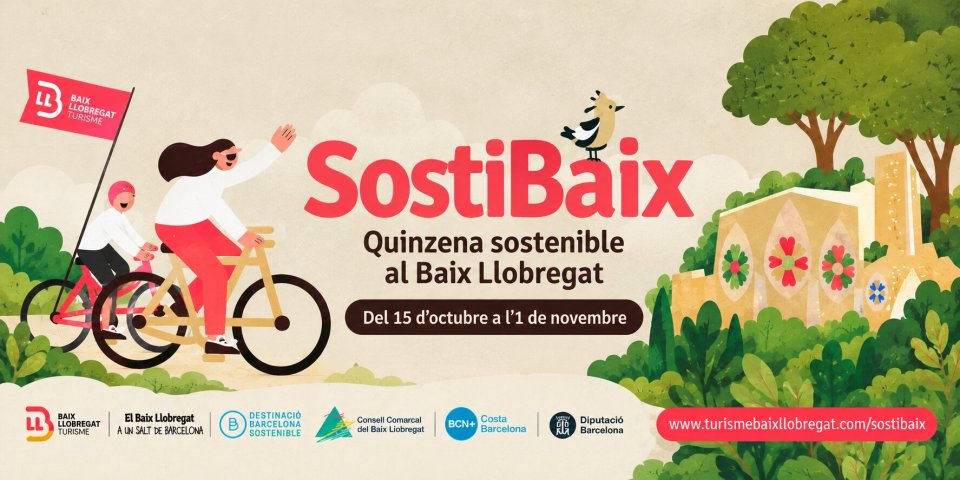
Sostibaix, the sustainable fortnight of Baix Llobregat
From 15 October to 1 NovemberPanoràmic Festival in Granollers, Barcelona, Terrassa and Vic
From 15 October to 27 DecemberThe Castañera in La Pedrera!
24 OctoberTransmaresme Bike
24 OctoberCrossing of the Three Hermitages of Olesa de Montserrat
25 OctoberAutumn of Cooking and Mushrooms in Terrassa
From 30 October to 22 NovemberOpen doors at the Cava Centre, Sant Sadurní d'Anoia
1 NovemberFestival 42 - Barcelona Fantasy Festival
From 4 to 8 NovemberMost, International Wine Film Festival in Penedès and Priorat
From 5 to 15 NovemberTerror Molins, Molins de Rei Horror Film Festival
From 6 to 15 NovemberScenic programming in Gelida
8 NovemberNearby routes
Mediterranean Trail
The Baix Llobregat, a trip through history
A stroll through the gardens surrounding Barcelona
Itinerary Jujol in Sant Joan Despí
The main characters in the the siege of 1714
Trying the 1714 food
May 18: International Museum Day in Barcelona
Fairs, cowherd boys, games and theater to celebrate Christmas
The battles of 1714
Sports tourist destinations of Catalonia
News
Iron architecture: the light and steam of industrial Catalonia
In the 19th century, the Industrial Revolution not only changed the way people worked and lived, but also profoundly transformed architecture. The arrival of new materials, such as cast iron, wrought iron, and glass, opened up possibilities…
Gothic Architecture: The light and height of medieval Catalonia
Gothic architecture marks a turning point in the history of Catalonia. It was the style that transformed cities, places of worship, and the way people built collectively. A style that changed not only the stone itself, but also the way people…








 Sustainable turism
 Biosphere