


Avinyó
Avinyó is a municipality located in the northern part of the Bages region, in the Gavarresa valley, near the Lluçanès region. The municipality is extensive and features a wide range of holm oak and pine forests. Crops are mostly dryland, with cereals being particularly prominent. In the livestock sector, pig farming is the most important.
Vineyards play a significant role, although they were much more widespread in the past. Over time, they have transformed considerably thanks to the introduction of high-quality grape varieties and modern cultivation techniques. The Pla de Bages Designation of Origin will further strengthen this wine-growing activity. As for industry, the meat processing sector is the most prominent. The textile industry should also be mentioned, although it has suffered several crises.
The main population center is located on the right bank of the Relat stream, in relatively flat terrain. Other important villages are Horta d'Avinyó and Santa Eugènia de Relat. The municipality is crossed by the B-431 road (connecting to Prats de Lluçanès and Artés) and the BP-4313 road (connecting to Balsareny and Santa Maria d'Oló).
History
Avinyó has been inhabited since prehistoric times, as evidenced by the megalithic tombs found in Sant Marçal and Serradebena. An Iberian settlement existed there as early as the 6th century BC, and documents predating the year 1000 mention places such as Villa Torcona (Torcó) and Rio Lato (Relat). The name Castro Avinione appears in a document from the year 967.
From Roman times, a document from 1053 mentions a road connecting Manresa with Prats, passing through Avinyó, probably crossing the Relat stream, where the Pont Vell (Old Bridge ), built in the 14th century, now stands. During the Reconquista, the Counts of Barcelona and the Kings of Aragon were the feudal lords of the area, where the castle of Avinyonet, in the Riberota region, was located. It changed hands several times until 1803, when it was sold to the Verdaguer family. Currently, no trace of it remains.
In 932, Sunyer, Count of Barcelona, promoted the construction of a hermitage dedicated to Saint Andrew on the site of the present-day square. In 1232, due to the deterioration of the church near the Relat, this hermitage, or a new construction, became the parish church of Saint John, consecrated on February 28, 1233. The earthquake of 1427 caused the collapse of part of the Pont Vell (Old Bridge).
On August 16, 1714, Avinyó withstood an attack by the French troops of Philip of Anjou during the War of the Spanish Succession, but the troops later destroyed the town hall and the church. During the Second Carlist War, on November 16, 1848, the Carlist general Rafael Tristany captured the Isabeline Brigadier Manzano in Avinyó, an act for which Tristany received the title of Count of Avinyó. The telegraph tower, known as the Torre dels Soldats (Tower of the Soldiers), was built during this war.
Romanesque art in Avinyó
Romanesque art flourished between the 11th and 13th centuries across much of Europe and is one of the principal expressions of the great importance of religion and the Church's influence in medieval society. In the town of Avinyó, we find several Romanesque churches, although almost all have undergone modifications and the incorporation of new styles.

Events
Fes-ta Bruixa (Witches' Festival) in Sant Feliu Sasserra
31 OctoberOperation Castaween in Món Sant Benet
31 OctoberScary Nights in Sant Joan de Vilatorrada
31 October'Trenca 3 Pics' in Navàs
1 NovemberSant Feliu Sasserra Witches' Fair
1 NovemberNAVÀS T'APASSIONA!
From 5 to 22 NovemberPlaza Saturdays in Santpedor
7 NovemberLocal market in Santpedor
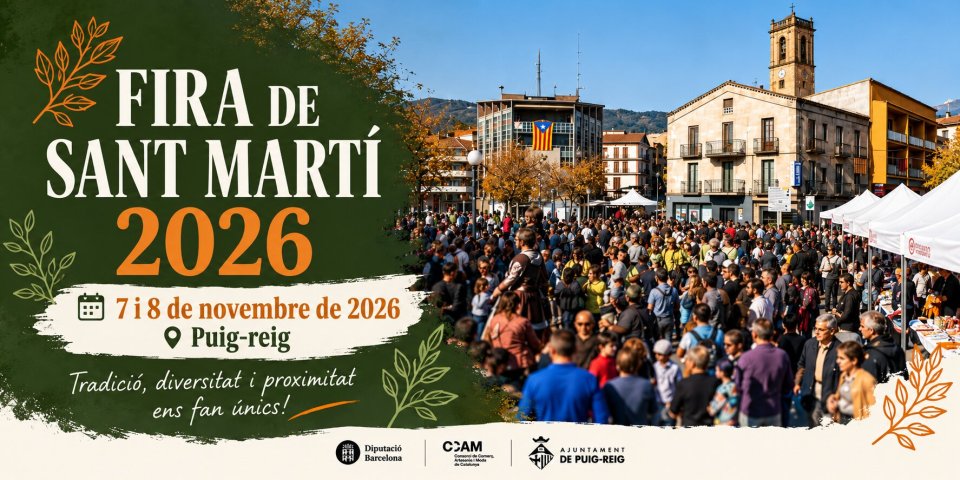
7 NovemberSant Martí Fair in Puig-reig
From 7 to 8 NovemberMatiners Fair in Avinyó
8 NovemberFamily Medieval Gymkhana in Súria
8 NovemberNearby routes
Geological itinerary through the Brai de Oló
The Ribera forest in Santa Maria d'Oló
The battles of 1714
Camino de Santiago: from Sant Esteve d'en Bas in Cervera
Paths of the Bishop and Abbot Oliba
Route through the heritage of Balsareny
Route to the manresans lock in Balsareny
Navàs Historical Memory Route
El Mujal via la cresta (circular)
From Castelladral to Balma de Comaposada (circular)








 Sustainable turism
 Biosphere