


Municipalities
On this route we suggest you put on a tunic and take a horse-drawn chariot to enter Tarragona and let ourselves be carried away by the Roman legacy that is preserved. Some Roman remains that have survived over the years and that in 2000 UNESCO declared a World Heritage Site.
But after the Romans, many other cultures still had to set foot on this land, Visigoths, Muslims, Jews... All of them have left their mark in the form of language, culture or monuments; traits that we currently find perfectly integrated into the daily life of the people of Tarragona, and that we invite you to discover.
A bit of history: Hispania, the empire at the foot of Tarragona
The first years before Christ, Tarragona began to experience a real revolution, it went from being a Phoenician city ( Tarcon ) of little importance to being occupied by the Romans ( Tarraco ), and being declared a military base, the first outside the Italian peninsula.. From there the invasion and structuring of the entire empire of Hispania was promoted. Later Tarraco became the capital of Tarraconense, an area that occupied the entire current Iberian Peninsula except for the South of Portugal, Extremadura and Andalusia.
Five hundred years later, the achievements and majesty of Tarragona merged with the fall of the Roman Empire and the entry of the Visigoths who destroyed and burned the city as a symbol of strength and occupation.
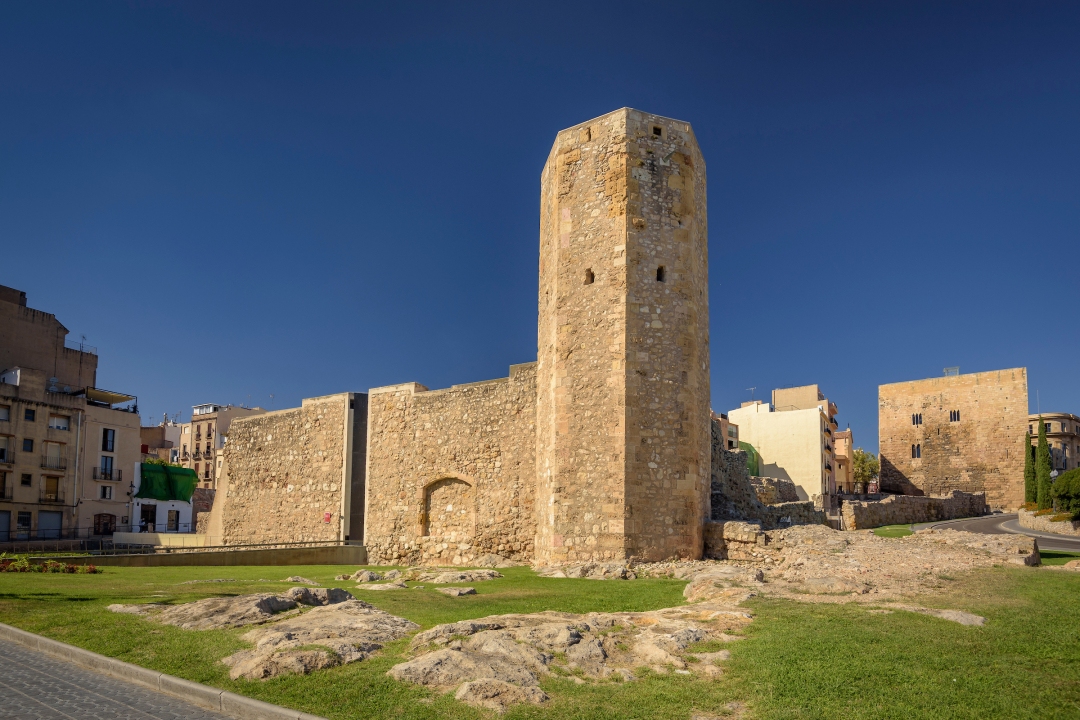
Runes del Circ Romà de Tarragona. Foto: Sergi Boixader
The three symbols of Tarraco's supremacy
We will begin our route through the Tarragona of 2000 years ago, visiting the Roman Amphitheatre, built in the 2nd century. You will find it going towards the sea, in front of the Miracle beach, where the animals came from and next to the Via Augusta, the entrance way to the city. It was built for gladiator fights and wild beast hunts, but it was also the setting for public executions. It had room for 14,000 people who accommodated themselves in the stands carved into the rock that can still be visited today.
Next, following the palm tree promenade, we find the Roman Circus dating from the 1st century. It is considered one of the best preserved in the West and has a unique structure since it was built inside the city. Horse races took place, the mass spectacle of the Roman world, which explains the large capacity of this venue, 30,000 spectators. Later it changed its use and during the 19th century other buildings were built inside.
Finally, it would be interesting to see the Roman Theater, a construction that together with the previous two symbolized the supremacy of the Roman city. Unfortunately, the theater is in very poor condition and cannot be visited.
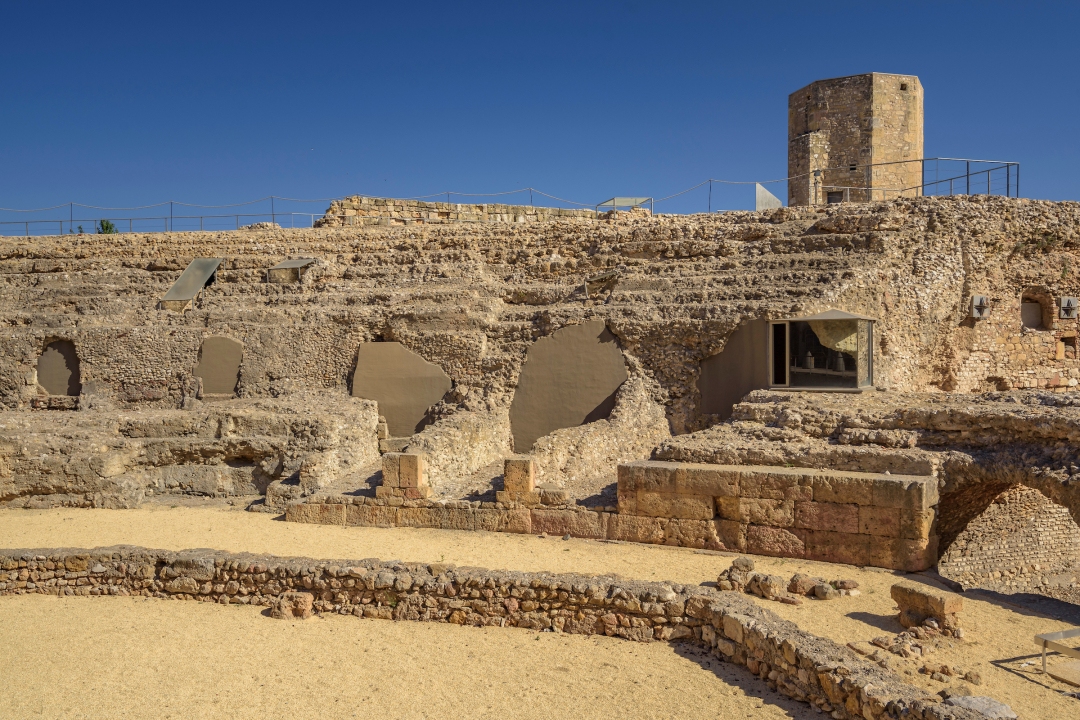
Amfiteatre del Teatre Romà de Tarragona. Foto: Sergi Boixader
The daily life of the Romans in Tarragona
Beyond the large buildings is the legacy of the daily life of the Romans in Tarragona . In the area near the Circus we can find remains of the Provincial Forum, the political and administrative center of the province of Tarragona, built in the 1st century. The most outstanding remains are those of the Plaza del Pallol (door, vault and pilasters of the Old Beaterio) and, at the end of the Rambla Vella, the Praetorium (tower that allowed passage from the lower city to the Provincial Forum), which connects through underground corridors with the Circus.
Walking through these streets you will come across the Cathedral of Tarragona, dating from the late Middle Ages, s. XIV, much later than the aforementioned constructions, but it is still a symbol of the city and shows the passage of different cultures through this land. It is built on a mosque, in turn, built on a Roman temple that was part of the buildings of the provincial forum.
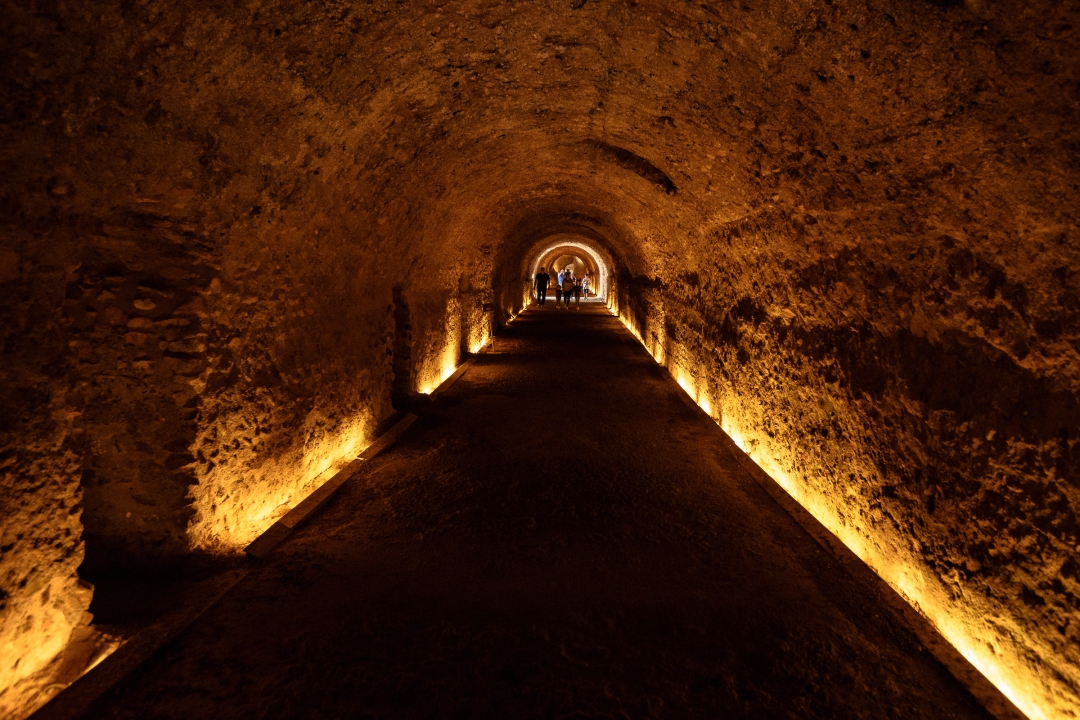
Galeries subterrànies del Circ Romà. Foto: Sergi Boixader
Also in the Plaza del Rei, since 1848 we have the National Archaeological Museum of Tarragona where all the objects and furniture from the Roman period found in Tarragona are collected. It is currently closed for renovations and in the meantime we can find the Tarraco/MNAT exhibition in Tinglado 4.
Around this entire area, in the old town, is the wall. It is the oldest preserved Roman construction outside of Italy, it was built in the sII BC and we can still see 1,100m of the original 3,500m that protected the city.
If we move to the other side of the Rambla Nova, in Lleida street, we will find the Local Forum or the Colony, the religious and social center of the Roman city. The remains are among the oldest in Tarragona, dating from the year 30 BC. Originally it was a wide covered square with the most important buildings around it, the religious, political and commercial area of the city. Currently only part of the Basilica remains, which housed the Court of Justice.
Finally, leaving Tarragona along Avenida Ramon y Cajal we will find the Paleochristian Necropolis, a cemetery and a set of funerary structures, dating from the mid-III century and perfectly suitable for visiting.
The Romans in the vicinity of the capital
Beyond the center of Tarragona, to which we can dedicate a whole day, we find a series of buildings, the furthest 20km from the city, which complete a weekend for the Roman legacy of the area.
If we take the N-340 road towards Barcelona we will find the Tower of the Scipios, 6 km away, the most famous funerary monument in Tarragona, almost completely preserved. Following the same road, after 14 km we will find Altafulla, where the Roman Vil·la dels Munts is preserved. Its owner, a senior member of the Tarraco administration, flaunted his wealth with murals, statues, mosaics, marble columns... which have largely been preserved to this day. Finally, if we return to the N-340 to Roda de Berà, 20 km from the capital, we will see the Arco de Berà. It is an arch dedicated to the emperor Augustus, located on the via augusta as a reception in the city of Tarraco. Years ago the road passed through it, but it was moved so as not to damage the monument, which, except for some inscriptions, is preserved in its entirety.
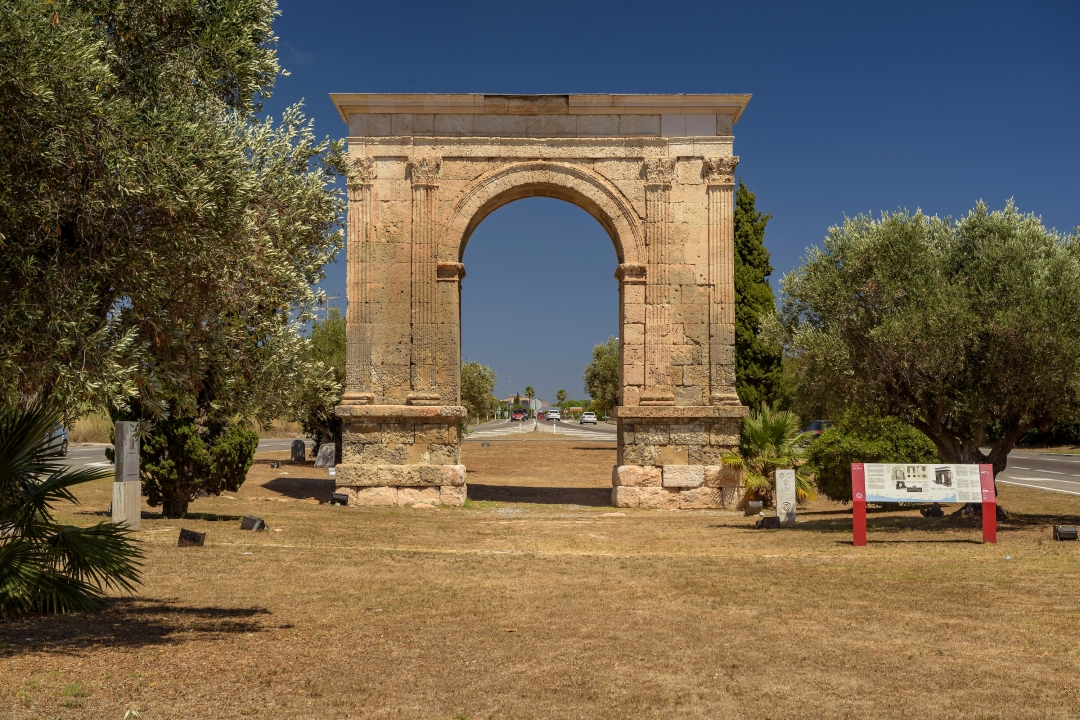
Arc de Berà a Roda de Berà. Foto: Sergi Boixader
If we change direction and take the N-240 road towards Constantí, 4 km from Tarragona we will find the Roman Vil·la de Centcelles. It is believed that it corresponds to a rural villa dedicated to agricultural and livestock exploitation. The most outstanding rest that we find is a dome considered a key monument for the knowledge of paleochristian art, since it is covered with paintings and mosaics with hunting scenes and biblical representations.
Finally, a visit to the Tarragona Aqueduct, commonly called the Devil's Bridge, is a must. Taking the N-240 road towards Lleida, in the town of Ferreres stands this famous aqueduct, built to supply water from Francolí, the city of Tarragona. It is built with two rows of arches, a lower one of 11 and an upper one of 25 that allow the water to save the unevenness of the valley. It has a length of 217m and the maximum height is 27m.
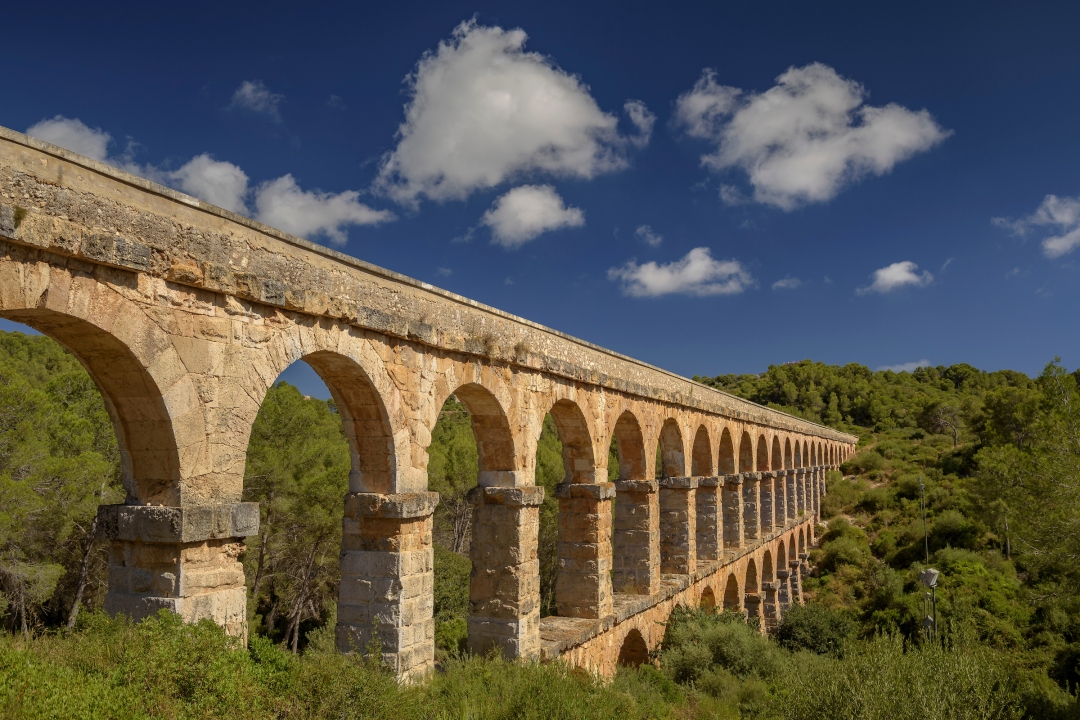
Pont del Diable. Aqüeducte de Tarragona a les Ferreres. Foto: Sergi Boixader
During the second fortnight of the month of May, the Tarraco viva, the Roman festival of Tarragona (International Days of Roman historical dissemination) is celebrated. A sample of art, food, commerce, traditions, history, cinema... around the Roman Tarragona.
interesting museums
- Tarragona History Museum (MHT). Composed by: Castellarnau House Museum, Archaeological Walk (Roman Walls), Praetorium and Roman Circus, Roman Amphitheatre, Roman Local Forum, Mèdol Quarry and Canals House
- National Archaeological Museum of Tarragona and Paleochristian Necropolis.
- Roman villas of Centcelles and Els Munts (MNAT).
- Cathedral and diocesan museum.
Nearby experiences
Nearby routes
Route through the Plana de Xim in Roda de Berá
Albinyana, Bonastre, Roda de Berà
Not uploaded to the Flat of Xim? We propose you an excursion in the Baix Penedès to enjoy nature by doing health.
the castle fact
L'Arboç, La Bisbal del Penedès, Tarragona, Valls, Vilafranca del Penedès
The castells are one of the traditions par excellence of Catalan culture, hundreds of people united to defy gravity and perched on top of each other to make constructions that have reached up to ten floors. The small ditches that crown the…
The Cucurull route through the Coll de Revision in Roda de Berá
Roda de Berà
Do you know the Coll de Revision in Roda de Berá? We propose a route around the municipality where you will enjoy spectacular views.
Route of Tarraco, The footprint of Rome
Altafulla, Constantí, Roda de Berà, Tarragona
I want to do this route by electric vehicle! This route is designed to be done by electric vehicle, although it can be done with any other car. Along the route we will suggest municipalities that have charging points and places of interest…
Related routes
Route through the historic center of Vic
Vic
Strolling through the historic center of Vic is a stroll through the past and the history of our country. A signposted route allows to look at thirty buildings, all of historical, architectural or artistic interest, among which the Roman Temple…
La Vall de Bianya, nature and heritage in the Garrotxa
La Vall de Bianya
La Vall de Bianya is a landscape to discover in the region of the Garrotxa. A municipality that is a set of valleys and villages with a wide variety of forests, meadows and streams. But in this valley valleys all is nature, heritage also plays…
The mystery of Camp dels Ninots
Caldes de Malavella, Sils
Despite being unknown to many tourist routes in the province of Girona, more focused on coastal areas, El Camp dels ninots (field of the dolls) is one of the most important archaeological sites in Catalonia, and in the Iberian Peninsula in…
The Baix Llobregat, a trip through history
El Papiol, Gavà, Sant Boi de Llobregat, Sant Climent de Llobregat, Sant Joan Despí, Santa Coloma de Cervelló, Torrelles de Llobregat
The route offers you this month femTurisme lies south of the Baix Llobregat, a region full of historical heritage, natural and monumental, but often absorbed and forgotten by the tourist attractions and events of Barcelona. The proposed route…
Events
Forest week in Sant Celoni
16 OctoberAmateur Theatre Showcase in Sant Gregori
16 OctoberEuropean Heritage Days in Collbató
16 OctoberRACC Costa Dorada Rally in Salou
From 16 to 17 OctoberZim Zam Cassà - Cassà de la Selva Urban Art Festival
From 16 to 17 OctoberEmbarrats Fair in Sant Joan de Vilatorrada
From 16 to 18 OctoberFish and Rice Gastronomic Days
From 9 to 18 October








 Sustainable turism
 Biosphere