


Municipalities
One of the most classic and essential routes of Catalan hiking. An emblematic route that many of us have engraved in our heads.
- Difficulty: easy. Very busy road and cemented sections with steps
- Elevation: 520 meters
- Time: 1h15' uphill (1h30' at an easy pace or 50' at a brisk pace) Between 1h15' and 2h back along the circular route.
- Kilometers: 11km
Variants: We can avoid a large part of the slope from the Sant Joan funicular. You can also connect from the Funicular de Sant Joan to the old path of San Jeroni to return through the same point. Apart from this, there are countless other variants, such as going to the viewpoint of the cross of Sant Miquel or the hermitage of San Joan, 15' from the funicular.
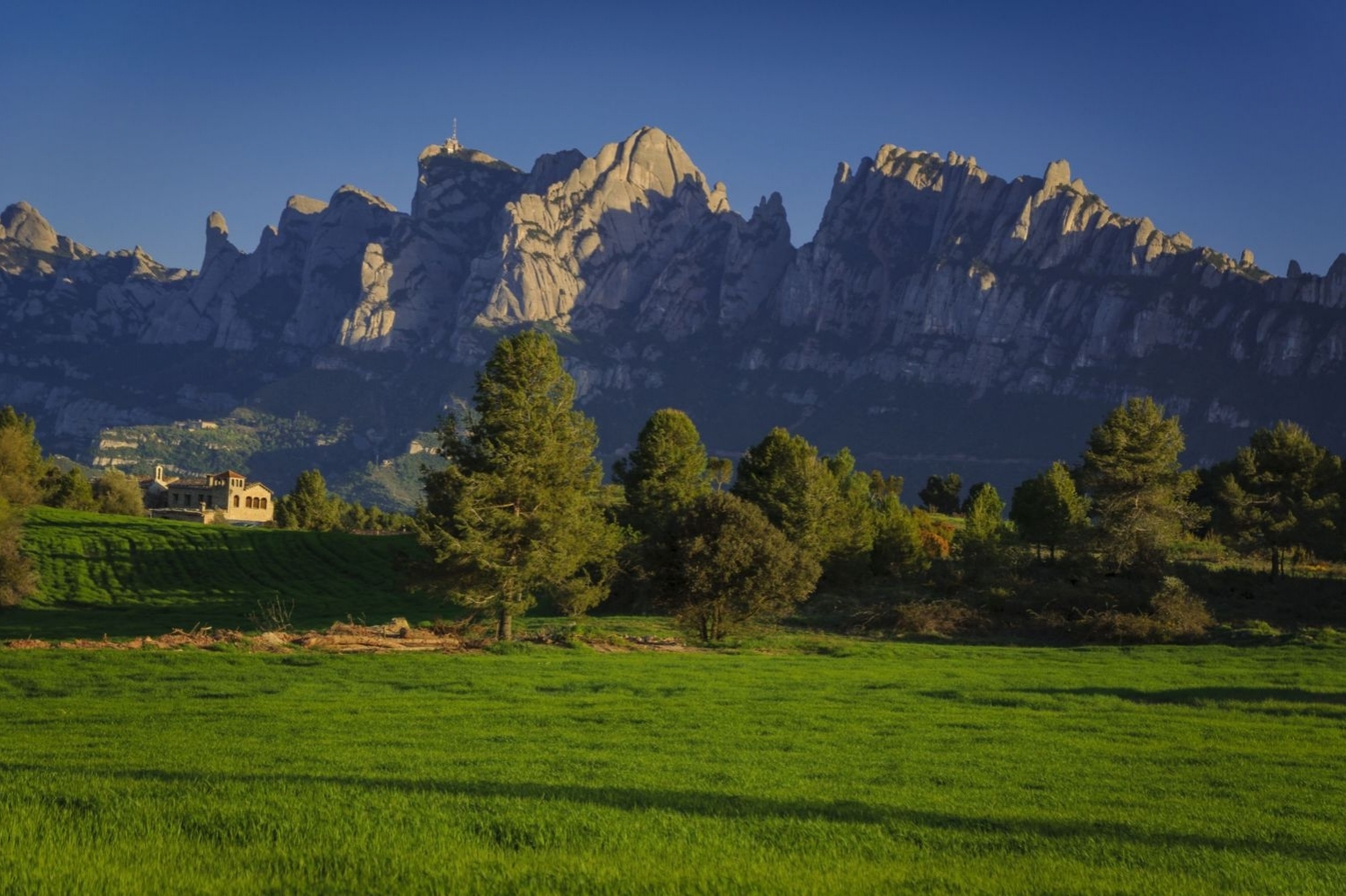
Foto: Vistas a las montañas de Montserrat desde un prado a Sant Salvador de Guardiola
We will leave the square of the Montserrat Monastery and we will go to the Montserrat enclosure. From there, we will go up the first steps next to a fountain from which we will take the Camí Vell de Sant Jeroni on the right, crossing the bridge. At this point we will begin a long ascent of steps that gradually ascends. A seemingly strong start but perfectly bearable! Approximately, it will be a 25-30 minute climb.
One of the most emblematic sections of this first part is the Pas dels Francesos, an area of steps wedged between two rocks that reminds us of one of the battles of the French War in Montserrat. Shortly after, we will arrive at the hermitage of Santa Anna, from where we could take a path that would take us to the funicular of Sant Joan, which is another good option that is quite flat and with excellent views.
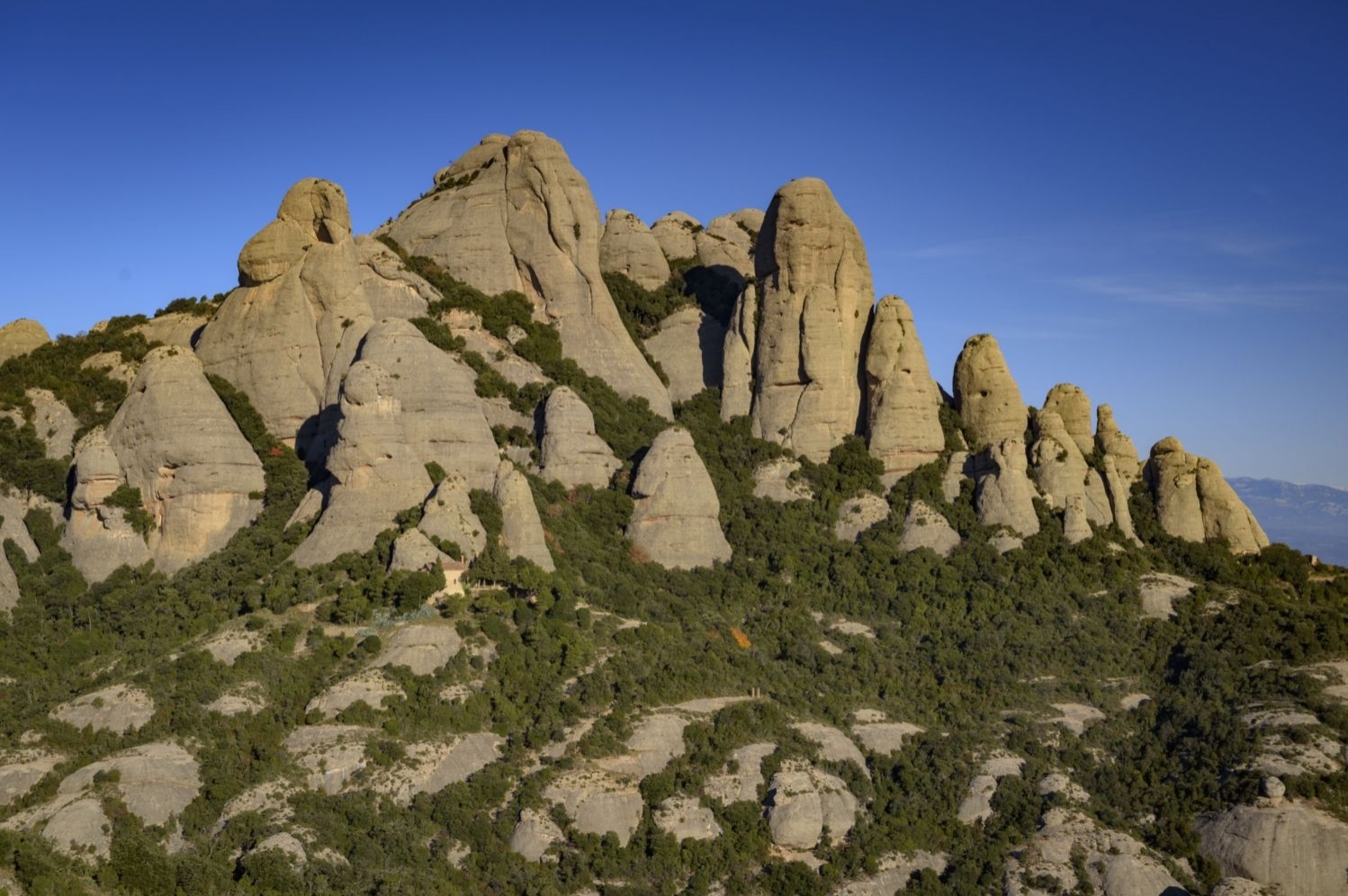
Foto: Vistas a las rocas del Elefant y la Mòmia desde la estación del funicular de Sant Joan
We will continue ascending, this time but for a more relaxed stretch. Above us we can clearly see the Panxa del Bisbe, a very apt name. From here, the path begins to flatten out and enters a forest of oaks known as El Pla dels Ocells. Indeed, the song of the birds is more than evident if we are lucky enough to be alone on that stretch. The path is not lost, although in some cases, natural streams and other trails deviate from the original path. After about 5 minutes from the beginning of the route, we will find a detour to the right that will allow us to climb the Miranda de Sant Antoni, to the magnificent Cavall Bernat viewpoint.
Continuing upwards, after about 55 minutes from the start of our route, the path becomes steep again and shortly, it will join the Camí Nou de Sant Jeroni. From this point we will follow the same route both ascent and descent in the 20 minutes that separate us from the summit. After about 10 minutes of moderate ascent, we will arrive at the hermitage of Sant Jeroni, an ideal location to take a break and enjoy this wonderful plain. From here we can turn right, and in 10 minutes we will arrive at the Mirador del Moro, another beautiful viewpoint with views over El Serrat de les Onze and the old Sant Jeroni Air Station. We could also go down the Sant Jeroni canal.
We will finish the climb to Miranda de Sant Jeroni in just 10 minutes of climbing a hundred steps and a magnificent view of much of Catalonia.
We will make the return through the Camí Nou de Sant Jeroni, which will take us straight to the Sant Joan funicular. From there, we can go down on foot or take the same funicular. If we decide to do it on foot, we can follow a wide track that goes down to the hermitage of Sant Miquel (it is highly recommended to turn off to the Mirador de la Creu, just 5 minutes away). From there, in only 15 minutes we will find the Monastery.
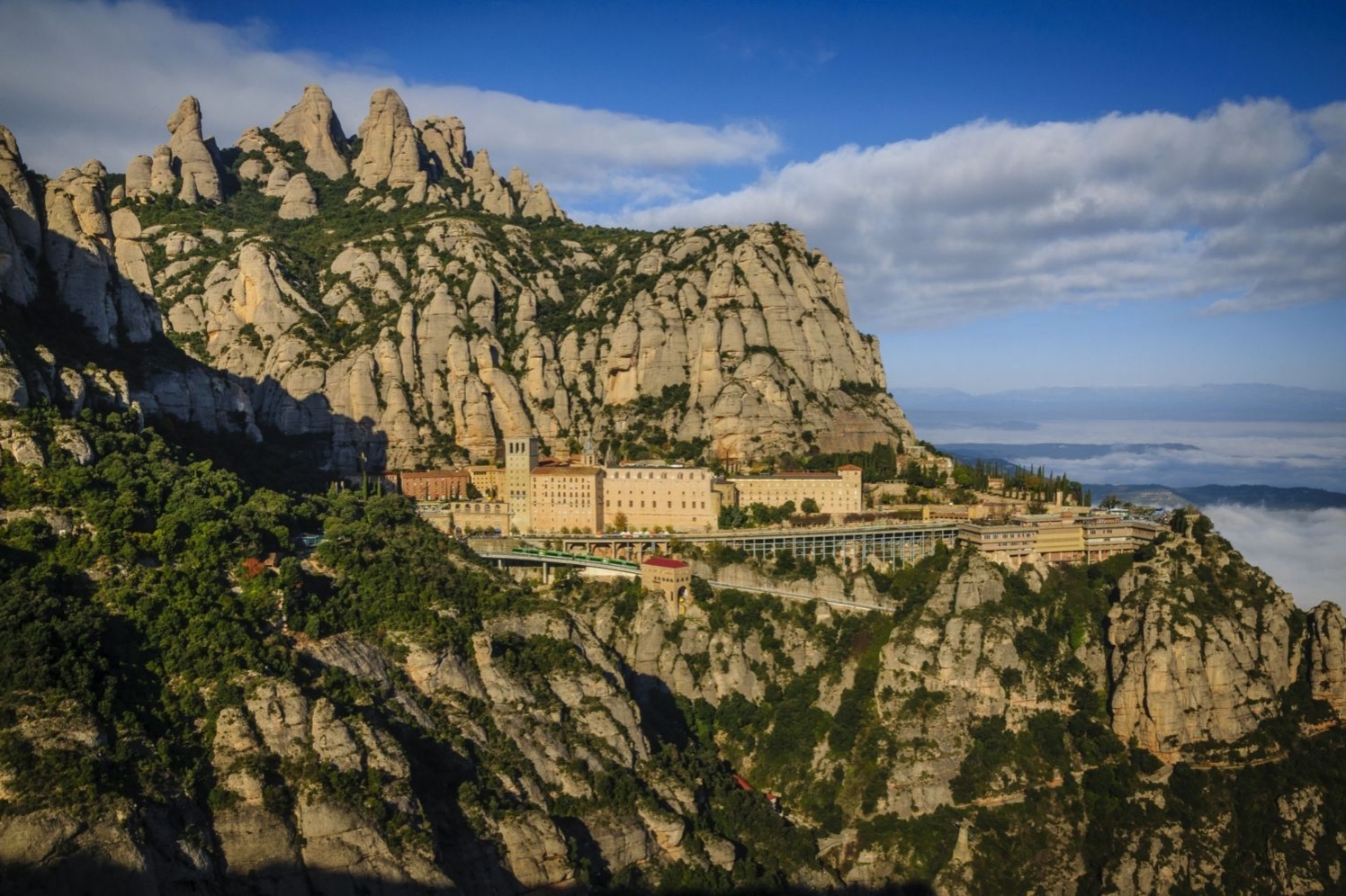
Foto: Vistas al Monesterio de Montserrat desde la Creu de Sant Jeroni
Once in the Monastery, do not forget to go and greet the Virgin of Montserrat!
Author images and text: Sergi Boixadeu
Nearby experiences
Nearby routes
Grand Tour de Catalunya - Section 1. Vineyards with taste in the sea: from Barcelona to Tarragona
Aiguamúrcia, Barcelona, Cabra del Camp, Cardona, El Vendrell, Monistrol de Montserrat, Mura, Navès, Sant Fruitós de Bages, Sant Llorenç de Morunys, Sant Sadurní d'Anoia, Sitges, Solsona, Súria, Tarragona, Vilafranca del Penedès
I want to do this route by electric vehicle! This route is designed to be done by electric vehicle, although it can be done with any other car. Along the route we will suggest municipalities that have charging points and places of interest…
Montserrat, symbol of Catalonia
Collbató, El Bruc, Monistrol de Montserrat
Montserrat is much more than a mountain in the interior of Catalonia, it is a must-see symbol for all those who wish to delve deeper into the country, it is a natural park that we can enjoy with marked walks, it is a monastery with an active…
The route of the 3 mountains
Figaró-Montmany, Monistrol de Montserrat, Montseny, Mura, Rellinars, Sant Feliu de Codines, Sant Llorenç Savall, Tagamanent
The route of the 3 mountains is a journey that takes place on trails that hide Montseny natural parks, and Sant Llorenç del Munt and Montserrat Obac. Hence the reason for its name. This itinerary is a trip to the Catalan littoral which…
Related routes
Semi-circular route in Tosa de Alp and Puigllançada
Bagà
In the dividing range that separates Berguedà from Cerdanya, two of the highest and most spectacular peaks are Tosa de Alp (2,536 m) and Puigllançada (2,409 m). From a good part of the region you can see these two peaks that close…
Puigmal via Fontalba and return via Núria (circular)
Queralbs
The ascent to Puigmal is one of the essential routes of the Catalan Pyrenees. One of the great classics, one of the peaks that every hiker in Catalonia will do or has done. The route is ideal both for beginners in this sport and for veterans,…
Ebro Delta, nature in its purest form
Alcanar, Amposta, Deltebre, La Ràpita, Sant Jaume d'Enveja
The Ebro delta, with 320 square kilometers, is the most important wetland area in Catalonia and the first aquatic habitat in the western Mediterranean. The route we propose will allow you to discover an area of extraordinary biological wealth,…
Natural Park of Els Ports
Alfara de Carles, Arnes, Roquetes
It listed as an area of natural interest by the Generalitat de Catalunya in 2001, the declaration of Natural Park of Els Ports and the Partial Natural Reserve of Fageda Retaule recognized the value of this area south of Catalonia, only surpassed…
Events
Forest week in Sant Celoni
16 OctoberAmateur Theatre Showcase in Sant Gregori
16 OctoberEuropean Heritage Days in Collbató
16 OctoberRACC Costa Dorada Rally in Salou
From 16 to 17 OctoberZim Zam Cassà - Cassà de la Selva Urban Art Festival
From 16 to 17 OctoberEmbarrats Fair in Sant Joan de Vilatorrada
From 16 to 18 OctoberFish and Rice Gastronomic Days
From 9 to 18 October
News
Iron architecture: the light and steam of industrial Catalonia
In the 19th century, the Industrial Revolution not only changed the way people worked and lived, but also profoundly transformed architecture. The arrival of new materials, such as cast iron, wrought iron, and glass, opened up possibilities…
Gothic Architecture: The light and height of medieval Catalonia
Gothic architecture marks a turning point in the history of Catalonia. It was the style that transformed cities, places of worship, and the way people built collectively. A style that changed not only the stone itself, but also the way people…








 Sustainable turism
 Biosphere