


Municipalities
This route, leaving from the Church of Santa María de Gallecs, proposes a light itinerary, of low difficulty, through the Gallecs Natural Area, in the municipality of Mollet del Vallés.
The route has a distance of 3.5 km and a duration of one hour.
We started!
From the Church of Santa María de Gallecs, the itinerary heads north, passing through Can Magre and the Can Mainou leisure area until crossing the Caganell stream.
You go through the lower part of the Can Cristal forest; You pass through Can Jaume Magre and from there you go down to the Los Diablillos stream. From there you go up until you find the Torre de Malla path, passing through the repopulation area, a small geological cut and the pothole of Los Olmos. At this point it breaks west towards Can Salvi. And from there, upstream of the Caganell stream, you return to the point of origin.
The landscape is made up of small hills, where cultivated fields alternate with forests, such as Can Cristal, populated by masses of Aleppo pine, holm oaks and oaks. Another element of interest is the Caganell stream, which is surrounded by a riverside forest, where plane trees abound, but it is also easy to find poplars, ash trees and elms that offer a gloomy and cool landscape in the summer. We must also mention the Can Salvi wetlands, a small humid area, where you can see mallards, green woodpeckers, cornflowers and even some leprous terrapin.
In the center of the Plaza de la Iglesia, we must highlight the farmhouse and the Gallecs workshop, where you can find organic and local products that are grown and made in rural areas.
Source: Mollet del Vallès Town Council
Nearby experiences
Nearby routes
Route of the hidden Churches of Baix Vallès
Mollet del Vallès, Montcada i Reixac, Sant Fost de Campsentelles, Santa Perpètua de Mogoda
At the southern end of the Vallès hide four unique buildings of the Vallesan religious architecture, the churches of Santa María de Gallecs (Mollet del Vallès), Santa María la Antigua, Santiga (Santa Perpètua…
Bicycle axis in Gallecs
Mollet del Vallès
Do you want to know the natural area of Gallegos on two wheels? This route fits perfectly with what you are looking for! It is a bike route that covers 15 km of medium difficulty for the entire rural environment of Gallecs. The exit is in the…
The path of Sant Valerià in Mollet del Vallés
Mollet del Vallès
We propose a route of low difficulty through the surroundings of the Gallecs protected area, in Mollet del Vallés. The route of a total distance of 7.5 km, lasts 2 hours, starting in the square of the Church of Gallecs.
Related routes
Route through the heritage of Balsareny
Balsareny
Balsareny is a town located in the Llobregat valley, north of the Bages region . Located in an undulating terrain where white pine forests predominate, the term is very well connected by road as it is crossed by the Eje del Llobregat. Next,…
Know El Masnou, land of the sea
El Masnou
This itinerary is part of an ambitious and stimulating project that aims to rehabilitate and adapt highly relevant elements of Masnou's local heritage, such as the Water Mine, the Culture House and the Lake Park. Likewise, it wants to value…
Ascent to Mont Caro from the Caro refuge
Roquetes
This summit without technical difficulty rises in the municipality of Roquetes, in Tarragona. From above we can enjoy atypical views of the Ebro Delta, and with a bit of luck, we can even make out the silhouette of Mallorca far out to sea.…
Route of the viewpoints of Salou
Salou
23 spectacular viewpoints that make up a pleasant path to walk under the open and sunny sky of the Costa Daurada and, at the same time, with the intense blue Mediterranean. A path between sea and mountains, surrounded by forest mass and typical…
Events
European Heritage Days in Collbató
16 OctoberAlfaro Year in Sant Andreu de Llavaneres
16 OctoberForest week in Sant Celoni
16 OctoberRACC Costa Dorada Rally in Salou
From 16 to 17 OctoberZim Zam Cassà - Cassà de la Selva Urban Art Festival
From 16 to 17 OctoberEnvironmental Fair in Tàrrega
From 15 to 18 OctoberEbrencas Letters Days in Amposta
From 16 to 18 October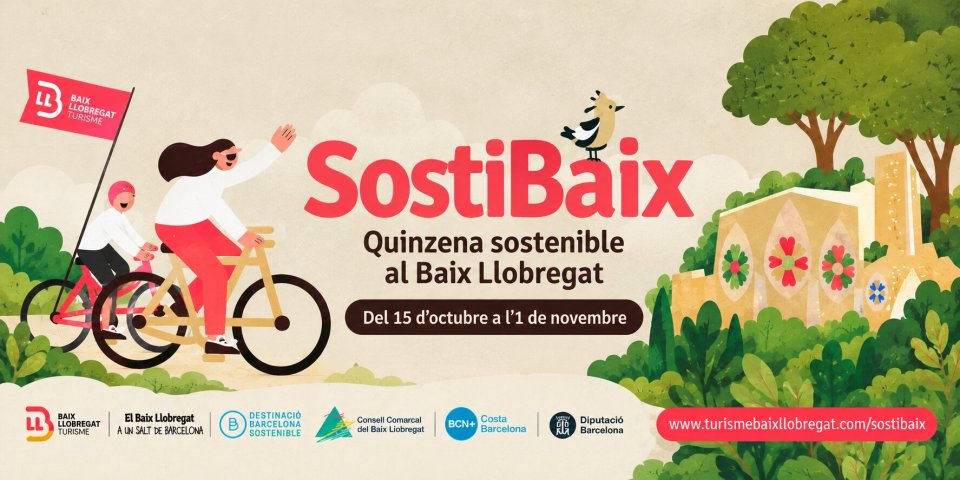
News
Iron architecture: the light and steam of industrial Catalonia
In the 19th century, the Industrial Revolution not only changed the way people worked and lived, but also profoundly transformed architecture. The arrival of new materials, such as cast iron, wrought iron, and glass, opened up possibilities…
Gothic Architecture: The light and height of medieval Catalonia
Gothic architecture marks a turning point in the history of Catalonia. It was the style that transformed cities, places of worship, and the way people built collectively. A style that changed not only the stone itself, but also the way people…








 Sustainable turism
 Biosphere