


Municipalities
The Barcelona regions of Osona and Bages, and the Girona region of Ripollès, are the protagonists of this route that takes the name of a capital figure in the history of Catalonia, the Bishop and Abbot Oliba.
The route (173 km and +) has one of its great attractions in Romanesque art, but also in landscapes such as those of the spectacular Tavertet cliffs or the Sau reservoir.
It is a route to do on foot (in fact, it follows a Long Distance Path, the GR-151, and its variant GR-151-1), and which wants to be accessible to most people. That is why two alternatives are offered in many of its sections: a passage through more population centers, with shorter stages and more services, and the other is designed for people more prepared to walk.
The stages of the demarcation of Barcelona are:
- Montserrat Monastery * - Manresa: Route: 24.1 km Accumulated difference in altitude: 918 m Estimated time: 5-6 h
- Manresa - Navarcles: Distance: 11 km Accumulated difference in altitude: 158 m Estimated time: 2-3 h
- Navarcles - Artés: Distance: 9.3 km Accumulated elevation gain: 199 m Estimated time: 2-3 h
- Artés - El Lago: Route: 23.2 km Accumulated difference in altitude: 881 m Estimated time: 5-6 h
- El Lago - Vic: Route: 20.47 km Accumulated difference in altitude: 614 m Estimated time: 5-6 h
- Vic - Folgueroles: Route: 10.7 km Accumulated elevation gain: 128 m Estimated time: 2-3 h
- Folgueroles - Casserres: Route: 11.5 km Accumulated difference in altitude: 545 m Estimated time: 2-3 h
- Casserres - Vilanova de Sau: Route: 9.25 km Accumulated difference in altitude: 490 m Estimated time: 2-3 h
- Vilanova de Sau - Tavertet: Route: 10 km Accumulated difference in altitude: 663 m Estimated time: 2-3 h
- Tavertet - La Ardilla: Route: 16 km Accumulated difference in altitude: 621 m Estimated time: 4 - 5 h
- La Ardilla - Sant Pere de Torelló: Route: 11.1 km Accumulated difference in altitude: 240 m Estimated time: 2-3 h
- Sant Pere de Torelló - Santa Maria de Besora: Route: 11.5 km Accumulated difference in altitude: 842 m Estimated time: 3 - 4 h
- Santa Maria de Besora - La Farga de Bebié: Route: 8.3 km Accumulated difference in altitude: 330 m Estimated time: 2-3 h
WALK AMONG ROMANESQUE
The Caminos del Obispo and Abad Oliva bring hikers closer to some of the best examples of Romanesque art in the Barcelona regions. This is the case of the monastery of Santa María del Lago, with an excellent Romanesque cloister, or the monastery of Sant Pere de Casserres, humble but full of history and details
and located on a meander of the Ter. Both the Manresa Regional Museum and the Vic Episcopal Museum will find an extensive and rich collection of medieval art.
A STOP IN VIC
The Plaza Mayor, arcaded, elegant by the buildings that surround it and with an immense central esplanade that every Tuesday and Saturday lives an intense market of medieval origin; the Cathedral of San Pedro Apóstol, with a Romanesque crypt and tower and wall paintings by Josep M. Sert; the Episcopal Museum, which exhibits more than 20,000 works of Romanesque and Gothic art; the old town, the Romanesque bridge, the Roman temple... Vic is well worth a stop on the way, and when you do, don't forget to try the salchichón!
Source: Barcelona Provincial Council

Nearby experiences
Nearby routes
Circular route in the Puig de l'Àliga and Hayedo de la Grevolosa from the Bracons pass
Sant Pere de Torelló
It is a circular route around the Bracons pass, with two great places to go through: the Puig de l'Àliga, one of the peaks of the Puigsacalm mountain range, and the well-known Hayedo de la Grevolosa, one of the most spectacular in Catalonia,…
Aiats and Cabrera cliffs from Cantonigròs
L’Esquirol
From the plain of Vic, one of the profiles that is always outlined on the horizon are the crests of Pla d'Aiats and Cabrera. As if they were two "flans" or two towers with a very flat top, their shape is well visible from the plain. From above,…
Ruta Medieval in Bages
Cardona, Manresa, Sant Fruitós de Bages, Súria
As you know, the medieval period, also known as middle age, has left a great legacy in Catalunya which currently can enjoy in different situations and places. For this reason, several times when I've recommended a route of this subject.…
Related routes
Mediterranean Trail
Calafell, Lloret de Mar, Montcada i Reixac, Sant Vicenç dels Horts, Tordera, Vallgorguina, Vilanova i la Geltrú
The GR-92 or Path of the Mediterranean (162 km and +) crosses from north to south -or from south to north, as preferred- all of Catalonia, almost always doing it as close as possible to the coast. It is part of the European path E-10 (Baltic…
The Ignatian Way
Cervera, Igualada, Manresa
The path that recalls the journey that Ignacio de Loyola, as a knight, made in 1522 from Loyola, in the Basque Country, to Manresa, finds his last steps in the regions of Barcelona. Igualada, Montserrat and the city of arrival - where the cave…
Camino de Santiago: from Sant Esteve d'en Bas in Cervera
Artés, Cervera, Igualada, L'Estany, L’Esquirol, Manresa, Vic
At the end of the last century, the Catalan sections of the millenary and well-known route of the Camino de Santiago (99 km and +) began to be recovered. Today it is possible to travel, on foot, on horseback or by bicycle, the almost 500 km…
Events
Amateur Theatre Showcase in Sant Gregori
16 OctoberEuropean Heritage Days in Collbató
16 OctoberAlfaro Year in Sant Andreu de Llavaneres
16 OctoberZim Zam Cassà - Cassà de la Selva Urban Art Festival
From 16 to 17 OctoberRACC Costa Dorada Rally in Salou
From 16 to 17 OctoberFish and Rice Gastronomic Days
From 9 to 18 OctoberModernist Conferences in la Garriga
From 16 to 18 October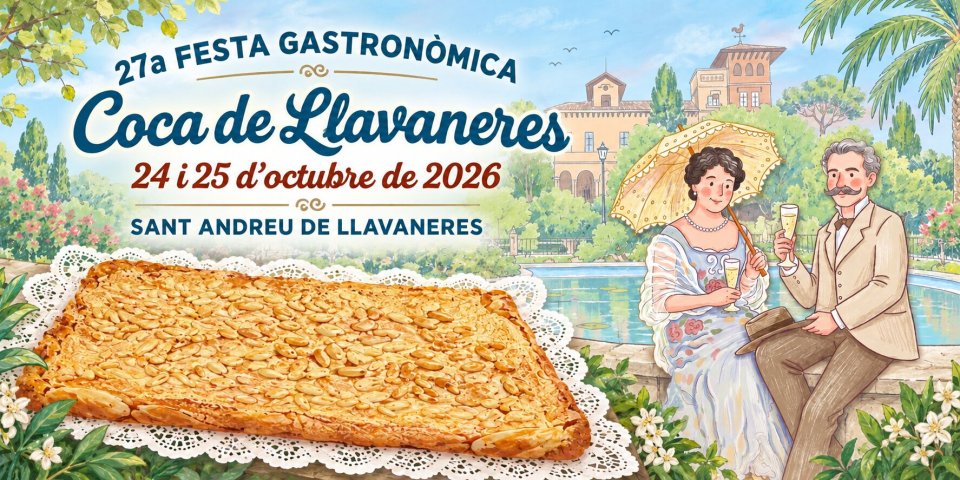
News
Gothic Architecture: The light and height of medieval Catalonia
Gothic architecture marks a turning point in the history of Catalonia. It was the style that transformed cities, places of worship, and the way people built collectively. A style that changed not only the stone itself, but also the way people…
Iron architecture: the light and steam of industrial Catalonia
In the 19th century, the Industrial Revolution not only changed the way people worked and lived, but also profoundly transformed architecture. The arrival of new materials, such as cast iron, wrought iron, and glass, opened up possibilities…








 Sustainable turism
 Biosphere