


Turisme Anoia
Welcome to Anoia!
Anoia is a region made up of territories with diverse characteristics, which have been grouped together to form a rich puzzle full of contrasts.
You will be captivated by its rural landscapes, with scattered farmhouses and small charming villages where you can buy local products, visit an impressive historical heritage such as medieval castles or hidden hermitages and live in the middle of a natural environment where you can practice the sport you like the most.
Anoia is a territory of territories, a mosaic of a wide and varied range of colours and shades that make it singular and unique.
Anoia is diversity. And this is its uniqueness, this is its personality and what truly makes it unique. Anoia is a historic region of passage and settlement, it is a land that over the centuries has brought together cultures, has brought together different ways of thinking and acting, has seen great travellers and simple merchants or cattle breeders pass through, in the middle of Catalonia it has marked the dividing line between Old Catalonia and New Catalonia and, today.
Anoia has many attractions. Visiting it means:
- Discover a rich and varied industrial and museum heritage, highlighting the Igualada Leather Museum, located in old factories and tanneries; the Capellades Paper Mill Museum, an old paper factory, and the Traginers Museum, with an important collection of carriages and items related to this trade.
- Understand the habitat and living conditions of the beginnings of humanity in the Abric Romaní of Capellades, an archaeological site from the Middle Paleontolithic, and discover the lost step in the evolution of humanity with the “Pierolapithecus catalanicus”, popularly known as Pau, in Els Hostalets de Pierola.
- Contemplate the rosary of castles, watchtowers and churches that marked the limits of the Hispanic March: La Pobla de Claramunt, La Tossa de Montbui, Òdena, Rubió, the Prats de Rei, Boixadors, Queralt, Miralles and Orpí.
- Experiencing the festivals and celebrations, a cultural heritage that its inhabitants do not want to lose, such as the Fiesta del Timbaler or Feria de la Guerra del Francés in El Bruc, the Fiesta de los Traginers y Negociantes in Copons, the Feria de la Trashumancia in Pujalt, and the Fiesta de la Caldera, Feria de los Innales y los Viajeros. It also means experiencing the symbol of its modernity: the European Balloon Festival in Igualada and the Aerosport in Òdena.
- Enjoy the rural tourism offer, full of charming houses, equipped with top quality services and surrounded by welcoming landscapes.
- Discover and try the wide range of artisanal food products, such as cheeses, sausages, oil, wines and cavas, legumes, and the popular Garbancito de la Alta Anoia.
- Taste the exquisite and unique gastronomic offering of the region.
- Stroll through the attractive range of factory shops and outlets in Igualada.
- Discover the uniqueness of its landscapes by hiking along the countless trails, flying in a hot air balloon or riding a horse or mountain bike.
Igualada
Igualada, a dynamic city With a wide range of fairs, festivals, and large-scale events, Igualada has earned a reputation as a city that never stops. As the regional…
La Llacuna
La Llacuna is a municipality in the Anoia region, located 600 meters above sea level and covering an area of 52.25 km², mostly forested with pines, oaks, and…
Els Hostalets de Pierola
Landscape and surroundings, culture and heritage, local produce and organic gardens, community and well-being. These are values that Els Hostalets de Pierola embodies…
El Bruc
El Bruc, located in the Anoia region, is one of the entrances to Montserrat Mountain. In fact, a large part of its area is included within the Montserrat Mountain…
Castellfollit de Riubregós
Belonging to the region of Anoia and located in the Vall del Llobregós is the communication gate between the Anoia and the Segarra. It has an extension of…
La Torre de Claramunt
La Torre de Claramunt is an old village well oriented towards the sunrise, with a population of 3,833 inhabitants, covering an area of 14.80 km2. It is part of…
Argençola
The municipality of Argençola, in the Anoia region, is the fourth largest in the region. It comprises eight population centers: Argençola, Clariana,…
Vilanova del Camí
Vilanova del Camí is a municipality in the Anoia region with a distinct character shaped by the passage of time, its connection to the Anoia River, and a…
Pujalt
Pujalt is a small municipality in the Anoia region, located in central Catalonia, bordering the province of Barcelona and adjacent to the La Segarra region. Its…
Experiences
Events
Fira Mediterrània de Manresa 2026
From 15 to 18 OctoberEmbarrats Fair in Sant Joan de Vilatorrada
From 16 to 18 OctoberEcoviure Fair in Manresa
From 2 to 20 OctoberCatalonia Industrial Tourism Week 2026
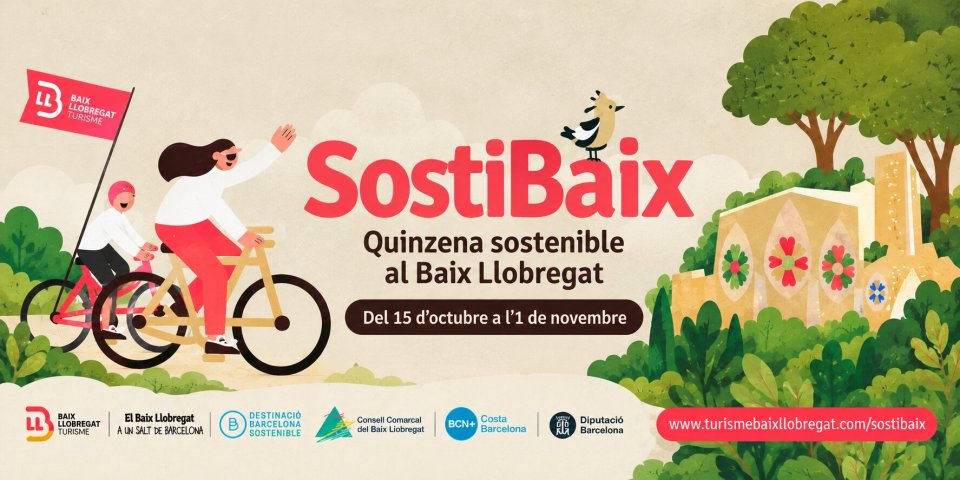
From 16 to 25 OctoberSostibaix, the sustainable fortnight of Baix Llobregat
From 15 October to 1 NovemberMARIDA'm: The secrets of two liquid golds of Catalonia, Sant Sadurní
17 OctoberScenic programming in Gelida
17 OctoberDay of the siege in Castellfollit de Riubregós
17 OctoberOperation Castaween in Món Sant Benet
17 OctoberSample of High Altitude Wines from La Llacuna
From 17 to 18 October"El Nostre Festival" - Llet Nostra
18 October
Nearby routes
The paper path for Catalonia
Knowing which is the papermaking process or as this has evolved over time are some of the intricacies that can be removed to make the route that we propose this month. The paper path is a path with a historical component that reveals when and…
The leather path in Igualada
The Anoia is one of the interior regions of Catalonia, located at the eastern end of the Catalan Central Depression, where Igualada exerts its capital. Igualada has been one of the municipalities of the territory that has taken advantage of…
The Ignatian Way
The path that recalls the journey that Ignacio de Loyola, as a knight, made in 1522 from Loyola, in the Basque Country, to Manresa, finds his last steps in the regions of Barcelona. Igualada, Montserrat and the city of arrival - where the cave…
Camino de Santiago: from Sant Esteve d'en Bas in Cervera
At the end of the last century, the Catalan sections of the millenary and well-known route of the Camino de Santiago (99 km and +) began to be recovered. Today it is possible to travel, on foot, on horseback or by bicycle, the almost 500 km…








 Sustainable turism
 Biosphere