


Pessebre Vivent de Pals
Municipalities
When the Christmas holidays are approaching...
In the town you begin to breathe a different air and from the end of October you can sense the first movements. The time has come to prepare the representations of the Living Nativity of Pals.
Today, we can already say, that our manger has a long history. It all started in 1987, when a group of parents of the then APA of the Public School Quermany de Pals decided that it was time to start a new adventure and set up a living manger. That year, the performances took place at the House of Culture of Ca la Pruna and there were many participants if we consider how it has grown.
The following year, with the help of Mn. Barcons, former rector of the parish, the manger moved to the Gothic precinct, occupying its streets and some of the houses of the neighbors and, began to grow in number of participants or extras, collaborators, visitors and, also, in extension and quality.
At present we are a living Nativity of Pals where currently 4 representations are made , there are more than 50 pictures, more than 200 participants participate that, defying the cold or leaving the family table on such a marked dates, do not miss the opportunity to get in the skin of some of the characters, and neighbors collaborate that leave the houses where the paintings, tools, material are assembled... or they are in charge of the great assembly that the manger supposes.
The Living Nativity of Pals goes beyond its religious meaning and has become an affordable, close, familiar and quality cultural and leisure proposal. Touring the streets of the Villa for about an hour, visitors can be participants in different passages of the old and the new testament.
It is difficult to highlight any particular aspect of our manger, because what characterizes it is the harmony of the whole, as all the details are perfectly related to make the trip a success.
Those who come to visit our manger will hear and see first-hand the pride and work of a people, of its people. Be welcome, then.

Nearby routes
A tour for golf players in Catalonia
Calafell, Caldes de Malavella, El Catllar, Girona, Gualta, Mont-roig del Camp, Pals, Peralada, Puigcerdà, Sant Cugat del Vallès, Sant Julià de Ramis, Santa Cristina d'Aro, Sitges, Tarragona
Golf is a sport that started practicing in the fifteenth century. Its origins come from Scotland, the entertainment that had the Scottish shepherds, who with batons beat pebbles they had to reach a target. In Catalonia the game came later in…
Route with Josep Pla
Palafrugell, Pals
Josep Pla i Casadevall is considered one of the best writers Catalan history, his work, thirty thousand pages of prose, is one of the most read in Catalan and has been translated into eight languages. Follow your path will allow us to see places…
Grand Tour de Catalunya - Section 5. From Surrealism to Modernism. From Figueres to Barcelona
Arenys de Mar, Barcelona, Begur, Blanes, Cadaqués, Caldes de Malavella, Canet de Mar, Figueres, Girona, L'Escala, Lloret de Mar, Manlleu, Mataró, Palafrugell, Palamós, Pals, Rupit i Pruit, Tossa de Mar, Vic, Viladrau
I want to do this route by electric vehicle! This route is designed to be done by electric vehicle, although it can be done with any other car. Along the route we will suggest municipalities that have charging points and places of interest…
The Medieval architecture of the Empordà
Forallac, La Bisbal d'Empordà, Palau-Sator, Ullastret
The Baix Empordà region is a territory that, during the 8th century, was already part of the "brand" of the Carolingian empire against the Muslims, the so-called Old Catalonia. Therefore, it is logical that medieval architecture has…
Route through the Romanesque of Empordà: Stone, wind and memory
El Port de la Selva, La Bisbal d'Empordà, Palau-Sator, Rabós, Roses, Sant Feliu de Guíxols, Santa Cristina d'Aro, Ullastret, Vilabertran
When we think of the Empordà region, coastal landscapes, charming villages, and figures like Dalí and Josep Pla often come to mind. But beyond that, there's a heritage that stands the test of time almost silently: the Romanesque…
Fair of Indians
Begur, Palafrugell, Sant Feliu de Guíxols
In the late sixteenth century to about the beginning of the twentieth century experienced significant movements of people crossing the Atlantic, embarking on a journey overseas, going to America to seek his fortune. These people are known today…
Events
Xavier Miserachs Photography Biennial in Palafrugell
From 2 August to 18 OctoberGastronomic days "Es Niu" in Palafrugell
From 16 October to 13 DecemberSant Narcís Fairs in Girona 2026
From 23 October to 1 NovemberSant Narcís castle day in Girona
25 OctoberChestnut festival and Halloween in Santa Cristina d'Aro
From 28 to 29 OctoberChestnut in Torroella de Montgrí and L'Estartit
From 29 October to 1 NovemberGuided hiking routes in Santa Cristina d'Aro
1 November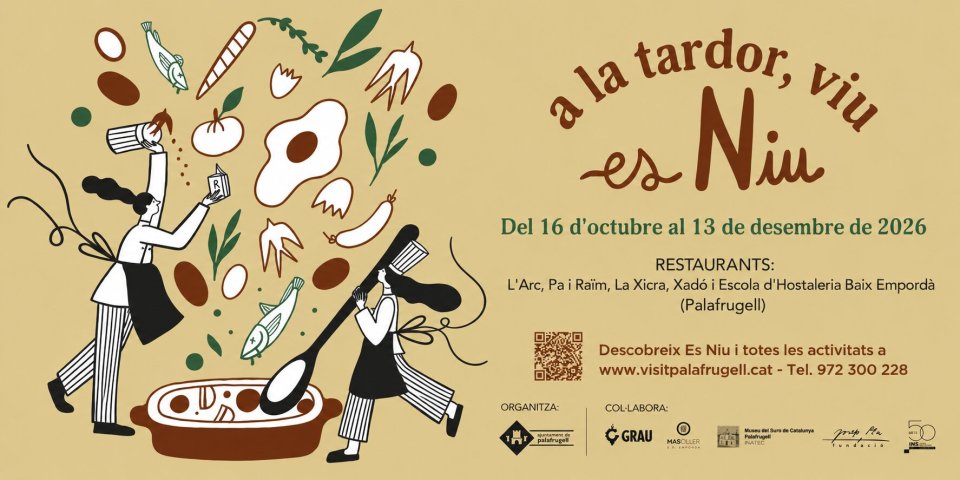
News
Gothic Architecture: The light and height of medieval Catalonia
Gothic architecture marks a turning point in the history of Catalonia. It was the style that transformed cities, places of worship, and the way people built collectively. A style that changed not only the stone itself, but also the way people…
Iron architecture: the light and steam of industrial Catalonia
In the 19th century, the Industrial Revolution not only changed the way people worked and lived, but also profoundly transformed architecture. The arrival of new materials, such as cast iron, wrought iron, and glass, opened up possibilities…








 Sustainable turism
 Biosphere