


Pessebre Vivent de Les Torres de Fals
Municipalities
The Living Nativity Scene of the Torres de Fals is an iconic spectacle of the Bages region, celebrated in a unique natural and heritage setting: the imposing Torres de Fals and its surroundings. Since 1977, hundreds of volunteers have brought to life a series of scenes that combine history, culture, and spirituality, making it a deeply moving Christmas experience.
Welcome and presentation panels
Currently, the Nativity scene consists of the following scenes:
Welcome scenes
Static paintings that place the visitor in time and history, introducing them to the atmosphere of the show before starting the tour.
Presentation about the Towers
A solemn welcome with background music and a spectacular light show projected onto the Fals Towers, one of the most iconic and recognizable images of the nativity scene.
Everyday life and traditional scenes
The Fairground Vendors and the Washing Machines
Dynamic, fast-paced scenes depicting the trades and activities of the era. The set design and the participation of numerous actors transport the audience to a time of rural life and craftsmanship.
Scenes from the Road
The Annunciation, the Cave of the Nativity, and the Annunciation to the Shepherds are highly evocative biblical scenes, depicted in entirely natural settings. Other locations, such as the Balma del Majoral, the Rabadans, Living in the Open Air, Pouant Aigua, and La Cleda, fill the long route and lend warmth and authenticity.
These scenes, despite being simple, connect emotionally with visitors and sustain the narrative of the nativity scene in a fluid way.
Large biblical paintings
Herod and the impactful episodes
Herod's orgy, the Magi, the Flight into Egypt, and the Massacre of the Innocents are scenes visible from a distance. Coordinated with light, sound, and narration, they have a powerful visual and emotional impact, sparking the imagination, especially of children, and helping them to understand the verisimilitude of the biblical events.
The Presentation in the Temple and the Carpentry Workshop of Nazareth
Two paintings that reflect the continuation of the biblical message and the passage of time in the story of the manger.
The final market and dismissal
Finally, the viewer arrives at a market bursting with color, life, and movement, with men, women, and children bustling among the stalls selling essential trades and products of village life. It's a warm and endearing finale that symbolizes community and everyday life.
The visit concludes among shepherds who offer a souvenir of Falso, providing even more closeness and a desire to return.
A constantly evolving nativity scene
The Fals Cultural and Recreational Association is aware of the cultural and emotional importance of this event. Therefore, year after year, it introduces improvements to all the tableaux, the set design, and the staging, in order to maintain a high level of quality and continue to surprise the audience.
The performances last approximately 50 minutes, in a fast-paced but comprehensive tour.
A career full of accolades
The Living Nativity Scene of Falso began humbly in 1977 and has grown to become a Christmas landmark in the Bages region. Throughout its history, it has received several prestigious awards:
- National Prize for Popular Culture (1992) – Generalitat of Catalonia
- "El 7 de la Escena" Award from Region 7 (1991)
- Ateneus Prize (1992)
- Manresa Young Camera Award (2001)
These awards recognize not only the artistic quality of the nativity scene, but also the strength of the volunteers and their ability to generate culture from within the community.
Enjoy the incomparable setting of the Torres de Falso, enveloped in a Christmas that will touch your heart. We look forward to seeing you!
Nearby routes
Astronomical observatory route of Catalonia
Àger, Albanyà, Esterri d'Àneu, Lladurs, Olivella, Prades, Pujalt, Sant Martí Vell, Sant Mateu de Bages
Looking at the sky has never been boring, there is not a single day that we find the clouds in the same position, we clearly observe all the stars or the moon shines equally. In Catalonia we like to look at the sky, and not only at a meteorological…
Route through the Torres de Fals in Fonollosa
Fonollosa
We propose a visit to the towers of Fals, in Fonollosa, a set of buildings for defense made up of two cylindrical towers raised on two nearby hills, in the middle of which runs the Fonollosa stream, which empties into the stream Name. We started!
The battles of 1714
Barcelona, Cardona, Castellví de Rosanes, Corbera de Llobregat, Gaià, Gironella, La Seu d'Urgell, Manresa, Monistrol de Calders, Sallent, Sant Hilari Sacalm, Sant Llorenç Savall, Sant Martí Sarroca, Sant Quintí de Mediona, Sort, Talamanca
On this route femTurisme.cat offers a journey through the countries that suffered the most significant battles occurred during the year 1714. These are spread throughout Catalonia and predated the city Barcelona . This proposal follows a chronological…
Paths of the Bishop and Abbot Oliba
Artés, Casserres, Folgueroles, L'Estany, L’Esquirol, Manresa, Navarcles, Olesa de Montserrat, Sant Pere de Torelló, Santa Maria de Besora, Tavertet, Vic, Vilanova de Sau
The Barcelona regions of Osona and Bages, and the Girona region of Ripollès, are the protagonists of this route that takes the name of a capital figure in the history of Catalonia, the Bishop and Abbot Oliba. The route (173 km and +)…
Trying the 1714 food
Barcelona, Cardona, Cervera, Els Prats de Rei, La Seu d'Urgell, Lleida, Manresa, Moià, Sant Boi de Llobregat, Talamanca, Vic
The 1714 was a year that marked the Catalan region: culture, traditions, people and also gastronomy. This was important because it was the fuel that gave strength to the fighters of the battles. It gave them strength or weakened, the carrying…
The Ignatian Way
Cervera, Igualada, Manresa
The path that recalls the journey that Ignacio de Loyola, as a knight, made in 1522 from Loyola, in the Basque Country, to Manresa, finds his last steps in the regions of Barcelona. Igualada, Montserrat and the city of arrival - where the cave…
Events
Embarrats Fair in Sant Joan de Vilatorrada
From 16 to 18 OctoberFira Mediterrània de Manresa 2026
From 15 to 18 OctoberEcoviure Fair in Manresa
From 2 to 20 OctoberCatalonia Industrial Tourism Week 2026
From 16 to 25 OctoberSostibaix, the sustainable fortnight of Baix Llobregat
From 15 October to 1 NovemberThe Berguedà mushroom kitchen
From 18 September to 22 NovemberOperation Castaween in Món Sant Benet
17 October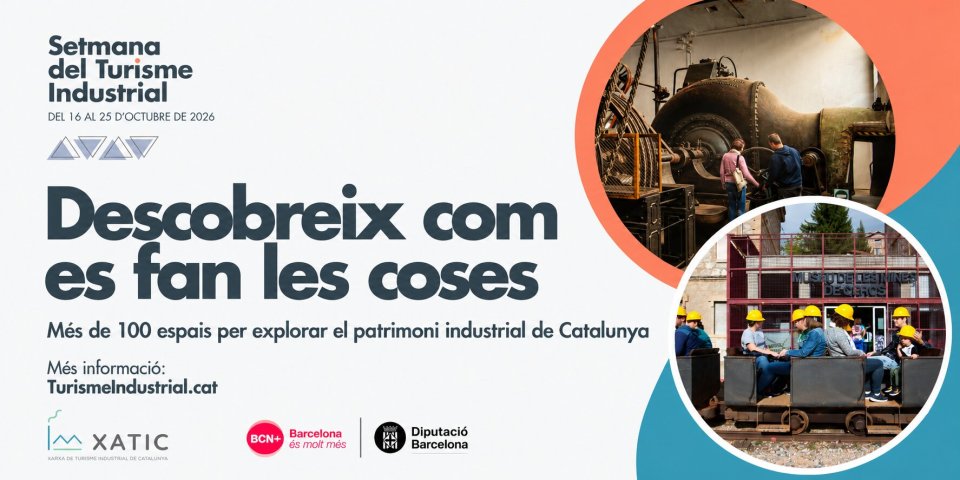
News
Gothic Architecture: The light and height of medieval Catalonia
Gothic architecture marks a turning point in the history of Catalonia. It was the style that transformed cities, places of worship, and the way people built collectively. A style that changed not only the stone itself, but also the way people…
Iron architecture: the light and steam of industrial Catalonia
In the 19th century, the Industrial Revolution not only changed the way people worked and lived, but also profoundly transformed architecture. The arrival of new materials, such as cast iron, wrought iron, and glass, opened up possibilities…








 Sustainable turism
 Biosphere