


Fundació Mona
Municipalities
The MONA Foundation is a non-profit organization created to put an end to illegal trafficking and mistreatment of primates in captivity and denounce their current situation of risk of extinction. It has established one of the few rescue centers in Europe that provides a lifelong home for rescued primates.
The animals that come to the MONA Foundation were circus artists, television artists, advertising models or even pets. The isolation, loneliness and mistreatment they receive in these environments generate physical and psychological problems.
MONA offers these primates a second chance to live as a family with their peers and in an environment that encourages their natural behavior and recovery.
At MONA they work to make everyone who visits their center aware of the importance of conserving and protecting nature and biodiversity. To help society become aware of the impact of our daily actions and how we can contribute to reversing the situation in which primates find themselves.
GUIDED VISITS
On weekends and holidays, visits are made for the GENERAL PUBLIC, adapted to the different age ranges, with the aim of educating and raising awareness.
It is essential to make a reservation in advance on the Fundación Mona website.
MONAEDUCA. ACTIVITIES FOR SCHOOLS AND INSTITUTES
FACE-TO-FACE MONAEDUCATION
With more than 20 years of experience in the world of education, the guided tours are adapted to the age of the students, for infants, primary, secondary and high school.
The face-to-face educational experience focuses on a talk , a visit to the center's facilities and different workshops appropriate to each of the educational cycles.
VIRTUAL MONAEDUCA
Innovative project designed to bring environmental education to all primary, ESO and high school classrooms, live from the rescue center.
The virtual educational experience focuses on the "Hour of the Expert" , interactive connections with educators where the contents of the activity will be developed. Using live images of the animals rescued by MONA and other audiovisual materials, a unique approach to issues such as the conservation of the planet or evolution is achieved.
More information and reservations on the web: www.fundacionmona.org
Nearby routes
Circular route through the south of Gironès
Campllong, Cassà de la Selva, Fornells de la Selva, Girona, Llambilles, Quart, Sant Andreu Salou
Route: Girona - Quart - Llambilles - Cassà de la Selva - Sant Andreu Salou - Campllong - Fornells - Girona Start: Girona Route: Circular Distance: 37.5km Difficulty: Medium
Route through the dry margin of Campllong
Campllong
Campllong is a small municipality in the Gironès region, surrounded by crop fields and agricultural and livestock farms. With a flat land full of streams such as the Onyar, which is drained by the Campllong stream or the Gotarra or Bugantó…
Camino de Santiago: Sarrià de Ter, Girona and Fornells de la Selva
Fornells de la Selva, Girona, Sarrià de Ter
Route about 11 km away to travel a part of the Camino de Santiago, used during the Middle Ages by pilgrims who were going to Compostela. It runs through the municipalities of Sarrià de Ter, Girona and Fornells de la Selva. Let's go!
Route to the hermitage of Sant Cristòfol del Bosc in Llambilles
Llambilles
This itinerary in the municipality of Llambilles allows you to visit the hermitage of Sant Cristòfol del Bosc. The route is very representative of the different types of forests that can be found in the Gavarres: holm oaks, cork oaks,…
Carrilet II adapted route: from Girona to Sant Feliu de Guíxols
Cassà de la Selva, Castell - Platja d'Aro, Girona, Llagostera, Llambilles, Quart, Sant Feliu de Guíxols
With almost 40 kilometers in total and a constant gentle slope from Girona to Sant Feliu de Guíxols, the Ruta del Carrilet transports us from the capital of Gironès to the Baix Empordà following what were once the tracks…
Circular route pedaling between cork oaks and hot springs
Caldes de Malavella, Cassà de la Selva, Girona, Llambilles, Quart
Route: Girona – Cassà de la Selva – Caldes de Malavella (return to Girona by train) Start: Girona Station End: Caldes de Malavella train station Route: Circular, bicycle + train Distance: 27 km of pedaling route Difficulty:…
Events
Autumn Theater Season in Caldes de Malavella
17 OctoberGuided walking tour through Tossa historic centre in English
17 OctoberGuided tour of Hostalric Castle
17 OctoberGuilleries Fair in Sant Hilari Sacalm
From 17 to 18 OctoberXavier Miserachs Photography Biennial in Palafrugell
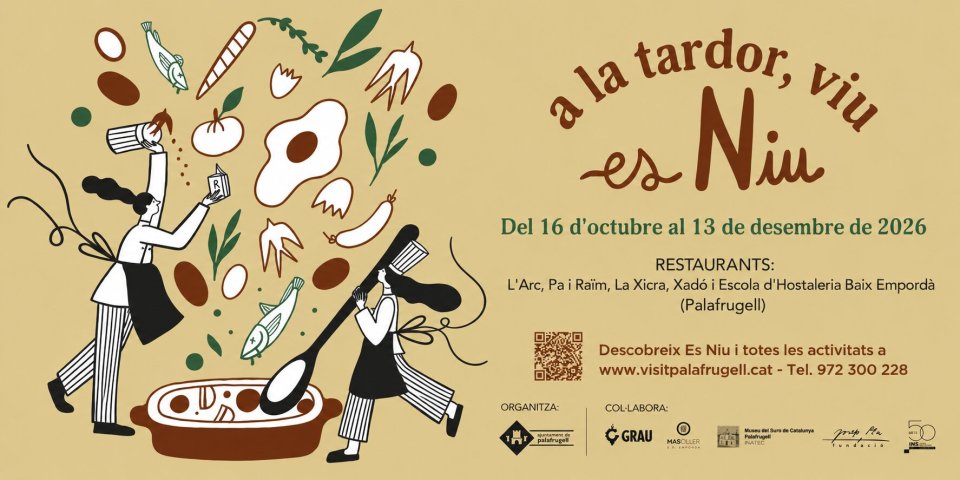
From 2 August to 18 OctoberGastronomic days "Es Niu" in Palafrugell
From 16 October to 13 DecemberGuided visit to Confluencia de la Tordera and the Santa Coloma stream
18 October
News
Gothic Architecture: The light and height of medieval Catalonia
Gothic architecture marks a turning point in the history of Catalonia. It was the style that transformed cities, places of worship, and the way people built collectively. A style that changed not only the stone itself, but also the way people…
Iron architecture: the light and steam of industrial Catalonia
In the 19th century, the Industrial Revolution not only changed the way people worked and lived, but also profoundly transformed architecture. The arrival of new materials, such as cast iron, wrought iron, and glass, opened up possibilities…








 Sustainable turism
 Biosphere