


Castell de Miravet
Municipalities
The Miravet Medieval Castle is a remarkable sample of the architecture of the Order of the Templars in Europe. Located in a privileged place, on a watchtower, this religious and military building, of Arab origin, follows the defensive style of the castles of the Holy Land. It stands out for its majestic walls that rise over the Ebro river.
In 1153, the Christians took control of the castle and Ramón Berenguer IV gave it to Pedro de Rovira, master of the Templars in Hispania and Provence. Rovira rebuilt and turned the castle into one of the main centers of Christian power in the Iberian Peninsula.
The uniform appearance of the construction suggests that the Templars erected the building in a relatively short time. However, remains of the old Andalusian fortress can still be seen, especially in the lower sections of the walls and in part of the constructions of the sovereign enclosure.
Beyond the castle, Miravet is a walled citadel with buildings on different levels. Its forms are imposing and austere, and within the walls were all the necessary elements for life, like a kind of medieval beehive.
Thus, Miravet has become one of the best examples of Catalan military architecture from the 12th-13th centuries.
Visiting hours:
From Tuesday to Sunday, including holidays.
- From December 16 to February 28: from 10:00 a.m. to 4:00 p.m.
- From March 1 to May 31: from 10:00 a.m. to 5:30 p.m.
- Easter hours:
- Friday, Saturday and Sunday from 10:00 a.m. to 7:00 p.m.
- Monday from 10:00 a.m. to 5:30 p.m.
- From June 1 to September 30: from 10:00 a.m. to 8:00 p.m.
- From October 1 to December 15: from 10:00 a.m. to 5:30 p.m.
Closed on non-holiday Mondays, December 25 and 26 and January 1 and 6.
*The ticket office and entrance close 30 minutes before the time limit.

Nearby routes
3 routes through some of the most beautiful towns in Tarragona
L'Espluga de Francolí, Miravet, Pratdip, Riudoms, Siurana, Tivissa
With a privileged geographical location, Tarragona became a point of passage and settlement of different civilizations. In addition, it has an invaluable historical legacy, embodied in the unique towns that make up the province. Delving into…
Route of the castles in Catalonia
Cardona, Figueres, Foradada, Miravet, Montesquiu, Peralada, Riudecanyes
In Catalonia there are about six hundred castles and fortresses scattered throughout the territory. Surely, many of you must have one close to home or you will have visited more than one in different occasions. These castles, located in different…
Grand Tour de Catalunya - Section 2. Meeting history: from Tarragona to Lleida
Bot, Cambrils, Capafonts, Cornudella de Montsant, Deltebre, El Perelló, El Pinell de Brai, Falset, Gandesa, Guimerà, L'Ametlla de Mar, L'Espluga de Francolí, La Sénia, Les Borges Blanques, Lleida, Miravet, Montblanc, Salou, Tarragona, Tortosa, Ulldecona, Vallbona de les Monges
I want to do this route by electric vehicle! This route is designed to be done by electric vehicle, although it can be done with any other car. Along the route we will suggest municipalities that have charging points and places of interest…
Water and life through the Ebro by electric car
Benifallet, Miravet, Tivenys, Tortosa
This route is designed to be done by electric vehicle, although it can be done with any other car. Along the route we will suggest municipalities that have charging points and places of interest to visit while we charge batteries. Electric…
Inside the Ebro river
Benifallet, Miravet, Tivenys, Tortosa
In contrast to the Delta del Ebro, internal land Tarragona noted for its dryness and its potent summer heat. Therefore, they are less attractive for tourism, linking this province with the beach. However, this region surrounded by hills and…
Getting into the Terra Alta
Arnes, El Pinell de Brai, Gandesa, Horta de Sant Joan
The region of Terra Alta is the least industrialized area around the Ebro. It preserves a wide variety of unspoiled landscapes and towns that maintain the charm of the past. The most recent, the Battle of the Ebro, decisive chapter of the Spanish…
Events
Tortosa artery
From 15 to 18 OctoberCatalonia Industrial Tourism Week 2026
From 16 to 25 OctoberGastronomic rice days in Mont-roig del Camp and Miami Platja
From 9 to 25 OctoberArrossejat Day in l'Ametlla de Mar
17 OctoberDay "No Jubilem la Memòria" in La Figuera
From 17 to 18 October'Dolça Tardor' Fair in Horta de Sant Joan
From 17 to 18 October1708, The siege of Tortosa
From 24 to 25 October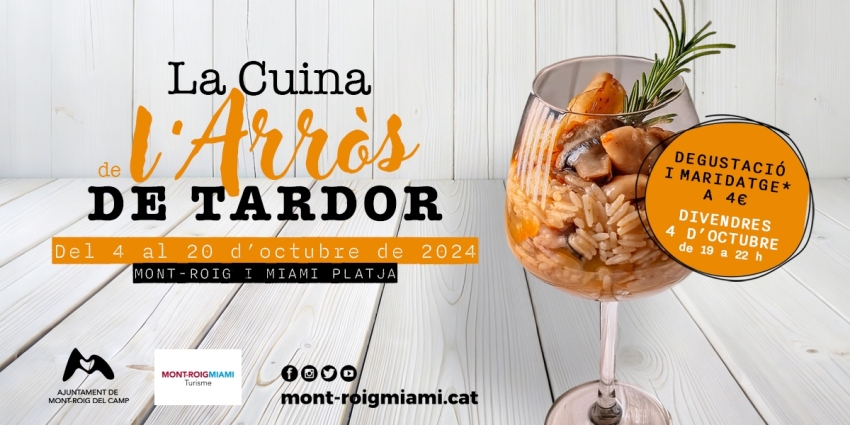
News
Gothic Architecture: The light and height of medieval Catalonia
Gothic architecture marks a turning point in the history of Catalonia. It was the style that transformed cities, places of worship, and the way people built collectively. A style that changed not only the stone itself, but also the way people…
Iron architecture: the light and steam of industrial Catalonia
In the 19th century, the Industrial Revolution not only changed the way people worked and lived, but also profoundly transformed architecture. The arrival of new materials, such as cast iron, wrought iron, and glass, opened up possibilities…








 Sustainable turism
 Biosphere